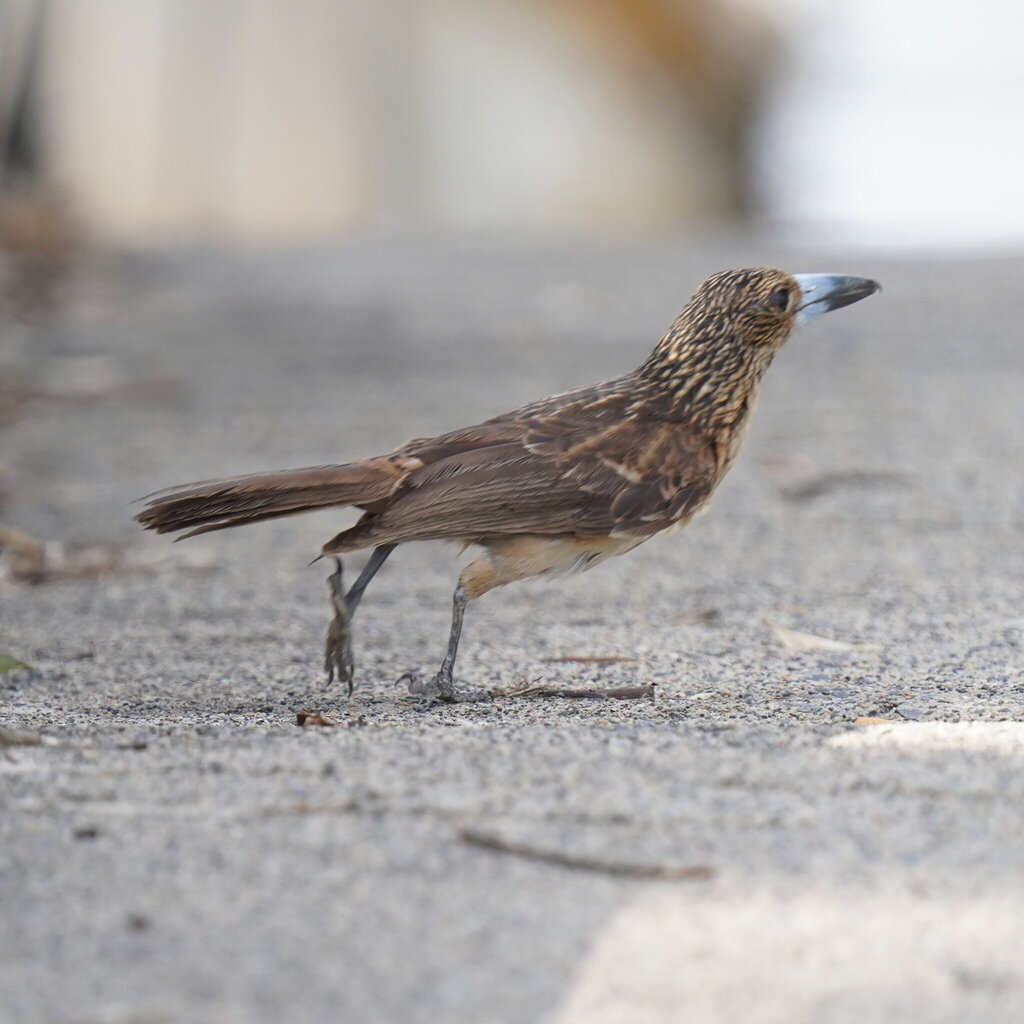
Black Butcherbird
Photo © Daniel S. Katz
Photo © Daniel S. Katz — CC BY 4.0 — Source: iNaturalist #322369790Identification
The Black Butcherbird is a striking all-black passerine with a distinctive grey bill tipped in black—a key field mark that sets it apart from similar species. Adults are uniformly dark, while juveniles present a confusing array of plumages: most are rufous-brown, though some are black, and occasionally brown individuals retain their juvenile colouration into adulthood. This variable plumage can make identification challenging for the inexperienced observer. The species is sometimes mistaken for crows or currawongs, but the characteristic grey, hooked bill is diagnostic and will confirm identification in the field.
Range & Habitat
The Black Butcherbird is found across a broad geographic range spanning Australia, Indonesia, and Papua New Guinea. Within this distribution, the species inhabits a variety of forested environments, including subtropical and tropical dry forests, moist lowland forests, and mangrove swamps. Early observations noted interesting microhabitat preferences within this range: the black variety tends to favour deeper forest interiors, while the brown variety shows a preference for more open coastal scrub and mangrove habitats.
Behaviour & Diet
Like other members of the butcherbird family, this species is an active predator, though specific diet details remain relatively undocumented in published literature. An intriguing aspect of Black Butcherbird behaviour is their recorded engagement in nest parasitism: in Papua New Guinea, they have been observed parasitising the nests of Hooded Monarch birds, a behaviour that suggests opportunistic breeding strategies and complex ecological interactions within their forest communities.
Best Time & Places to See It
For travellers seeking this species, the range of suitable habitats across Australia, Indonesia, and Papua New Guinea offers multiple opportunities. The preference shown by different colour morphs for distinct microhabitats—with black birds in deeper forest and brown birds in coastal mangroves—means that habitat selection will influence your chances of encountering either variant. Visiting during the breeding season may increase encounters, particularly in areas where Hooded Monarchs nest, though detailed phenological data for the species remains limited.
Photography Tips
The Black Butcherbird's all-black plumage presents both challenges and opportunities for photographers. The dark coloration demands careful exposure metering to retain detail in shadow areas; shooting in open woodland or mangrove edges where dappled light penetrates will provide more flattering lighting than dense forest interiors. The diagnostic grey, hooked bill is a critical feature to capture—aim for clear shots of the head to showcase this distinguishing mark. The colour polymorphism within the species makes documentation valuable; capturing both black and brown individuals, particularly juveniles, will provide valuable reference material for identification purposes.
Kakadu National Park
Kakadu, Australia
+273 birds+46 mammals
Kakadu National Park is Australia’s largest national park and one of the world’s most remarkable protected areas, covering nearly 20,000 square kilometres in the tropical north…
VIEW NATIONAL PARKDaintree National Park
Dedin, Australia
+362 birds+37 mammals
Daintree National Park is one of the world’s oldest and most biologically diverse tropical rainforests, protecting an extraordinary landscape where ancient forests meet the Great Barrier…
VIEW NATIONAL PARKAnnan River (Yuku Baja-Muliku) National Park
Australia
+78 birds
Where the Annan River winds through northeastern Queensland's coastal hinterland, a compact national park of roughly 246 square kilometers protects a mosaic of subtropical rainforest, eucalypt…
VIEW NATIONAL PARKEndeavour River National Park
Philadelphia, Australia
+203 birds+1 mammals
Where the Endeavour River winds through northeastern Queensland's tropical lowlands, a compact mosaic of rainforest, open woodland, and riverine corridor creates one of Australia's most ecologically…
VIEW NATIONAL PARKRinyirru National Park
Lakefield, Australia
+258 birds+7 mammals
Where the savanna grasslands of far north Queensland meet seasonal wetlands and eucalypt woodlands, Rinyirru National Park sprawls across more than 12,500 square kilometres of rugged,…
VIEW NATIONAL PARKKulla National Park
Coen, Australia
+11 birds
Across the tablelands and coastal lowlands of far north Queensland, where the landscape transitions from eucalypt woodland to open grassland and remnant rainforest pockets, Kulla National…
VIEW NATIONAL PARKWhitsunday Islands National Park
Whitsundays, Australia
+163 birds+9 mammals
Crystalline waters lap against seventy-four islands where rainforest canopies tumble down to pristine beaches and coral gardens flourish in the shallows. This archipelago off Queensland's coast…
VIEW NATIONAL PARKLitchfield National Park
Australia
+175 birds+15 mammals
Where weathered sandstone plateaus rise above the savanna woodlands of Australia's Top End, Litchfield National Park unfolds as a landscape of dramatic contrasts shaped by a…
VIEW NATIONAL PARKGirringun National Park
Australia
+231 birds+10 mammals
Where granite gorges cleave through subtropical woodland in North Queensland, Girringun National Park unfolds across rugged terrain shaped by millions of years of weathering and erosion.…
VIEW NATIONAL PARKWooroonooran National Park
Australia
+240 birds+28 mammals
Where the Great Dividing Range rises sharply inland from Queensland's tropical coast, Wooroonooran National Park encompasses a landscape of steep, forested gorges and cascading waterways carved…
VIEW NATIONAL PARKBlue Mountains National Park
Australia
+220 birds+43 mammals
Dramatic sandstone cliffs rise in tiers across this mountainous plateau west of Sydney, their rust-coloured faces weathered into amphitheatres and gorges where eucalyptus forest clings to…
VIEW NATIONAL PARKNo community photos yet. Log in to add the first one.
No community observations of this species yet.