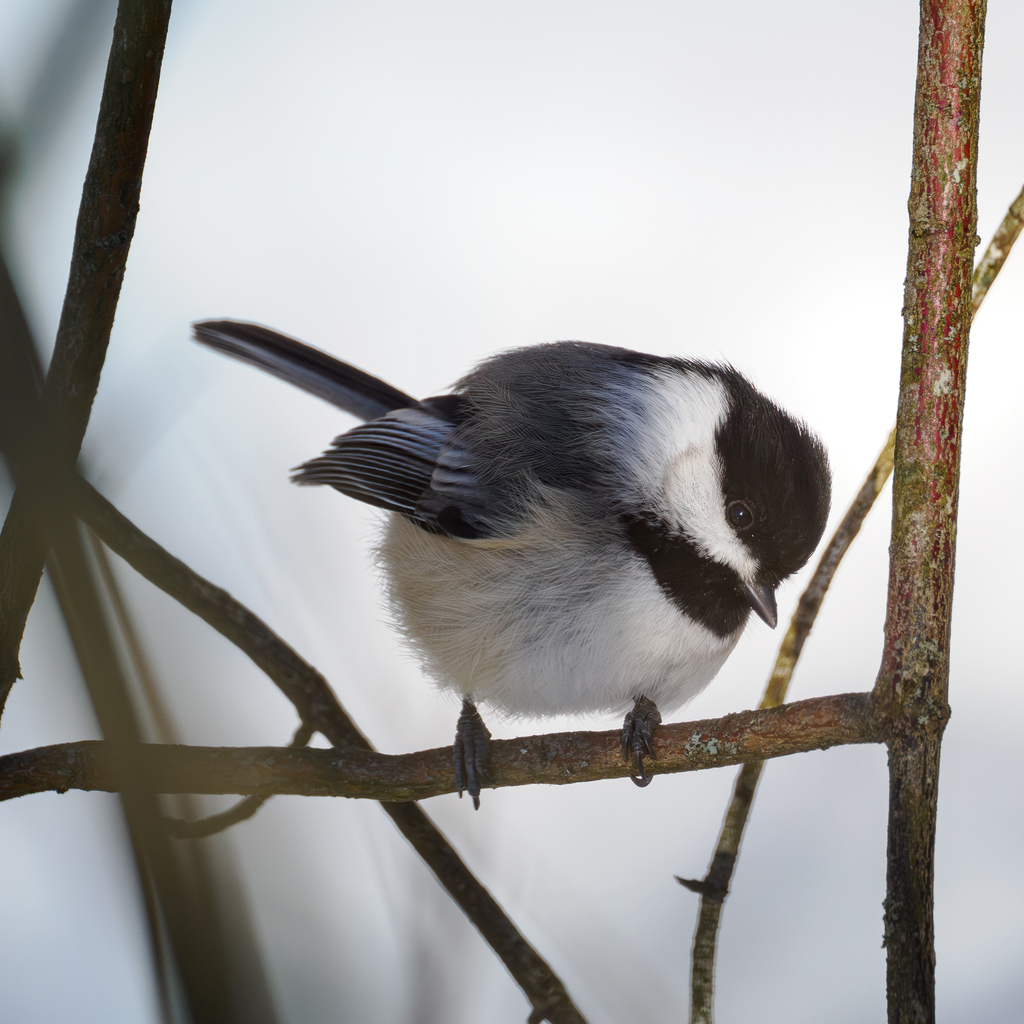
Black-capped Chickadee
Photo © Michael
Photo © Michael — CC BY 4.0 — Source: iNaturalist #337100299Identification
The black-capped chickadee is instantly recognizable by its striking plumage pattern: a jet-black cap and bib contrasting sharply with pristine white cheeks and underparts. The back is unstreaked greenish-grey, while the wings, tail, and slate-grey plumage give it a neat, compact appearance. Males typically display a larger bib than females. This small passerine is particularly well known for its vocalizations—the clear, whistled fee-bee song and its namesake chick-a-dee-dee-dee call, which becomes more emphatic in alarm situations.
Range & Habitat
The black-capped chickadee is a nonmigratory resident throughout much of North America, ranging from southern Canada and the northern United States through Alaska and Yukon. Nine subspecies are currently recognized, with regional variations in coloration and size. The species shows a preference for deciduous and mixed forests, making it a common sight across its extensive range.
Behaviour & Diet
These social birds are primarily insectivorous and granivorous, with a remarkable behavior of caching seeds and insects for winter consumption. Remarkably, their hippocampus grows during caching season, enhancing their spatial memory for retrieving hidden food. Black-capped chickadees form strict dominance hierarchies within flocks, which expand during winter to include other bird species. They possess an extraordinary physiological adaptation: the ability to lower their body temperature on cold winter nights to conserve energy. Breeding occurs in tree cavities, with nesting starting in late April and continuing through late June, producing clutches of 6–8 eggs that hatch in 11–14 days, with fledging occurring 12–16 days later.
Best Time & Places to See It
Black-capped chickadees are year-round residents across their range, making them accessible to observers throughout the seasons. They are particularly conspicuous during winter months when mixed-species flocks become more active and noisy. Look for them in deciduous and mixed forests, woodland edges, and suburban areas with mature trees. Their vocal nature makes them relatively easy to locate by ear, even in dense vegetation.
Photography Tips
The black-capped chickadee's bold facial markings and compact size offer excellent opportunities for detailed portraiture. Position yourself near feeding stations or known roosting areas to maximize encounter chances. Their activity levels and social nature mean they rarely remain still for long, so use a fast shutter speed. The contrast between their black cap and white cheeks provides natural compositional drama—frame these distinctive markings prominently. Early morning or late afternoon light will enhance the subtle grey tones of the back and wings while accentuating their bold black-and-white head pattern.
Tombstone Territorial Park
Acadia National Park
Alaska Maritime National Wildlife Refuge
Algonquin Provincial Park
Arches National Park
Badlands National Park
Banff National Park
Bear River Migratory Bird Refuge
Becharof National Wildlife Refuge
Nothing matches these filters.
No community photos yet. Log in to add the first one.
No community observations of this species yet.