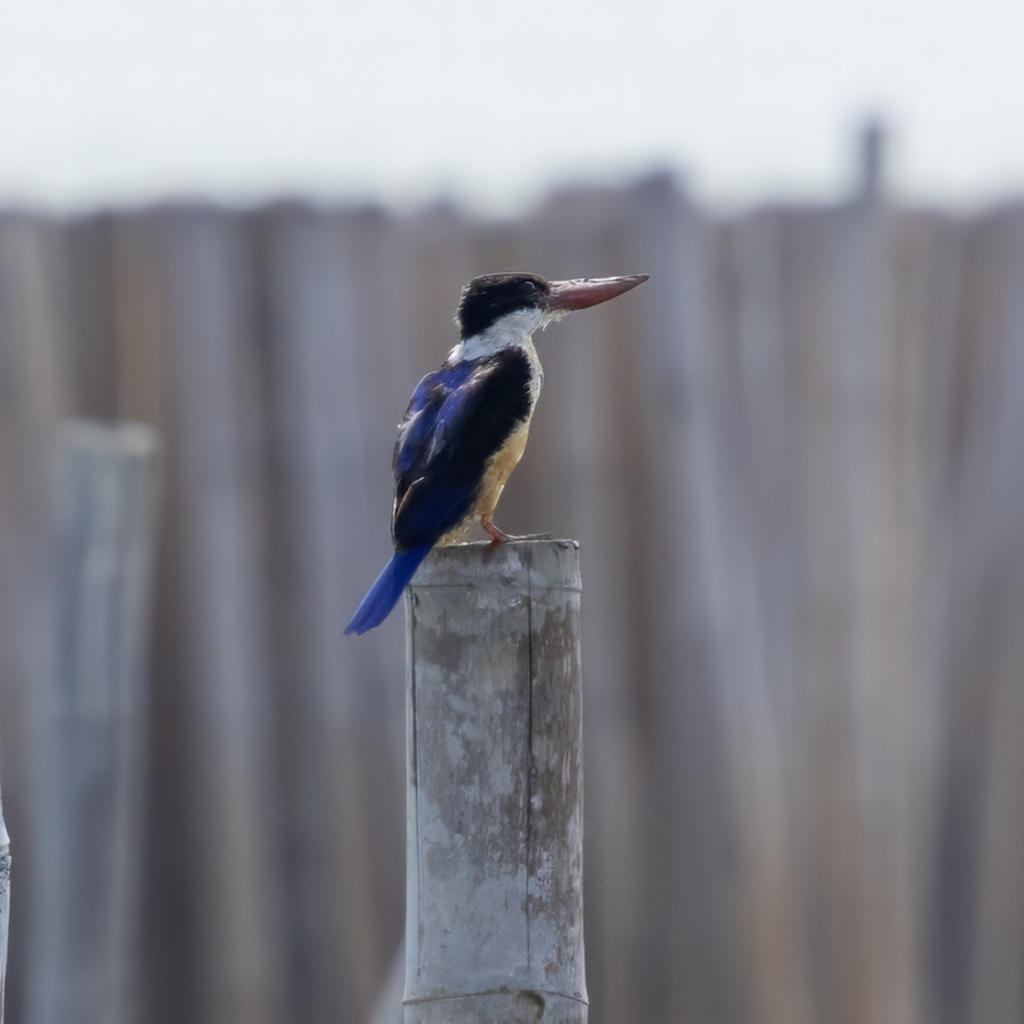
Black-capped Kingfisher
Photo © Dan Vickers
Photo © Dan Vickers — CC BY 4.0 — Source: iNaturalist #344069106Identification
The black-capped kingfisher is a striking and unmistakable bird, measuring about 28 centimetres in length. Its most prominent feature is the distinctive black cap that contrasts sharply with a whitish throat and neck collar. The wings and back are a vibrant purple-blue, while the underparts are rufous. The large bill and legs are bright red, adding to its colourful appearance. In flight, look for conspicuous white patches or "mirrors" at the base of the primary feathers, visible against the blue and black wings. The sexes are similar in plumage, though juveniles are duller and show streaks on the throat. Its loud, cackling call—a rapid ki-ki-ki-ki-ki—is often the first indication of its presence.
Range & Habitat
This is the most northerly of the tree kingfishers, with a wide distribution across tropical Asia from India east to China, Korea, and Southeast Asia. The species is resident throughout much of its range, though northern populations are migratory, wintering in Sri Lanka, Thailand, Borneo, and Java. Its range extends across the Andaman and Nicobar Islands, the Malay Peninsula, the Philippines, Sumatra, and Sulawesi, among other regions.
The black-capped kingfisher is primarily a coastal specialist, found mainly in mangrove forests, estuaries, and along rivers. However, movements related to rainfall can occasionally push birds far inland from their typical distribution, and winter vagrants have been recorded as far west as Pakistan. The species is easily disturbed and prefers undisturbed waterside habitats.
Behaviour & Diet
This kingfisher hunts by perching conspicuously above water before diving to catch fish, its primary food source. It also feeds on large insects. The flight is rapid and direct, with its short, rounded wings producing a characteristic whirring sound. During the breeding season in summer, pairs nest in tunnels excavated into earth banks, laying a single clutch of four to five round, white eggs.
Best Time & Places to See It
The black-capped kingfisher is most reliably seen in coastal mangrove habitats and along estuaries throughout its tropical Asian range. Visit during the breeding season in summer for the best chance of encountering birds at their nesting sites. In northern parts of the range, spring and autumn are ideal for observing migratory populations. Key locations include the Andaman and Nicobar Islands, coastal Thailand, mangrove forests throughout Southeast Asia, and the Philippines. Early morning visits to quiet waterside sites increase your chances of spotting this easily disturbed species.
Photography Tips
The black-capped kingfisher's colourful plumage and conspicuous perching behaviour make it an attractive photographic subject. Its preference for coastal and mangrove habitats means good lighting is often available. Photograph from a distance to avoid disturbing the bird, as the species is easily frightened. Watch for diving behaviour—anticipating these rapid strikes requires patience and quick reflexes. The in-flight white mirrors on the wings are particularly striking and worth capturing. Early morning light will best showcase the vibrant purple-blue wings and black cap. A telephoto lens is essential for obtaining detailed shots without approaching too closely.
Hat Noppharat Thara-Mu Ko Phi Phi National Park
Ao Nang, Thailand
+253 birds+9 mammals
Where limestone karsts rise dramatically from turquoise waters, Hat Noppharat Thara-Mu Ko Phi Phi National Park unfolds across a mosaic of beach, mangrove forest, and island…
VIEW NATIONAL PARKKhao Yai National Park
Prachantakham District, Thailand
+377 birds+46 mammals
Evergreen dipterocarp forest blankets the rolling terrain of this national park in eastern Thailand, where limestone hills rise abruptly from the forest floor and seasonal streams…
VIEW NATIONAL PARKMu Ko Similan National Park
Lam Kaen, Thailand
+82 birds+1 mammals
Granite islands rise from the Andaman Sea in a scattered archipelago where limestone cliffs meet turquoise shallows, their steep faces weathered into caves and overhangs that…
VIEW NATIONAL PARKKhao Laem Ya-Mu Ko Samet National Park
Mueang Rayong District, Thailand
+159 birds+3 mammals
Where limestone hills meet the Gulf of Thailand, Khao Laem Ya–Mu Ko Samet National Park stitches together a mosaic of terrestrial and marine worlds that few…
VIEW NATIONAL PARKKhao Laem National Park
Sangkhla Buri District, Thailand
+197 birds
Where the Vajiralongkorn Reservoir sprawls across the forested valleys of Kanchanaburi's northern borderlands, Khao Laem National Park protects a landscape where limestone ridges rise dramatically from…
VIEW NATIONAL PARKGiant Panda National Park
Mianyang, China
+447 birds+47 mammals
Where the eastern slopes of China's Sichuan plateau descend into cloud-wrapped valleys, one of Asia's most biodiverse landscapes unfolds across more than 350,000 square kilometres. This…
VIEW NATIONAL PARKMount Nanling Forest Park
Ruyang Forest Farm, China
+179 birds+3 mammals
Granite ridges and weathered peaks rise through a canopy of subtropical montane forest where Ruyang Forest Farm anchors one of southern China's most biodiverse landscapes. Across…
VIEW FOREST & JUNGLEKanha Tiger Reserve
Kanha Kisli F.V., India
+321 birds+23 mammals
Where sal forests give way to emerald meadows and crystalline streams carve through ancient valleys, one of India's finest wilderness reserves unfolds across the Maikal Range.…
VIEW NATIONAL PARKTadoba National Park
Palasgaon Singru, India
+270 birds+20 mammals
Where sal forests meet open grasslands and rocky outcrops rise from red laterite soil, central India's landscape unfolds in raw, untamed beauty. Ancient teak woodlands and…
VIEW NATIONAL PARKKeoladeo National Park
Shreenagar Rural, India
+326 birds+14 mammals
Where shallow wetlands shimmer beneath vast Rajasthani skies, one of Asia's finest bird sanctuaries pulses with extraordinary life. This former maharaja's hunting reserve, now spanning 29…
VIEW NATIONAL PARKPeriyar National Park
Mlappara, India
+232 birds+4 mammals
Dawn breaks over mist-shrouded ridges where the Western Ghats tumble toward Kerala's spice-scented lowlands. Here, ancient tropical forests envelope a glittering artificial lake, creating a mosaic…
VIEW NATIONAL PARKPampadum Shola National Park
Vattavada, India
+258 birds+14 mammals
Where misty shola forests cling to the high plateaus of the Nilgiri Mountains, ancient evergreen remnants create a world apart. This 2,316-hectare reserve protects one of…
VIEW NATIONAL PARKTaman Negara National Park
Kampong Samas, Malaysia
+393 birds+48 mammals
Where ancient rainforest meets limestone peaks, one of Southeast Asia's oldest protected wilderness preserves sprawls across 4,343 square kilometers of primordial landscape. Dipterocarp giants tower overhead,…
VIEW NATIONAL PARKPenang National Park
Balik Pulau, Malaysia
+107 birds+2 mammals
Granite peaks rise abruptly from the Andaman Sea where tropical rainforest clings to steep slopes in one of Malaysia's oldest protected landscapes. Mangrove forests fringe the…
VIEW NATIONAL PARKGir National Park
Asundrali, India
+258 birds+13 mammals
Dry deciduous forests cloak the rolling hills of western Gujarat where the Gir landscape rises as a final sanctuary for one of the world's rarest felids:…
VIEW NATIONAL PARKWolong National Nature Reserve
Wenchuan County, China
+333 birds+17 mammals
Where the Qingyi River cuts through the eastern flanks of the Minshan Range, a temperate montane forest cloaks steep valleys in dense canopy that thins dramatically…
VIEW NATURE RESERVENo community photos yet. Log in to add the first one.
No community observations of this species yet.