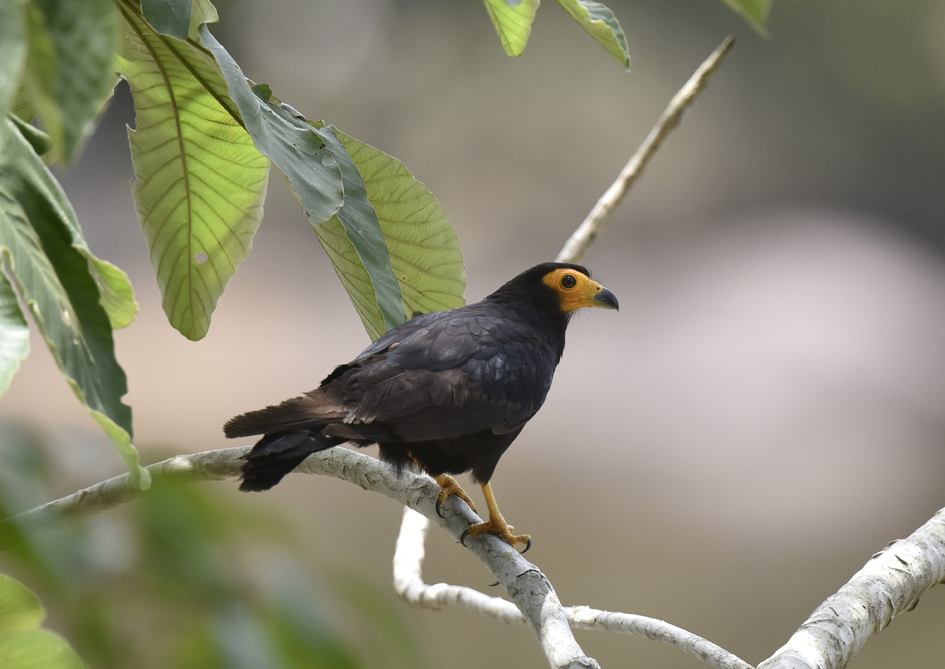
Black Caracara
Photo © Christoph Moning
Photo © Christoph Moning — CC BY 4.0 — Source: iNaturalist photo #107922982Identification
The black caracara is a striking raptor measuring 41–47 cm in length, instantly recognizable by its glossy black plumage contrasted with a distinctive white band at the base of the tail. Adults display bright yellow to orange-red feet and facial skin, paired with a black beak. Females, weighing 350–440 g, are noticeably larger than males at around 330 g. In flight, the bird's long, narrow wings and tail are particularly evident, and it characteristically uses continuous wing-flapping rather than soaring. Juveniles appear duller overall, with pale yellow faces and 3–4 black bars across the tail feathers. The closest relative, the red-throated caracara, can be distinguished by its red throat patch, which the black caracara entirely lacks.
Range & Habitat
The black caracara inhabits the lowland regions of northern South America, occurring across Bolivia, Brazil, Colombia, Ecuador, French Guiana, Guyana, Peru, Suriname, and Venezuela. As a year-round resident, it does not migrate, remaining in tropical regions throughout the year. The species favours subtropical and tropical moist lowland forests, gallery forests, and wooded savannas at altitudes up to 900 metres. It also frequents mangroves and disturbed forested areas, showing a particular affinity for habitats adjacent to water bodies, where it can be regularly encountered.
Behaviour & Diet
The black caracara is a highly sociable bird, typically observed in pairs or family groups of 3–5 individuals perching in tall trees or flying in straight lines with active wing-flapping. It exhibits remarkable behavioral flexibility, famously cleaning ectoparasites and insects from the fur of tapirs and capybaras—interactions the animals actively solicit by calling and lying still. This mutualistic relationship exemplifies the species' adaptability. As an opportunistic omnivore, the black caracara consumes an extraordinarily diverse diet including nestlings, smaller bird species, small mammals, reptiles, fish, invertebrates, palm nuts, and fruits. It hunts by attacking nests, gleaning insects from canopy foliage, and wading slowly along riverbanks and exposed rocks to spot and catch small fish with its bill or talons. The species shows no fear around human settlements, readily scavenging near towns and garbage sites, thereby playing an important ecological role in consuming carrion.
Best Time & Places to See It
Black caracaras can be encountered year-round throughout their range, as they are permanent residents. They are most reliably spotted in riverside habitats, gallery forests, and wooded savannas where they perch in tall trees or hunt along water margins. Early morning and late afternoon often yield the best sightings. The species is widespread and relatively common, making it an attainable sighting for nature travellers exploring Amazonian and French Guianan lowlands, particularly along river systems.
Photography Tips
The black caracara's contrasting plumage—glossy black body against the white tail band and bright facial colours—makes it visually striking in photographs. Watch for birds perched in tall emergent trees, which provide excellent vantage points for portrait shots. When photographing hunting behaviour, focus on riverine habitats where birds walk slowly along rocks and vegetation, allowing time for patient positioning. The species' continuous wing-flapping flight pattern, rather than soaring, requires faster shutter speeds to freeze motion crisply. The harsh, piercing call can help locate birds, making audio awareness a useful field technique. Light conditions are optimal during early morning or late afternoon when the glossy black plumage shows maximum sheen and the facial colouration becomes most vivid.
Yasuní National Park
Aguarico, Ecuador
+601 birds+43 mammals
Where the western Amazon basin converges with Ecuador's Orellana Province, lowland rainforest reaches toward the horizon in an unbroken canopy of staggering botanical density. Yasuní National…
VIEW NATIONAL PARKSangay National Park
Cebadas, Ecuador
+320 birds+10 mammals
High in Ecuador's Andean spine, where the Western Cordillera rises to touch perpetual snow, a landscape of volcanic drama and ecological intensity unfolds across Sangay National…
VIEW NATIONAL PARKSumaco Napo-Galeras National Park
Loreto, Ecuador
+563 birds+4 mammals
Where Ecuador's Amazon transitions into cloud forest, a massive shield volcano rises from the emerald lowlands of Orellana Province, anchoring one of the continent's most biodiverse…
VIEW NATIONAL PARKNatural Sierra de Chiribiquete National Park
Solano, Colombia
+359 birds+27 mammals
Massive table-top mountains rise abruptly from the lowland rainforest of southeastern Colombia, their sheer sandstone cliffs and isolated summits creating some of the most dramatic topography…
VIEW NATIONAL PARKNatural la Paya National Park
Puerto Leguízamo, Colombia
+262 birds+4 mammals
Where the Amazon's western reaches fold into the Andes foothills, La Paya National Park sprawls across more than 8,500 square kilometers of pristine Amazonian rainforest in…
VIEW NATIONAL PARKNatural Sierra de la Macarena National Park
Vista Hermosa, Colombia
+566 birds+15 mammals
Across nearly 20,000 square kilometres of Colombia's Meta Department, the terrain rises from lowland savanna into Andean foothills through a mosaic of gallery forests, palm-fringed wetlands,…
VIEW NATIONAL PARKAmacayacu National Park
Leticia, Colombia
+567 birds+25 mammals
Where the Rio Amazonas curves through the tri-border region where Colombia, Peru, and Brazil converge, Amacayacu National Park sprawls across more than 5,250 square kilometres of…
VIEW NATIONAL PARKViruá National Park
Brazil
+389 birds+6 mammals
Across the northern frontier of Roraima, where the forest canopy rises from ancient Amazonian lowlands, Viruá National Park protects nearly 3,700 square kilometres of terra firme…
VIEW NATIONAL PARKSerra do Pardo National Park
Brazil
+153 birds
Vast upland forests and weathered plateaus define this 7,129-square-kilometre protected expanse in the heart of Pará's remote interior, where ancient bedrock and swollen rivers have carved…
VIEW NATIONAL PARKAmazônia National Park
Brazil
+439 birds+6 mammals
Where the Rio Amazonas and its tributaries weave through the heart of Pará state, a vast tapestry of rainforest stretches across 23,611 square kilometers of unbroken…
VIEW NATIONAL PARKMapinguari National Park
Brazil
+354 birds
Vast tracts of western Amazonian rainforest blanket the remote terrain of this 56,827 square kilometre national park in Amazonas state, where seasonal rivers wind through dense…
VIEW NATIONAL PARKJaú National Park
Brazil
+354 birds+3 mammals
Vast floodplain forests and blackwater rivers define this remote corner of western Amazonas, where the Rio Negro and its tributaries have carved an intricate mosaic of…
VIEW NATIONAL PARKPacaás Novos National Park
Brazil
+279 birds+1 mammals
Across the border between Rondônia and Amazonas, vast tracts of humid tropical forest rise and fall in gentle undulations, carved by clear-flowing rivers that feed into…
VIEW NATIONAL PARKAnavilhanas National Park
Brazil
+468 birds+8 mammals
Across the Rio Negro in central Amazonas, an archipelago of over a thousand islands rises from the world's largest rainforest river system, creating a labyrinth of…
VIEW NATIONAL PARKCampos Amazónicos National Park
Amazonas, Brazil
+434 birds+7 mammals
Sprawling across the southwestern Amazon basin in Amazonas state, this 27,263-square-kilometre national park encompasses some of the region's most pristine lowland rainforest, where terra firme forest…
VIEW NATIONAL PARKSerra do Divisor National Park
Brazil
+448 birds+10 mammals
Where the western Amazon meets the Andes foothills, Serra do Divisor National Park sprawls across one of South America's most biodiverse and least accessible frontiers. Spanning…
VIEW NATIONAL PARKYanachaga–chemillén National Park
Palcazu, Peru
+639 birds+6 mammals
Where the eastern slopes of Peru's central cordillera plunge into cloud forest, Yanachaga–Chemillén National Park protects nearly three thousand square kilometres of montane wilderness that few…
VIEW NATIONAL PARKManu National Park
Manu, Peru
+892 birds+26 mammals
Across the eastern slopes of the Peruvian Andes, tropical rainforest descends into the Amazon basin with a complexity that few terrestrial ecosystems match. Manu National Park…
VIEW NATIONAL PARKSierra del Divisor National Park
Alto Tapiche, Peru
+298 birds+2 mammals
Where the western Amazon meets the Andes foothills, nearly 41,000 square kilometres of pristine rainforest rise across Peru's Alto Tapiche region in a landscape of extraordinary…
VIEW NATIONAL PARKBahuaja Sonene National Park
San Pedro de Putina Punco, Peru
+602 birds+8 mammals
Where the Madre de Dios and Heath rivers converge in southeastern Peru rises one of South America's most biodiverse wilderness regions: a vast protected realm of…
VIEW NATIONAL PARKIchigkat Muja – Cordillera del Cóndor National Park
Río Santiago, Peru
+101 birds
Where the Andes descend into the western Amazon, the Río Santiago carves through a landscape of profound biological complexity. Ichigkat Muja – Cordillera del Cóndor National…
VIEW NATIONAL PARKTingo Maria National Park
Mariano Dámaso Beraún, Peru
+423 birds
Where the eastern slopes of the Peruvian Andes descend toward the Amazon basin, the landscape fractures into a maze of limestone ridges, humid gorges, and cloud-wrapped…
VIEW NATIONAL PARKCordillera Azul National Park
Pampa Hermosa, Peru
+322 birds+1 mammals
Where the eastern Andes descend into the western Amazon basin, Cordillera Azul National Park sprawls across nearly 38,000 square kilometres of some of Peru's most pristine…
VIEW NATIONAL PARKNo community photos yet. Log in to add the first one.
No community observations of this species yet.