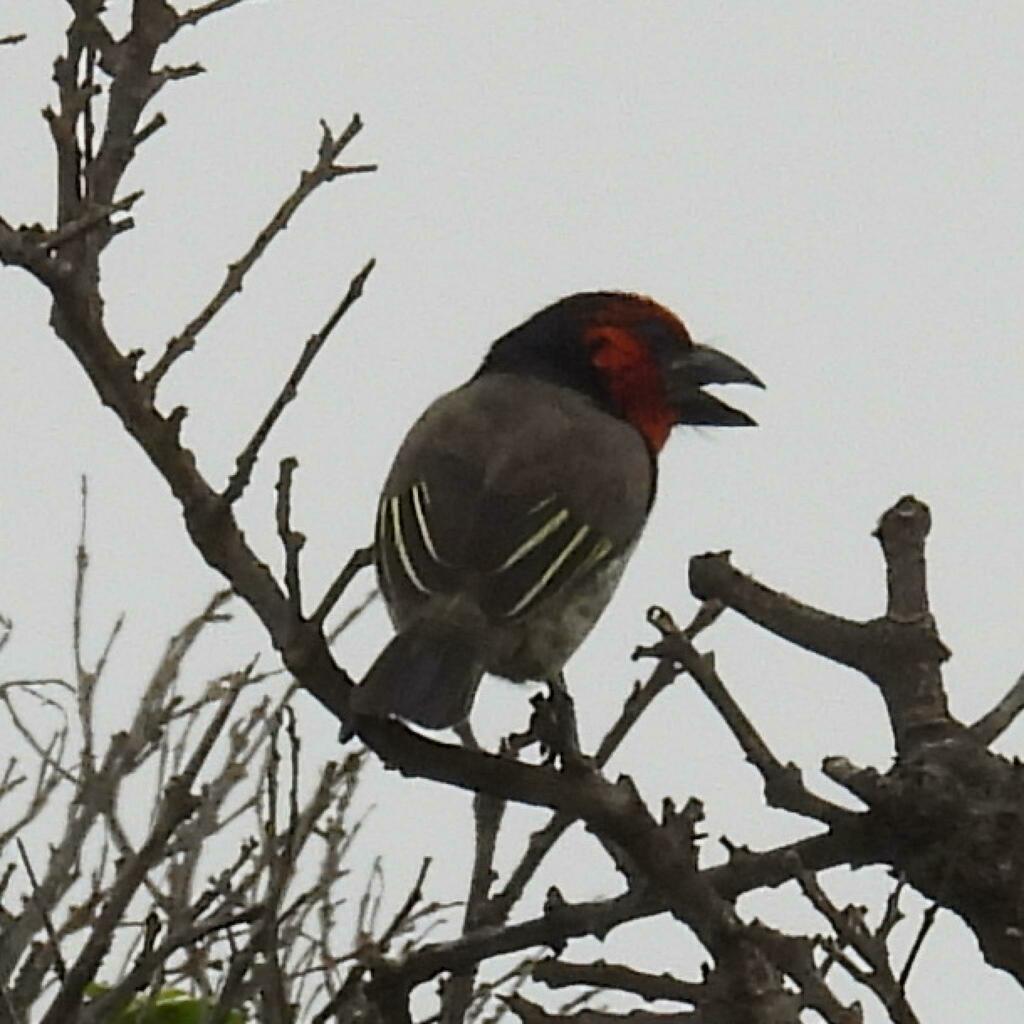
Black-collared Barbet
Photo © Henry de Lange
Photo © Henry de Lange — CC BY 4.0 — Source: iNaturalist #259325787Identification
The black-collared barbet is a stocky, plump-bodied bird measuring 20–25 cm in length, with a characteristically large head and heavy bill fringed with bristles typical of its genus. Its most distinctive feature is the very obvious black collar and head that gives the species its name, contrasted strikingly by fire-engine red coloring around the eyes and beak. The bird is notably more intense in color and larger than other barbet species. The black-collared barbet is sexually monomorphic, meaning males and females are virtually indistinguishable in appearance, morphology, size, and behavior.
Range & Habitat
This species is found throughout sub-Saharan Africa, with a range spanning Angola, Botswana, Burundi, Democratic Republic of the Congo, Eswatini, Kenya, Lesotho, Malawi, Mozambique, Namibia, Rwanda, South Africa, Tanzania, Uganda, Zambia, and Zimbabwe. The black-collared barbet frequents areas where fruit-bearing trees and vegetation are abundant, and it readily visits plantations in search of food.
Behaviour & Diet
The black-collared barbet is a gregarious species famous for its loud, synchronized duetting calls, which are commonly rendered as "too-puddly too-puddly" or "too-doodle too-doodle," accompanied by distinctive wing-flicking and bowing displays. This is an antiphonal duet in which partners sing alternately with an auditory response time of approximately 178 milliseconds, creating the illusion of a single bird to the casual listener. The species never sings alone and incorporates elaborate wing and flight displays into greeting, mating, and territorial ceremonies. Birds often roost together communally, with groups of up to 15 recorded in nest holes, and work in concert to drive off intruders.
Black-collared barbets feed primarily on fruits and vegetables, consuming them whole and later regurgitating the seed pits. They also opportunistically feed on insects, centipedes, lizards, frogs, and geckos, though animal matter comprises a smaller portion of their diet. These mostly solitary foragers are most active during their breeding season from December to February.
Best Time & Places to See It
The breeding season from December to February offers the best opportunity to locate and observe this species, as birds are most vocal and active during this period. The black-collared barbet is found across a vast range of southern and central African countries; birders should focus on areas with fruit-bearing vegetation and plantations where the species regularly forages. Listen for its distinctive loud duetting calls, which are the most reliable way to locate these birds in the field.
Photography Tips
The bold black and red plumage of the black-collared barbet makes it visually striking for photography. Wait for birds during their duetting displays, when they face each other while calling and perform their characteristic bowing and wing-flicking behaviors—these moments provide dynamic, engaging shots. Photograph pairs together when possible to capture their synchronized interaction. The bird's direct flight with loud wing whirring offers opportunities for action photography, and communal roosting sites can yield compelling group images.
Mapungubwe National Park
Musina Local Municipality, South Africa
+358 birds+29 mammals
Where the Limpopo River cuts through sandstone ridges at the convergence of South Africa, Botswana, and Zimbabwe, Mapungubwe National Park preserves a landscape of profound ecological…
VIEW NATIONAL PARKChobe National Park
Botswana
+446 birds+45 mammals
Where the Chobe River cuts a sinuous path through northern Botswana, the landscape transforms into one of Africa's most dynamic wetland-savanna mosaics. This national park encompasses…
VIEW NATIONAL PARKGarden Route National Park
George, South Africa
+353 birds+54 mammals
Sweeping across the Western Cape's coastal and mountainous terrain, this sprawling national park encompasses over five thousand square kilometers of extraordinarily diverse landscape—from coastal limestone cliffs…
VIEW NATIONAL PARKPilanesberg National Park
Moses Kotane Local Municipality, South Africa
+364 birds+49 mammals
Granite peaks and volcanic ridges rise unexpectedly from the savanna floor across this 734-square-kilometre expanse in the North West province, creating a landscape of profound ecological…
VIEW NATIONAL PARKMokala National Park
Siyancuma Local Municipality, South Africa
+246 birds+35 mammals
Across the semi-arid savanna of the Northern Cape, where red earth meets sparse acacia woodland and open grassland punctuated by rocky outcrops, lies a landscape shaped…
VIEW NATIONAL PARKKruger National Park
Ba-Phalaborwa Local Municipality, South Africa
+540 birds+91 mammals
Across the low-lying savanna of northeastern South Africa unfolds one of Africa's largest and most ecologically intact protected areas, where acacia woodlands merge into mopane scrub…
VIEW NATIONAL PARKMountain Zebra National Park
Inxuba Yethemba Local Municipality, South Africa
+265 birds+35 mammals
Across the windswept plateaus and deeply incised valleys of the Eastern Cape's interior, Mountain Zebra National Park unfolds as a landscape of geological drama and ecological…
VIEW NATIONAL PARKAugrabies Falls National Park
Kai !Garib Local Municipality, South Africa
+176 birds+20 mammals
Where the Orange River cuts a dramatic scar through the Northern Cape's arid interior, Augrabies Falls National Park sprawls across nearly 1,200 square kilometers of raw,…
VIEW NATIONAL PARKAddo Elephant National Park
Sundays River Valley Local Municipality, South Africa
+388 birds+55 mammals
Where the Eastern Cape's semi-arid scrublands meet transitional woodland, Addo sprawls across 13,478 square kilometres of one of southern Africa's most biodiverse landscapes. The terrain rises…
VIEW NATIONAL PARKIthala Game Reserve
uPhongolo Local Municipality, South Africa
+328 birds+26 mammals
Rolling thornbush savanna and acacia woodland dominate the landscape of this 494-square-kilometre national park in KwaZulu-Natal's uPhongolo Local Municipality, where granite outcrops punctuate grassland plateaus and…
VIEW NATIONAL PARKMarakele National Park
Modimolle Local Municipality, South Africa
+341 birds+36 mammals
Granite ridges and sprawling grasslands dominate this 1,176-square-kilometre reserve in Limpopo's heartland, where bushveld transitions between rocky outcrops and open savanna. The park's rugged topography creates…
VIEW NATIONAL PARKKhaudum National Park
Namibia
+221 birds+13 mammals
Where the Kavango River flows through northeastern Namibia, vast miombo woodlands and riverine forests create one of southern Africa's most remote and biodiverse wilderness corridors. Khaudum…
VIEW NATIONAL PARKBwabwata National Park
Namibia
+377 birds+35 mammals
Where the Kavango River winds through northeastern Namibia, vast floodplains and dense riparian woodland create one of southern Africa's most ecologically dynamic protected landscapes. Spanning 14,249…
VIEW NATIONAL PARKArabuko Sokoke Forest Reserve
Kilifi, Kenya
+383 birds+29 mammals
Coastal forest rises from the Indian Ocean plains of Kilifi County, where sandy soils and seasonal rainfall have sculpted a woodland ecosystem unlike anywhere else on…
VIEW NATURE RESERVENo community photos yet. Log in to add the first one.
No community observations of this species yet.