Identification
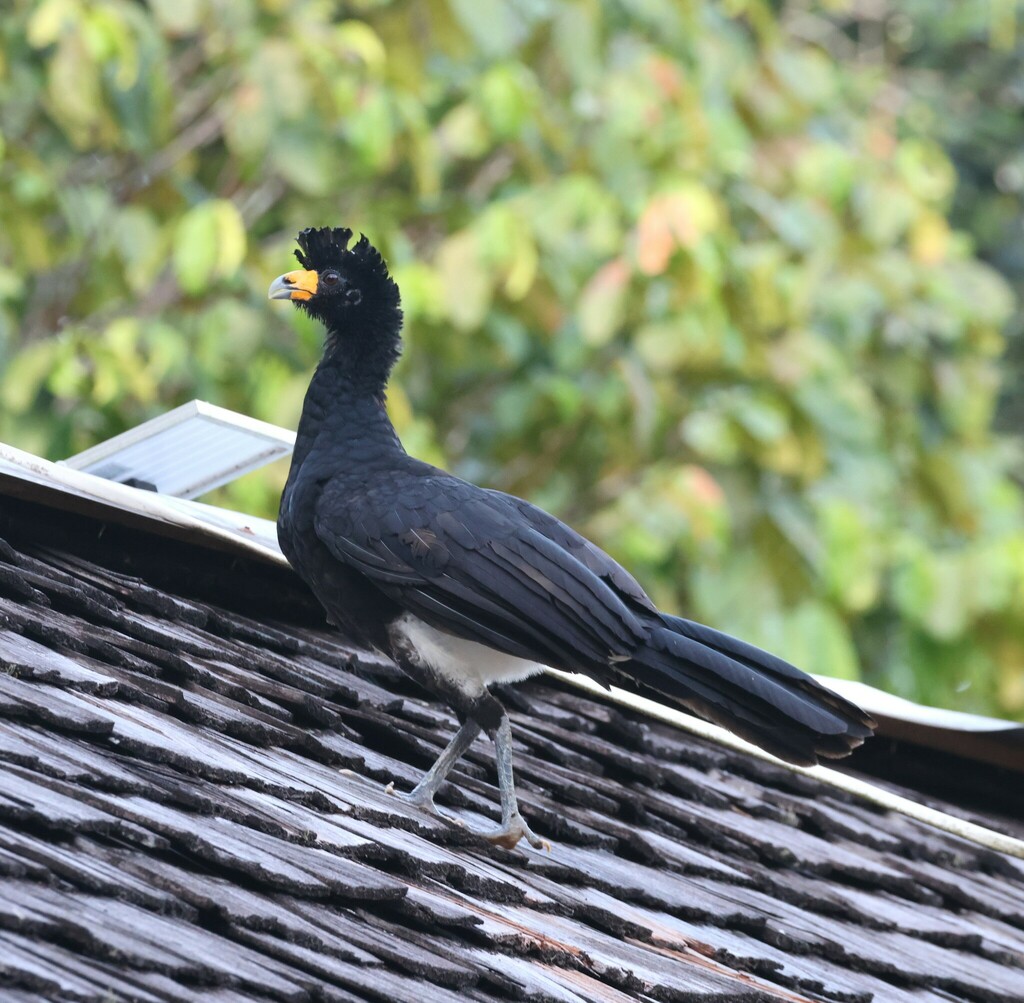
The black curassow is a large galliform bird, reaching approximately 35 inches in length. Both males and females are predominantly black, glossed with a purplish sheen on the upper parts, with distinctive white underparts. The most useful field mark for identifying this species is the white crissum—the area around the cloaca—which contrasts sharply with the black plumage. Both sexes sport an inconspicuous black crest, though in females this crest is barred with white, providing a subtle way to distinguish the sexes in the field. The bird's facial skin at the base of the grey beak is the most geographically variable feature: birds in the eastern part of the range display yellow cere, while western populations show orange-red coloration. Unlike many other curassow species, males and females cannot be reliably separated by plumage alone. Juveniles are darker and more heavily marked, appearing black but barred and mottled with reddish-brown and reddish-buff tones.
Range & Habitat
The black curassow is native to humid forests across northern South America, with its range extending through Colombia, Venezuela, the Guianas (including Suriname), and far northern Brazil. The species occupies two recognized subspecies populations: the western subspecies inhabits eastern Colombia and Venezuela south of the Orinoco River, while the eastern subspecies ranges from extreme eastern Venezuela through the Guianas and into Brazil north of the Amazon. The bird has also been introduced to several Caribbean islands, including the Bahamas, Cuba, Jamaica, Haiti, Dominican Republic, Puerto Rico, and the Lesser Antilles.
Within its native range, the black curassow favors lowland forests, particularly the undergrowth of humid forest habitats. It also inhabits plantations and riverside thickets, where dense vegetation provides shelter and foraging opportunities.
Behaviour & Diet
The black curassow is fundamentally a ground-dwelling species, spending much of its time in the forest undergrowth where it forages and moves about. It is primarily frugivorous, with fruit making up the bulk of its diet, though it supplements this with buds, shoots, leaves, flowers, fungi, and invertebrates. The bird nests a few meters above the ground in trees, constructing a simple platform nest made of sticks. Breeding timing varies geographically: in Suriname, breeding occurs during the rainy season, while in French Guiana, young birds have been recorded in both March and September, suggesting potentially multiple breeding cycles or extended breeding periods.
Best Time & Places to See It
For travelers seeking the black curassow, the humid lowland forests of northern South America offer the best opportunities. Within the bird's native range, Colombia, Venezuela, and the Guianas—particularly Suriname and French Guiana—are prime destinations. The species is described as fairly common, making it a realistic target for dedicated birdwatchers. The rainy seasons appear to be productive periods, particularly in Suriname where breeding activity concentrates at this time. Early morning visits to lowland forest undergrowth and riverside thickets offer the best chances of encounters.
Photography Tips
The black curassow's predominantly black plumage with white underparts and crissum creates strong visual contrast that can be effectively captured in photography. The bird's large size and ground-dwelling habits mean it may be approachable, though patience is essential. Photographers should focus on the white crissum as a key identifying feature and attempt to capture the facial cere coloration, which varies geographically and adds diagnostic detail. The inconspicuous crest may be difficult to photograph unless the bird is alert or displaying. Early morning light in forest undergrowth can be challenging; faster film speeds or higher ISO settings may be necessary when photographing in the dim lowland forest habitat where this species typically forages.
Natural Sierra de Chiribiquete National Park
Solano, Colombia
+359 birds+27 mammals
Massive table-top mountains rise abruptly from the lowland rainforest of southeastern Colombia, their sheer sandstone cliffs and isolated summits creating some of the most dramatic topography…
VIEW NATIONAL PARKNatural Sierra de la Macarena National Park
Vista Hermosa, Colombia
+566 birds+15 mammals
Across nearly 20,000 square kilometres of Colombia's Meta Department, the terrain rises from lowland savanna into Andean foothills through a mosaic of gallery forests, palm-fringed wetlands,…
VIEW NATIONAL PARKViruá National Park
Brazil
+389 birds+6 mammals
Across the northern frontier of Roraima, where the forest canopy rises from ancient Amazonian lowlands, Viruá National Park protects nearly 3,700 square kilometres of terra firme…
VIEW NATIONAL PARKAnavilhanas National Park
Brazil
+468 birds+8 mammals
Across the Rio Negro in central Amazonas, an archipelago of over a thousand islands rises from the world's largest rainforest river system, creating a labyrinth of…
VIEW NATIONAL PARKNo community photos yet. Log in to add the first one.
No community observations of this species yet.