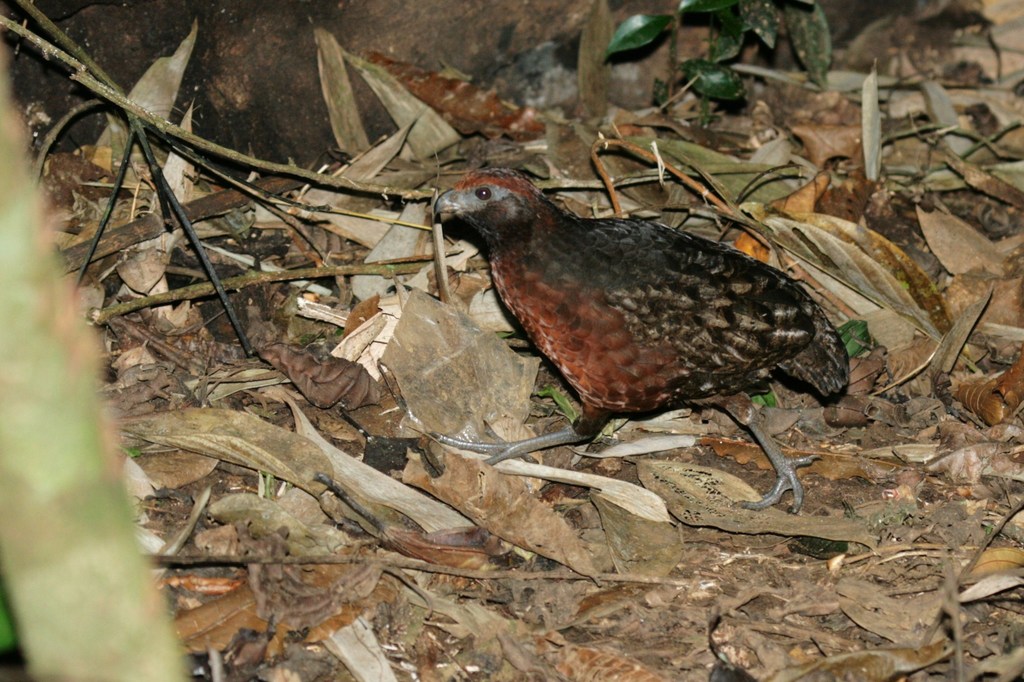
Black-eared Wood Quail
Photo © Mikael Bauer
Photo © Mikael Bauer — CC BY 4.0 — Source: iNaturalist #21432408Identification
The black-eared wood quail is a large, pheasant-like bird with distinctive plumage that makes it recognizable once seen. Its body is dark brown or black, contrasting sharply with a rufous breast. The most characteristic features are its unspotted chestnut crown and crest, black face and throat, black bill, and blue-black legs. A striking purple bare ring encircles the eye. Females are similar to males but show a blue-black eye ring instead of purple, darker sides of the head, and duller chestnut coloration overall.
The black-eared wood quail is very similar in appearance to its close relative, the rufous-fronted wood quail, but can be distinguished by the absence of a distinctive white jugular band—a marking that is present in the rufous-fronted species.
Range & Habitat
This species persists across the Caribbean slope of Central America, with its range encompassing Honduras, Nicaragua, Costa Rica, and eastern Panama, with likely presence in northwest Colombia. Two subspecies are recognized: one found on the Caribbean slope of Honduras, and another distributed across southeast Honduras, Nicaragua, the Caribbean coast of Costa Rica, and Panama.
Black-eared wood quails are forest-adapted birds found in tropical and lower subtropical forest habitats. They are typically ground-dwelling and territorial, preferring the forest floor of virgin forests or the dense vegetation of thick second-growth areas.
Behaviour & Diet
The black-eared wood quail is presumed to be sedentary with no known migration. Individuals may be encountered alone, in pairs, or in small coveys of up to 10 or 12 birds. The species is monogamous, and these quails are vocal birds, producing soft cooing or peeping conversational sounds among covey members. Their most distinctive vocalization is a repetitive, ringing duet advertising call that carries across long distances, described as "kooLAWlik kooLAWlik kooLAWK kooLAWK."
Like other New World wood quails, the black-eared wood quail is believed to scratch in leaf-litter to forage for insects and fallen fruit, though detailed dietary information remains limited. Breeding is suspected to occur during the dry season, with nests found between trees and lined with leaves and grasses; eggs appear in clutches of four and are cream or white colored with brown spots.
Best Time & Places to See It
The black-eared wood quail is best sought in primary and secondary forest habitats on the Caribbean slopes of Honduras, Nicaragua, Costa Rica, and Panama. The species is poorly studied and seldom observed, making it a challenge for travellers. Patience and familiarity with the bird's distinctive advertising call will greatly improve your chances of detection. Early morning hours are typically productive for listening to vocalizations.
Photography Tips
Photographing this elusive forest quail requires patience and stealth. The bird's preference for dense forest floor vegetation and thick second-growth makes visual encounters difficult. Focusing your efforts on listening for the distinctive repetitive duet calls will help locate birds. Early morning light and careful stalking of calling birds offer your best opportunities. Because the species is territorial and monogamous, paired birds may return to favored calling perches, allowing patient photographers to position themselves appropriately.
Arenal Volcano National Park
Peñas Blancas, Costa Rica
+551 birds+21 mammals
Straddling the border between Alajuela and Guanacaste in northwestern Costa Rica, this national park rises dramatically around one of Central America's most active volcanic systems. The…
VIEW NATIONAL PARKBraulio Carrillo National Park
Las Horquetas, Costa Rica
+547 birds+18 mammals
Where the Caribbean slope descends from the central volcanic cordillera toward the humid lowlands of Heredia, Braulio Carrillo National Park preserves one of Costa Rica's most…
VIEW NATIONAL PARKGuanacaste National Park
Santa Elena, Costa Rica
+461 birds+17 mammals
Where the Pacific slopes of northwestern Costa Rica rise toward the Continental Divide, dry tropical forest gives way to cloud-laden peaks and misty ridges—a landscape that…
VIEW NATIONAL PARKBaru Volcano National Park
Cerro Punta, Panama
+402 birds+6 mammals
Where the land rises sharply toward the Caribbean's western spine, Baru Volcano National Park sprawls across roughly 220 square kilometres of southwestern Panama, anchored by the…
VIEW NATIONAL PARKGeneral de División Omar Torrijos Herrera National Park
La Pintada, Panama
+401 birds+2 mammals
Across the highlands of central Panama, where the continental divide funnels moisture-laden trade winds into steep river valleys, the terrain rises and falls in a landscape…
VIEW NATIONAL PARKDarién National Park
Tucutí, Panama
+534 birds+13 mammals
Where the spine of Central America crumbles into wetland and rainforest, Darién National Park sprawls across more than 20,000 square kilometres of some of the tropics'…
VIEW NATIONAL PARKRincón de la Vieja National Park
Liberia, Costa Rica
+451 birds+30 mammals
Where volcanic slopes rise abruptly from the Guanacaste lowlands, Rincón de la Vieja National Park sprawls across a landscape shaped by geothermal drama and seasonal extremes.…
VIEW NATIONAL PARKVolcán Tenorio National Park
Guatuso, Costa Rica
+480 birds+12 mammals
Where volcanic slopes rise through Costa Rica's northwestern borderlands, Volcán Tenorio National Park sprawls across terrain shaped by ancient lava flows and mineral-rich springs. The park's…
VIEW NATIONAL PARKGandoca-Manzanillo National Wildlife Refuge
Manzanillo, Costa Rica
+394 birds+18 mammals
Where the Caribbean coastal plain surrenders to water-logged forest and mangrove tangles, Gandoca-Manzanillo Wildlife Sanctuary shelters one of Costa Rica's most biodiverse lowland wetland ecosystems. The…
VIEW WILDLIFE SANCTUARYNo community photos yet. Log in to add the first one.
No community observations of this species yet.