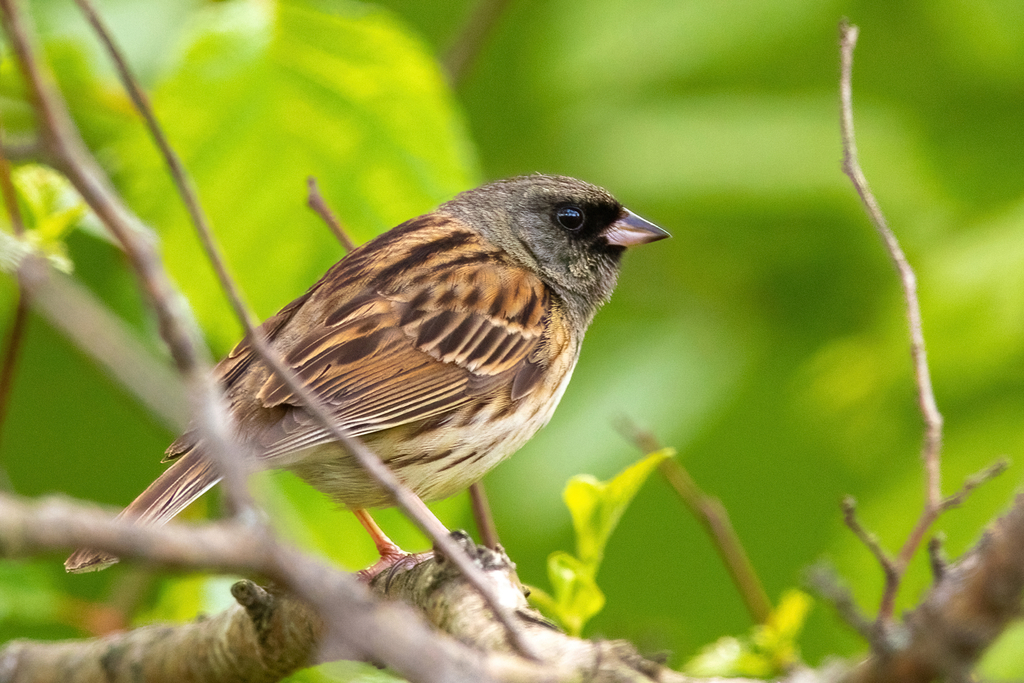
Black-faced Bunting
Photo © egorbirder
Photo © egorbirder — CC BY 4.0 — Source: iNaturalist photo #445767910Identification
The Black-faced Bunting is a compact passerine measuring approximately 16 cm long, comparable in size to a Reed Bunting. The breeding male is distinctive, with a dark grey head marked by a striking mix of yellow-green and black between the bill and eye. The upperparts are warm brown heavily streaked with black, except for an unmarked brown rump, while the tail is dark brown. The underparts are yellowish-white with fine dark brown streaks on the flanks. The stout, pink bill is characteristic of the bunting family.
Females and young birds present a subtler appearance, with olive-grey cheeks, a weak creamy-white supercilium, and creamy-yellow underparts heavily streaked with dark brown. The weaker head pattern of females and juveniles can make them challenging to identify in the field. The bird's terrestrial feeding habits and general appearance have prompted observers to describe it as resembling a Dunnock with a bunting's bill—a useful reference point for field identification.
Range & Habitat
The Black-faced Bunting breeds across southern Siberia extending into northern China, occupying dense undergrowth along streams and rivers within the taiga zone. This migratory species moves south during winter, with populations wintering in north-east India, southern China, and northern south-east Asia. The species is a very rare vagrant to western Europe, making sightings there noteworthy for birders.
Outside the breeding season, the birds favour habitats close to water, frequenting agricultural areas and open bushy landscapes. This seasonal shift from dense riparian undergrowth to more open terrain reflects the species' adaptive behaviour across its annual range.
Behaviour & Diet
The Black-faced Bunting is largely granivorous, subsisting primarily on seeds throughout the year. However, the diet shifts during breeding season, when adults supplement seeds with insects to provision their growing chicks—a common strategy among seed-eating birds during the energy-intensive nesting period.
The species' vocalisation is distinctive: a metallic tzii or tzee call that is notably short and staccato in character. This call is described as very much in the metallic register rather than a full song. Nesting occurs both in trees and on the ground, with clutches of four or five eggs, typical of the bunting family.
Best Time & Places to See It
For birdwatchers and nature travellers seeking this species, the breeding season across southern Siberia and northern China offers the primary opportunity to encounter it in suitable taiga habitats with dense riparian undergrowth. Winter visitors to north-east India, southern China, and northern south-east Asia may locate the species in open bushy areas near water during the cooler months.
Western European travellers should not expect to encounter this species in the field, though vagrant individuals do occasionally appear and represent valuable records for regional ornithological societies.
Photography Tips
The breeding male's striking head pattern and contrasting plumage make it a rewarding photographic subject, particularly in good light that emphasises the dark grey crown and yellow-green facial markings. Photographing males during breeding season will yield the most visually striking images with clear head pattern definition.
Females and juveniles present a more subtle challenge; patience and attention to detail will be necessary to capture the weaker head patterns and heavily streaked underparts that characterise these plumages. Ground-nesting and low vegetation preferences mean the bird often remains close to cover, requiring careful stalking and positioning to obtain clear, unobstructed views for photography.
Orang National Park
Rangagarapathar, India
+298 birds+1 mammals
Where the Brahmaputra's floodplains meet the foothills of Assam, Orang National Park unfolds across a mosaic of riverine grasslands, forests and wetlands that pulse with the…
VIEW NATIONAL PARKBaikal National Park
Ольхонский район, Russia
+184 birds+11 mammals
Where the world's deepest freshwater lake meets ancient Siberian taiga, Baikal National Park sprawls across 66,203 square kilometers of one of Earth's most singular ecosystems. The…
VIEW NATIONAL PARKShoria National Park
Tashtagolsky Municipal Okrug, Russia
+23 birds+1 mammals
Where the southern Siberian taiga meets the spine of the Altai Mountains, nearly ten thousand square kilometres of pristine forest and alpine terrain compose one of…
VIEW NATIONAL PARKGiant Panda National Park
Mianyang, China
+447 birds+47 mammals
Where the eastern slopes of China's Sichuan plateau descend into cloud-wrapped valleys, one of Asia's most biodiverse landscapes unfolds across more than 350,000 square kilometres. This…
VIEW NATIONAL PARKMount Nanling Forest Park
Ruyang Forest Farm, China
+179 birds+3 mammals
Granite ridges and weathered peaks rise through a canopy of subtropical montane forest where Ruyang Forest Farm anchors one of southern China's most biodiverse landscapes. Across…
VIEW FOREST & JUNGLEKaziranga National Park
Kohora, India
+422 birds+26 mammals
Dawn breaks over the floodplains of the Brahmaputra, where tall grasslands stretch endlessly beneath monsoon-heavy skies. This sprawling wilderness of northeastern Assam is a mosaic of…
VIEW NATIONAL PARKGorkhi-Terelj National Park
Ulaanbaatar, Mongolia
+137 birds+5 mammals
Where granite monoliths rise abruptly from rolling steppe grasslands, Gorkhi-Terelj National Park unfolds across the landscape north of Ulaanbaatar, a sanctuary where forest and alpine meadow…
VIEW NATIONAL PARKHustai National Park
Altanbulag, Mongolia
+198 birds+16 mammals
Where the steppe rolls endlessly beneath vast Mongolian skies, Hustai National Park preserves one of Central Asia's most dynamic grassland ecosystems. Rolling hills and open prairie…
VIEW NATIONAL PARKGobi Gurvan Saikhan National Park
Tsagaan Subarga Hural, Mongolia
+183 birds+23 mammals
Where rust-coloured badlands rise from the southern Gobi steppe, the terrain transforms into a landscape of geological drama that few visitors expect to find in Mongolia's…
VIEW NATIONAL PARKLand of the Leopard National Park
Khasansky District, Russia
+83 birds+11 mammals
Where coniferous and mixed forests sweep across the rolling terrain of Russia's Far East, Land of the Leopard National Park embraces a landscape shaped by the…
VIEW NATIONAL PARKNortheast China Tiger and Leopard National Park
Mu Dan Jiang Shi, China
+202 birds+19 mammals
Across the temperate forests of northeastern China, where winters grip the landscape in subzero silence and summers remain cool and brief, the Mudanjiang region supports a…
VIEW NATIONAL PARKWuyishan National Park
Yanshan County, China
+141 birds+2 mammals
Where subtropical monsoon rains sustain a perpetually humid landscape, Wuyishan National Park rises from Fujian's eastern plateau as a realm of forested ridges, cascading streams, and…
VIEW NATIONAL PARKWolong National Nature Reserve
Wenchuan County, China
+333 birds+17 mammals
Where the Qingyi River cuts through the eastern flanks of the Minshan Range, a temperate montane forest cloaks steep valleys in dense canopy that thins dramatically…
VIEW NATURE RESERVEYancheng National Nature Reserve
Yancheng, China
+208 birds+4 mammals
Where the East China Sea's tidal rhythms sculpt the Jiangsu coast, Yancheng National Nature Reserve sprawls across one of Asia's most dynamic wetland complexes. This vast…
VIEW NATURE RESERVEZhalong National Nature Reserve
Qiqihar, China
+78 birds
Across the wetlands of northeastern China, where the Heilongjiang climate swings between brutal winters and warm summers, lies one of East Asia's most vital refuges for…
VIEW NATURE RESERVEPoyang Lake National Nature Reserve
Shangrao, China
+270 birds+7 mammals
Where the Yangtze River's massive floodplain spreads across central China, Poyang Lake National Nature Reserve encompasses one of the continent's most dynamic and water-rich wetland systems.…
VIEW NATURE RESERVECaohai National Nature Reserve
Bijie, China
+93 birds
At roughly 1,900 metres elevation on Guizhou's high plateau, Caohai sprawls across a temperate landscape shaped by pronounced seasonal extremes. Winters here are dry and cool,…
VIEW NATURE RESERVEQinghai Lake National Nature Reserve
Hainan Tibetan Autonomous Prefecture, China
+243 birds+11 mammals
At 3,200 metres above sea level on the Tibetan plateau, where winter temperatures plunge far below freezing and snow blankets the landscape for half the year,…
VIEW NATURE RESERVEGaoligong Mountain National Nature Reserve
Nujiang Lisu Autonomous Prefecture, China
+443 birds+13 mammals
VIEW NATURE RESERVEBaima Snow Mountain National Nature Reserve
Diqing Tibetan Autonomous Prefecture, China
+204 birds+3 mammals
High-altitude ridges and steep-sided valleys define this reserve in northwestern Yunnan, where elevations surge from around 3,000 metres to peaks above 4,100 metres. The terrain supports…
VIEW NATURE RESERVENo community photos yet. Log in to add the first one.
No community observations of this species yet.