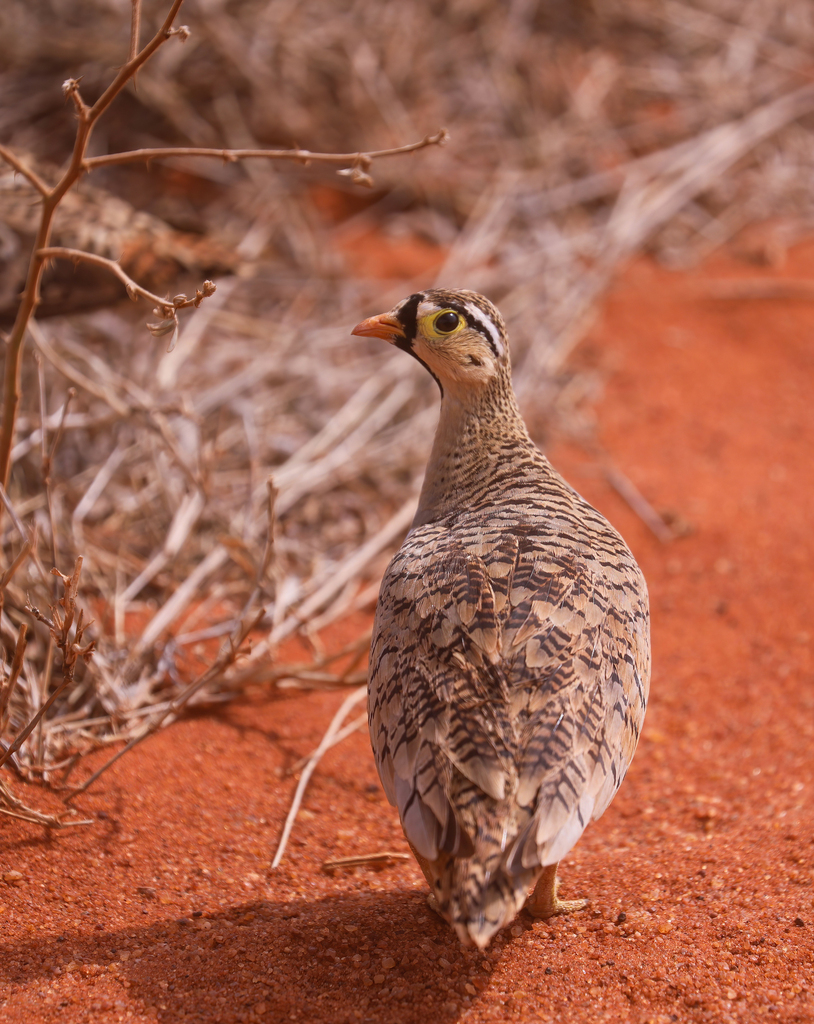
Black-faced Sandgrouse
Photo © Thomas Galewski
Photo © Thomas Galewski — CC BY 4.0 — Source: iNaturalist #262689924Identification
The black-faced sandgrouse is a medium-sized bird, approximately 28 cm long and weighing between 140 and 210 g. It has a compact body with a short tail, pointed wings, and short feathered legs, giving it a dove-like appearance. The wing tips are distinctly black in flight, a helpful field mark when observing birds in the air.
Males are unmistakable, featuring bold black face markings extending from the forehead to the throat, contrasted by striking black and white eyebrow stripes. A pinkish-orange bill and yellow eye-ring further distinguish males against their dark facial plumage. The breast displays a pale brown chest with a thin black stripe followed by a thick white stripe, while the belly is dark. Females lack the distinctive black mask and are overall pale brown with barred and streaked plumage on the wings and back. The white breast mark visible on males is also present on females, and juveniles resemble females but with darker barring on the back. Female black-faced sandgrouse can be confused with other sandgrouse species, but their small size and white breast mark are diagnostic.
Range & Habitat
This species is found exclusively in East Africa, occurring in Ethiopia, Kenya, Tanzania, Uganda, and Somalia. It is frequent in Ethiopia, common and widespread in southern Somalia, and locally common in Kenya. The black-faced sandgrouse is mainly sedentary and does not migrate.
The species inhabits the region's characteristic dry, open environments, including dry savanna, bushveld, and semi-desert scrub. It is occasionally found in dense thornbush, particularly in open spaces such as roadsides. Altitudinally, it ranges from sea level to 1,600 m, making it adaptable across a range of arid East African landscapes.
Behaviour & Diet
Despite being less social than other sandgrouse species, black-faced sandgrouse gather in flocks at waterholes in the early morning, often alongside chestnut-bellied sandgrouse. These gatherings are essential for accessing water in their arid habitat. Like other sandgrouse adapted to desert life, this species possesses modified abdominal feathers that can soak up water; males fly long distances carrying water in their feathers to cool eggs or hydrate chicks at the nest.
Rather than bathing in water, the black-faced sandgrouse cleans itself through dust bathing, creating shallow depressions in sandy soil and rolling to work dust into its plumage—a behaviour performed before and after drinking that removes parasites and excess preen oil. The diet consists primarily of seeds from leguminous plants such as indigofera and trianthema, as well as boraginacea plants like heliotropium. Birds drink water during the first half of the morning. Breeding is monogamous and correlates with rainfall patterns; in Kenya, two main breeding seasons occur in January–March and July–October, while in Tanzania breeding occurs from May–November/December, with peaks during the dry season. Females incubate during the day while males take the night shift, though once chicks hatch, males invest more time in chick-guarding.
Best Time & Places to See It
Waterholes in dry savanna and semi-desert regions of East Africa offer the best viewing opportunities, particularly in the early morning when flocks congregate to drink. The species is frequent in Ethiopia and common in southern Somalia, with locally common populations throughout Kenya and Tanzania. Suitable habitat includes dry savanna, bushveld, and open thornbush areas, especially near roadsides where the birds are more frequently observed.
Timing your visit during or shortly after the rainy seasons—January–March or July–October in Kenya—may increase your chances of encountering breeding birds and active family groups, though the species' sedentary nature means it can be found year-round within its range.
Photography Tips
Early morning visits to waterholes offer prime opportunities to photograph these birds as they gather in flocks. The male's striking black facial mask and contrasting eyebrow stripes, combined with the pinkish-orange bill and yellow eye-ring, provide excellent photographic subjects with strong colour contrast. Capture flight shots to showcase the distinctive black wing tips.
In-flight photography will best reveal the pointed wing shape and overall silhouette characteristic of the species. For ground photography, focus on dust-bathing behaviour—position yourself to capture the bird's rolling motion as it spreads dust through its plumage. Remember that females are more cryptically coloured and may require longer observation to locate and photograph effectively against the dry background of their arid habitat.
Serengeti National Park
Tanzania
+558 birds+57 mammals
Across Tanzania's northern plateau, where volcanic soils meet acacia woodland and open grassland, unfolds one of Earth's most dynamic ecosystems. The Serengeti National Park sprawls across…
VIEW NATIONAL PARKArusha National Park
Tanzania
+555 birds+16 mammals
Where the slopes of Mount Mawenzi rise above the Arusha region, a compact yet ecologically rich national park unfolds across montane forest, moorland, and alpine zones.…
VIEW NATIONAL PARKTsavo East National Park
Athi ward, Kenya
+468 birds+50 mammals
Across the semi-arid lowlands of southeastern Kenya, where acacia woodland fragments into scrubland and the landscape rolls toward the Indian Ocean horizon, lies one of Africa's…
VIEW NATIONAL PARKTsavo West National Park
Mwatate, Kenya
+513 birds+49 mammals
Where volcanic ridges and weathered lava flows meet the semi-arid lowlands of south-central Kenya, Tsavo West National Park unfolds across a landscape sculpted by fire and…
VIEW NATIONAL PARKAmboseli National Park
Etonet/Lenkism ward, Kenya
+501 birds+43 mammals
Where the Amboseli basin opens toward the Tanzanian frontier, a shallow alkaline lake mirrors vast skies across one of East Africa's most iconic savanna landscapes. The…
VIEW NATIONAL PARKTarangire National Park
Tanzania
+527 birds+50 mammals
Acacia woodland and grassland sweep across the Manyara Region where the Tarangire River carves through low hills and volcanic soils, creating one of East Africa's most…
VIEW NATIONAL PARKNgorongoro Conservation Area
Tanzania
+626 birds+55 mammals
Volcanic calderas and open grassland dominate this high plateau in northern Tanzania, where the landscape rises above 2,000 metres and ancient geological forces have shaped both…
VIEW WILDLIFE MANAGEMENT AREAMago National Park
Ethiopia
+128 birds+3 mammals
Where the Omo River cuts through southern Ethiopia's arid borderlands, Mago National Park sprawls across a landscape of dramatic escarpments, riverine forests, and semi-arid savanna that…
VIEW NATIONAL PARKAwash National Park
Didiga, Ethiopia
+473 birds+23 mammals
Where the Ethiopian Rift Valley carves through volcanic plateaus, a ribbon of riverine forest winds through acacia scrubland and grassland, creating a mosaic of habitats that…
VIEW NATURAL PARKYabelo Wildlife Sanctuary
Bedewera, Ethiopia
+359 birds+5 mammals
Where acacia woodlands meet volcanic plateaus in southern Ethiopia, a landscape of austere beauty unfolds across nearly 2,500 square kilometers. Yabelo Wildlife Sanctuary sprawls across semi-arid…
VIEW WILDLIFE SANCTUARYNairobi National Park
Nairobi, Kenya
+515 birds+35 mammals
Just minutes from Kenya's capital, where the Nairobi River winds through acacia woodland and open grassland, lies one of Africa's most paradoxical wildlife sanctuaries. The park's…
VIEW NATIONAL PARKMeru National Park
Igembe Central, Kenya
+408 birds+38 mammals
Granite outcrops and acacia woodland rise across the northern reaches of Meru, where semi-arid savanna transitions into drier scrubland under the fierce equatorial sun. The park's…
VIEW NATIONAL PARKSamburu National Reserve
Samburu, Kenya
+430 birds+42 mammals
Across the arid plains of northern Kenya, where scattered acacia woodland gives way to rocky outcrops and dry riverbeds, Samburu National Park unfolds as one of…
VIEW NATURE RESERVENo community photos yet. Log in to add the first one.
No community observations of this species yet.