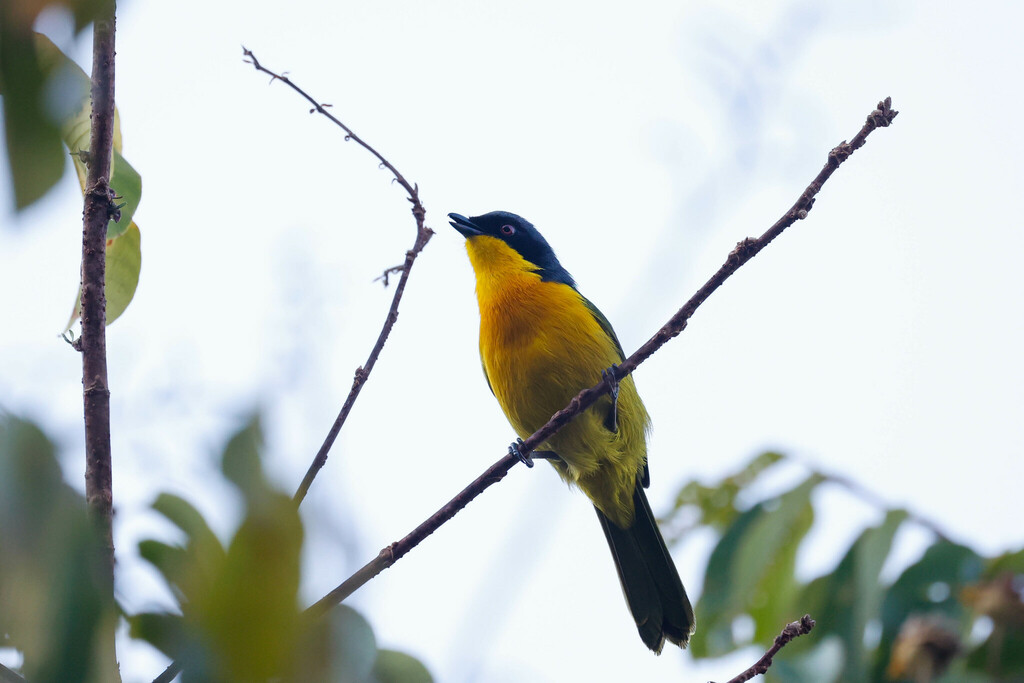
Black-fronted Bushshrike
Photo © Tom Field
Photo © Tom Field — CC BY 4.0 — Source: iNaturalist #265008961Identification
The black-fronted bushshrike is a compact passerine measuring 18–19 centimetres, notable for its striking colour polymorphism. All plumages share consistent features: green upperparts, grey crown and upper back, a yellow-tipped tail, and dark bill and legs. The species displays four main colour morphs. The orange morph shows a bold black mask and forehead with bright orange underparts shading to yellow under the tail. The red morph is similar but features a redder throat and breast with yellow on the belly and undertail-coverts. The buff form has more subdued buff underparts and a pale throat. The black morph is the most dramatic, with an entirely black face, forehead, throat and breast contrasting with a green belly and undertail-coverts. Females are noticeably duller than males, with less extensive black on the forehead. Juveniles display buffish underparts with dark barring and yellow edges to the wing-feathers. The species produces a distinctive song of repeated bell-like phrases, often delivered as duets between pairs.
Range & Habitat
The black-fronted bushshrike has a patchy distribution restricted to montane forests across East Africa. Three subspecies are recognized: C. n. nigrifrons ranges from central Kenya southwards through Tanzania to northern Malawi; C. n. manningi is found from south-eastern Democratic Republic of the Congo to northern Zambia; and C. n. sandgroundi occurs in southern Malawi, Mozambique, eastern Zimbabwe and north-eastern South Africa. The species shows a preference for forest canopy and middle levels, where it actively forages for food.
Behaviour & Diet
Black-fronted bushshrikes are social birds that join mixed-species feeding flocks outside the breeding season, moving through the forest canopy and mid-storey in search of food. Pairs maintain close bonds, duetting together with their characteristic bell-like song phrases. The species forms a superspecies complex with the many-coloured bushshrike, and the two were historically sometimes considered conspecific.
Best Time & Places to See It
This species is best located in montane forest habitats where it forages in the canopy. Its patchy distribution means that successful sightings require visits to appropriate highland forest regions within its range, particularly in Tanzania, Kenya, Malawi, and Mozambique. The bird's activity in mixed feeding flocks outside the breeding season may increase encounter rates during these periods.
Photography Tips
The variety of colour morphs makes this species fascinating to photograph, though the dramatic colour differences between individuals may initially confuse field identification. Look for the distinctive bell-like song to locate birds in the dense canopy. Patient observation of mixed feeding flocks during the non-breeding season offers the best opportunities. The birds' preference for canopy and mid-level foraging means scanning upwards is essential, and adequate lens reach will be necessary to capture detail from forest heights. Early morning activity may provide better lighting conditions in the forest environment.
Kilimanjaro National Park
Kenya
+207 birds+16 mammals
Africa's highest mountain rises not in isolation but as the centerpiece of a vast national park that sweeps across the borderlands of northern Tanzania, where savanna…
VIEW NATIONAL PARKMount-Kenya National Park
Abothuguchi west ward, Kenya
+334 birds+11 mammals
Where the slopes of Kenya's second-highest mountain rise steeply from the Meru County foothills, a landscape of profound ecological richness unfolds across Mount Kenya National Park.…
VIEW NATIONAL PARKTarangire National Park
Tanzania
+527 birds+50 mammals
Acacia woodland and grassland sweep across the Manyara Region where the Tarangire River carves through low hills and volcanic soils, creating one of East Africa's most…
VIEW NATIONAL PARKNgorongoro Conservation Area
Tanzania
+626 birds+55 mammals
Volcanic calderas and open grassland dominate this high plateau in northern Tanzania, where the landscape rises above 2,000 metres and ancient geological forces have shaped both…
VIEW WILDLIFE MANAGEMENT AREAAberdare National Park
Mweiga ward, Kenya
+394 birds+30 mammals
Where the central highlands of Kenya rise to their elemental grandeur, the Aberdare range unfolds across Nyeri County as a montane stronghold of cool, misty forest…
VIEW NATIONAL PARKSaiwa Swamp National Park
Sinyerere ward, Kenya
+255 birds+4 mammals
Where papyrus and sedge marshes stretch across a highland plateau in western Kenya, Saiwa Swamp National Park shelters one of East Africa's most productive freshwater wetland…
VIEW NATIONAL PARKChyulu Hills National Park
Kibwezi East, Kenya
+232 birds+30 mammals
Volcanic cones rise abruptly from the Kenyan savanna floor, their flanks clothed in dense acacia woodland and grassland that transforms the Chyulu Hills into an ecological…
VIEW NATIONAL PARKNo community photos yet. Log in to add the first one.
No community observations of this species yet.