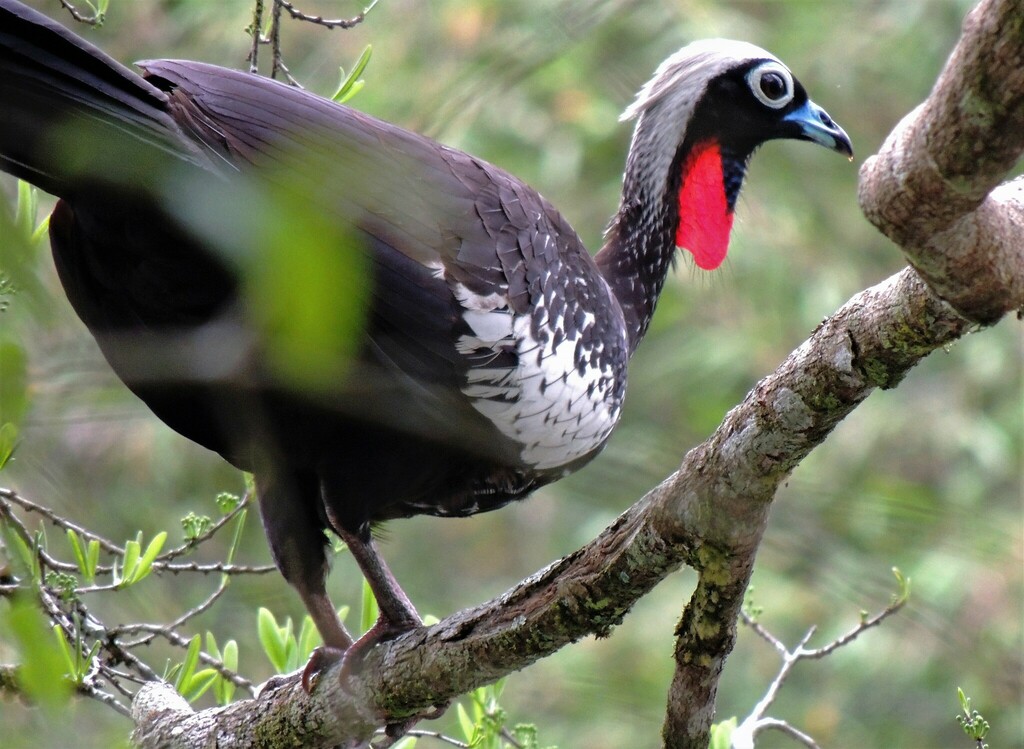
Black-fronted Piping Guan
Photo © Hugo Hulsberg
Photo © Hugo Hulsberg — CC0 1.0 — Source: iNaturalist photo #243789868Identification
The black-fronted piping guan is a distinctive medium-sized bird, measuring 63.5 to 74 cm in length and weighing 1,100 to 1,400 grams. It resembles a slim turkey, with a thin neck and small head. The plumage is predominantly black with a bluish gloss, accented by a conspicuous white wing patch bearing rows of black dots. A large white crest crowns the head, while a striking red throat wattle adorned with a dark blue patch at the front creates a dramatic facial display. The bird's unique identification features within its genus include a ring of bare white skin around its dark eye, coupled with a black-feathered face and forehead. The legs and feet are bright red, completing the bird's striking appearance.
Range & Habitat
The black-fronted piping guan is now found only in fragmented populations across southeastern South America. Its range includes coastal areas of southeastern Brazil, roughly from Paraná state northward to Rio de Janeiro, as well as Argentina's far northeastern Misiones Province and adjacent eastern Paraguay. It is the sole piping guan species in this region, though it formerly overlapped slightly with the blue-throated piping guan in Paraguay.
This species inhabits several types of Atlantic Forest, including evergreen, gallery, and coastal forests. It shows a strong preference for mature primary forest, though it also occurs in older secondary forest and restinga vegetation. Historically, the bird ranged from sea level to elevations of 1,850 meters, but it is now typically found only below 1,000 meters.
Behaviour & Diet
The black-fronted piping guan is an arboreal forager, though it occasionally descends to the ground to feed. It forages alone, in pairs, or in small groups reaching up to 11 individuals. The bird's diet is predominantly frugivorous, with studies in Brazil documenting 41 fruit species consumed there. It supplements this diet with seeds, buds, insects, and molluscs, and tends to remain in fruiting areas until the trees are exhausted of fruit. Some altitudinal and seasonal movements have been documented, though their causes remain unclear.
The breeding season extends from at least August through December. Pairs construct a simple stick-platform nest in the fork of a tree and lay a clutch of two to four eggs. While the female undertakes almost all incubation duties, both sexes participate in provisioning the young. The species communicates through a series of thin, rising whistles, with an alarm call distinguished by its metallic tone. During dusk and dawn, males perform an elaborate wing-whirring display consisting of two silent wingbeats, a long dry rattle, two quick wingbeats, and a final extended rattle.
Best Time & Places to See It
The black-fronted piping guan is now rare outside protected areas, making visits to established reserves essential for viewing. The bird's breeding season from August to December may offer increased observation opportunities as birds are more active during courtship and nesting. Early morning and dusk visits are particularly rewarding, as the species is most vocal and active during these periods when it performs its distinctive wing-whirring displays.
Photography Tips
Photographing this endangered guan requires patience and attention to the bird's arboreal habits. Position yourself beneath fruiting trees where birds are likely to forage, and use blinds or natural cover to avoid disturbance. The bird's striking white crest, red throat wattle, and contrasting white wing patches create excellent photographic subjects. Early morning light is ideal for capturing the bluish gloss of the plumage and the vivid red coloring of the legs and facial features. Silent movement and extended observation periods will yield the best opportunities to photograph natural behavior rather than alert or fleeing birds.
Iguaçu National Park
Brazil
+387 birds+17 mammals
Where the Paraná Plateau plunges toward the Atlantic watershed, six thousand square kilometers of subtropical rainforest cling to steep gorges and river valleys in this corner…
VIEW NATIONAL PARKIguazú National Park
Puerto Iguazú, Argentina
+346 birds+15 mammals
Where the Paraná Plateau plunges toward the Atlantic watershed, nearly 800 square kilometers of subtropical rainforest drape across Misiones Province in a landscape carved by millennia…
VIEW NATIONAL PARKNo community photos yet. Log in to add the first one.
No community observations of this species yet.