Black Guan
Photo © Forest Botial-Jarvis
Photo © Forest Botial-Jarvis — CC BY 4.0 — Source: iNaturalist photo #366687510Identification
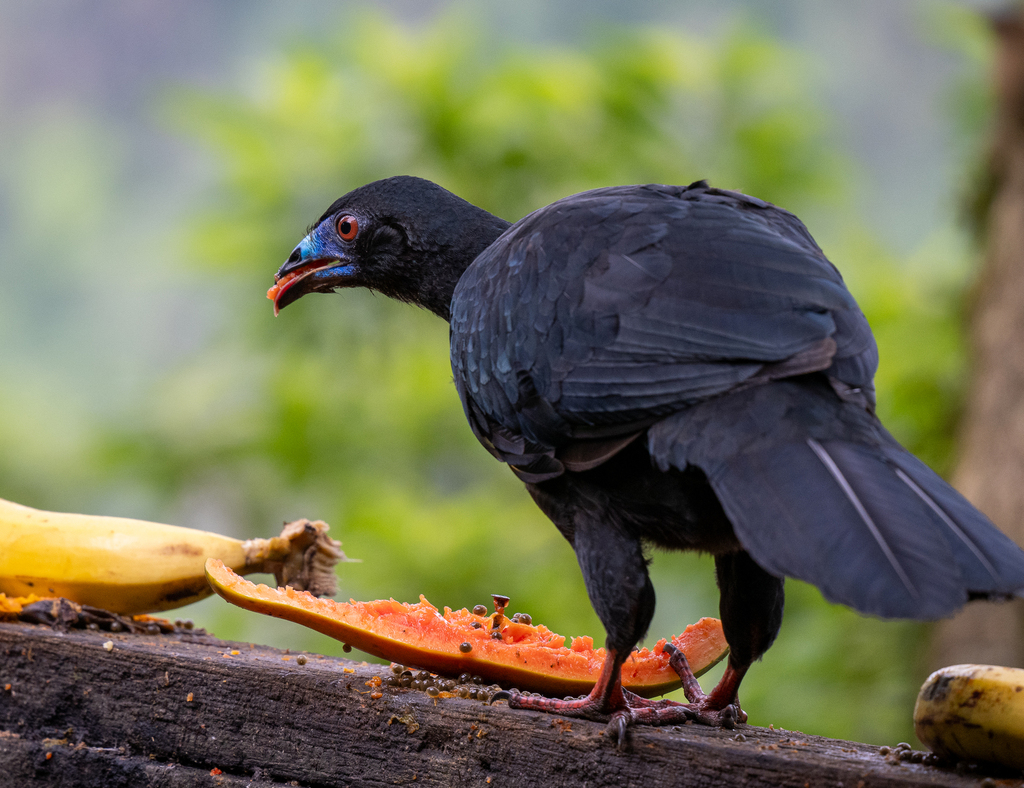
The black guan is a striking, medium-sized bird measuring 62 to 69 cm in length and weighing around 1,135 grams. Adults are unmistakable, with entirely black plumage that has a glossy appearance, contrasted dramatically by bright blue facial skin surrounding a distinctive red eye. Their legs and feet are pinkish-red, adding another splash of color to their otherwise dark appearance. Juveniles are similar in pattern but less glossy overall, with browner underparts and blackish or dark brown facial skin, making them somewhat less conspicuous than their parents.
Range & Habitat
The black guan is endemic to Central America, found only in Costa Rica and Panama. Its range extends from the Cordillera de Guanacaste in northern Costa Rica south to western Coclé Province in Panama. The species is confined to cloudforest within the Talamancan montane forest ecozone, showing a strong preference for steep terrain in temperate, subtropical, and tropical zones. It typically occurs between 1,000 and 2,250 meters in elevation, though it can occasionally be found as low as 800 meters and as high as 3,000 meters depending on local conditions.
Behaviour & Diet
The black guan is thought to be primarily sedentary, though there is some evidence suggesting seasonal movements to different elevations. It forages singly, in pairs, or in small groups, with fruit forming the primary component of its diet—at least 35 different fruit species have been documented in studies conducted in Costa Rica. While the bird mainly feeds in trees, it will also descend to the ground to eat fallen fruits. The breeding season is believed to span from February to June, with pairs constructing small platform nests made of twigs and leaves, typically placed in clumps of epiphytes high in trees around 4.5 meters above the ground. Clutch sizes are typically two or three eggs.
Best Time & Places to See It
The black guan is fairly common within protected areas of Costa Rica, making these reserves the most reliable locations for viewing. In Panama, the species is only locally numerous and generally less common. Your best opportunities occur during the breeding season from February to June, when birds may be more active and vocal. Visiting protected cloudforests in the specified elevation range will maximize your chances of encounters, particularly in Costa Rica where the species is more consistently present.
Photography Tips
The black guan's entirely black plumage with brilliant blue facial skin and red eye offers striking photographic potential, especially in good light. The bird's preference for steep, forested terrain and canopy feeding means patience and good positioning are essential. Early morning and dusk are particularly productive times, as the species performs loud, sharp, crackling wing-rattling displays at these times, making birds more detectable and active. Look for feeding birds in fruiting trees, where small groups may linger, offering opportunities for behavior photography.
Arenal Volcano National Park
Peñas Blancas, Costa Rica
+551 birds+21 mammals
Straddling the border between Alajuela and Guanacaste in northwestern Costa Rica, this national park rises dramatically around one of Central America's most active volcanic systems. The…
VIEW NATIONAL PARKChirripó National Park
Rivas, Costa Rica
+274 birds+6 mammals
Where the volcanic spine of Costa Rica's Central Cordillera reaches its apex, Chirripó National Park encompasses a landscape that shifts dramatically with elevation, from montane cloud…
VIEW NATIONAL PARKBraulio Carrillo National Park
Las Horquetas, Costa Rica
+547 birds+18 mammals
Where the Caribbean slope descends from the central volcanic cordillera toward the humid lowlands of Heredia, Braulio Carrillo National Park preserves one of Costa Rica's most…
VIEW NATIONAL PARKGuanacaste National Park
Santa Elena, Costa Rica
+461 birds+17 mammals
Where the Pacific slopes of northwestern Costa Rica rise toward the Continental Divide, dry tropical forest gives way to cloud-laden peaks and misty ridges—a landscape that…
VIEW NATIONAL PARKVolcán Poás National Park
Toro Amarillo, Costa Rica
+237 birds+4 mammals
Where volcanic slopes rise sharply from the Central Valley floor, Volcán Poás National Park protects one of Costa Rica's most active and accessible volcanic systems. The…
VIEW NATIONAL PARKBaru Volcano National Park
Cerro Punta, Panama
+402 birds+6 mammals
Where the land rises sharply toward the Caribbean's western spine, Baru Volcano National Park sprawls across roughly 220 square kilometres of southwestern Panama, anchored by the…
VIEW NATIONAL PARKGeneral de División Omar Torrijos Herrera National Park
La Pintada, Panama
+401 birds+2 mammals
Across the highlands of central Panama, where the continental divide funnels moisture-laden trade winds into steep river valleys, the terrain rises and falls in a landscape…
VIEW NATIONAL PARKParque Internacional la Amistad
Teribe, Panama
+325 birds+11 mammals
Where the continental divide rises between the Caribbean and Pacific watersheds, a wilderness of extraordinary biological richness unfolds across the Talamanca Range and into lowland rainforest—a…
VIEW NATIONAL PARKLos Quetzales National Park
Copey, Costa Rica
+232 birds+3 mammals
Cloud forest sweeps across the upper slopes of the Central Valley watershed, where elevation and persistent moisture forge an ecosystem unlike any other in Costa Rica.…
VIEW NATIONAL PARKRincón de la Vieja National Park
Liberia, Costa Rica
+451 birds+30 mammals
Where volcanic slopes rise abruptly from the Guanacaste lowlands, Rincón de la Vieja National Park sprawls across a landscape shaped by geothermal drama and seasonal extremes.…
VIEW NATIONAL PARKTapantí Macizo de la Muerte National Park
Orosi, Costa Rica
+503 birds+18 mammals
Where montane cloud forest rises steeply from the Orosi Valley, Tapantí Macizo de la Muerte National Park enfolds a landscape of perpetual moisture and emerald complexity.…
VIEW NATIONAL PARKLa Amistad International Park
Crorina, Costa Rica
+532 birds+20 mammals
Where the Caribbean slopes of Costa Rica's Talamanca Mountains rise steeply inland from Limón, the boundary between two nations dissolves into an unbroken expanse of rainforest.…
VIEW NATIONAL PARKBarbilla National Park
Chirripó, Costa Rica
+226 birds
Where the Caribbean slope of Costa Rica's eastern cordillera plunges into perpetual moisture, Barbilla National Park rises as one of Central America's most water-rich ecosystems. Fed…
VIEW NATIONAL PARKVolcán Tenorio National Park
Guatuso, Costa Rica
+480 birds+12 mammals
Where volcanic slopes rise through Costa Rica's northwestern borderlands, Volcán Tenorio National Park sprawls across terrain shaped by ancient lava flows and mineral-rich springs. The park's…
VIEW NATIONAL PARKNo community photos yet. Log in to add the first one.
No community observations of this species yet.