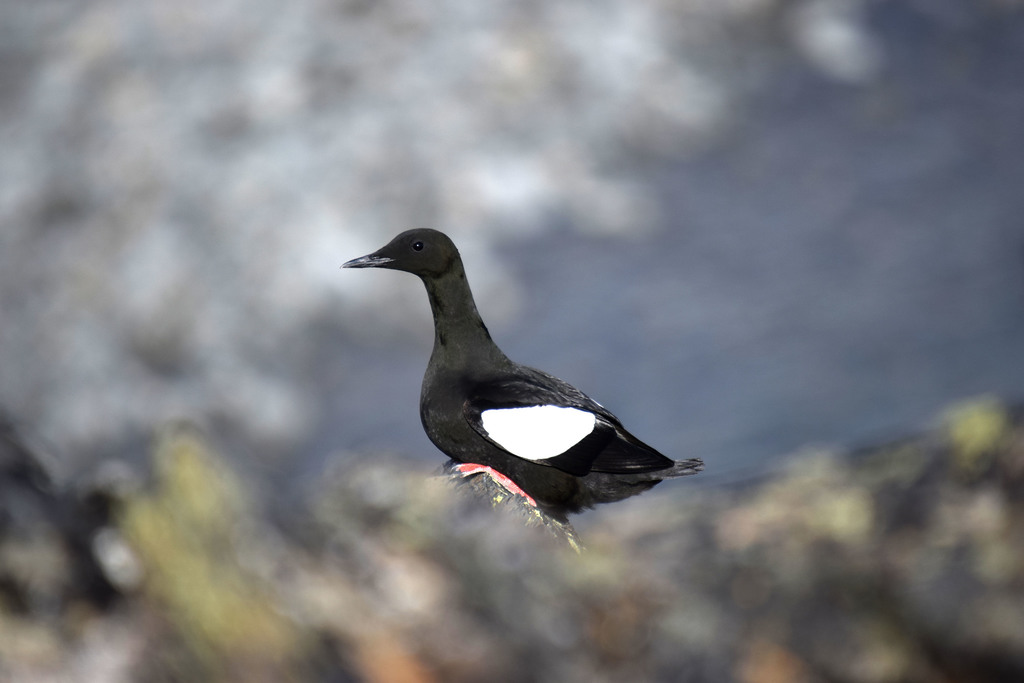
Black Guillemot
Photo © Алексей Логинов
Photo © Алексей Логинов — CC BY 4.0 — Source: iNaturalist photo #109363061Identification
The black guillemot is a medium-sized seabird, 30 to 32 centimetres in length with a wingspan of 52 to 58 centimetres. In summer breeding plumage, adults are strikingly black overall with a distinctive large white patch on the upper side of their wings. The bill is black, long and slender, while the legs, feet and inside of the mouth are bright coral-red. Both sexes appear identical in the field. In winter, the bird undergoes a dramatic transformation: the upper plumage becomes barred with light grey and white, the head turns pale grey, and the underparts become white, though the white wing patch, black bill and red mouth lining are retained. Juveniles and immatures are easily identified by their white wing patch spotted with grey or brown feathers, a feature visible even at considerable distances.
Range & Habitat
The black guillemot is a circumpolar species distributed across boreal, low arctic and high arctic regions of the North Atlantic and Arctic Oceans, breeding between 43° and 82°N. Five recognized subspecies inhabit different parts of this range. In North America, they are found from the Gulf of Maine and New England northward across the northern coast as far as Alaska. In Europe and Asia, their range extends from the British Isles northward across the northern coasts of Asia. They are a fairly common breeding bird around the coasts of Ireland and western and northern Scotland, with smaller populations elsewhere in Britain. Approximately 40% of the global population breeds in high arctic waters, 30% in low arctic regions, and 30% in boreal waters.
Black guillemots are typically restricted to rocky shores, utilizing cliffs, crevices and boulders for nesting. They hunt the inshore waters, remaining resident in more temperate zones year-round, though large populations from high arctic regions migrate southward in winter when ice forces them to seek more open waters.
Behaviour & Diet
Black guillemots are social but unobtrusive birds, seen in single pairs or small groups around their breeding habitat. They breed in solitary pairs or small groups, with the breeding season running from late February to early May. Pairs nest above the high tide mark, typically in cliff crevices or gaps in boulders, though many pairs lay eggs directly on the ground without constructing true nests. Breeding pairs typically lay two-egg clutches and raise two chicks to fledging. The eggs are dull white to pale green, boldly marked with dark spots and blotches. Both parents incubate the eggs for 28 to 32 days. Chicks, covered in black down at hatching, remain under parental care for 30 to 40 days before fledging. Remarkably, once fledged, chicks are totally independent and do not accompany their parents. Young birds typically return to their natal colony to breed at three or four years of age.
The birds feed mainly by diving towards the sea floor in pursuit of fish, crustaceans and other benthic invertebrates. During the breeding season, they produce a distinctive high whistle call, and the bright red interior of their mouth (gape) is prominently displayed at this time.
Best Time & Places to See It
The breeding season from late February through early May is the best time to observe black guillemots, when they are most active and vocal around their nesting colonies. For European travellers, the coasts of Ireland, western and northern Scotland, and Iceland offer the most reliable viewing opportunities, with smaller populations in the Faroe Islands and Baltic region. North American visitors should focus on the Gulf of Maine and New England coastlines. High arctic regions, particularly around Greenland, Svalbard and northern Siberia, hold the largest breeding populations but are less accessible. The birds remain resident in temperate waters throughout the year, though numbers in high arctic regions diminish in winter as populations migrate south.
Photography Tips
Photographers should visit during the breeding season to capture the bird's striking black and white summer plumage with its brilliant coral-red feet and bill. The contrast between the glossy black body and the large white wing patches provides excellent photographic opportunities. Look for birds around rocky shores, cliffs and islands where they nest in small, accessible groups. The bright red gape and mouth lining are particularly prominent during breeding season and worth capturing in close-up shots. Early morning light on rocky coastlines will best showcase the bird's coloration. In winter, the pale grey and white plumage offers a different photographic opportunity, though less visually dramatic. Patience is essential, as these birds are not particularly mobile on land and often remain near their nesting sites, offering chances for steady, detailed photography.
Cape Breton Highlands National Park
Cape Breton Highlands National Park, Canada
+215 birds+18 mammals
Where the Atlantic coast of Nova Scotia rises in weathered cliffs and glacially carved valleys, Cape Breton Highlands National Park spans a landscape where boreal and…
VIEW NATIONAL PARKStenshuvuds National Park
Skåne län, Sweden
+224 birds+19 mammals
Where limestone cliffs rise sharply above the Øresund Strait, Stenshuvuds National Park commands the southeastern tip of Skåne, a landscape carved by glaciation into rolling beech…
VIEW NATIONAL PARKKosterhavets National Park
Västra Götalands län, Sweden
+211 birds+9 mammals
Where the west coast of Sweden dissolves into an archipelago of granite skerries and pine-clad islands, Kosterhavets National Park emerges as one of northern Europe's most…
VIEW NATIONAL PARKSouth Spitsbergen National Park
Norway
+41 birds+15 mammals
Glaciers and tundra meet in Norway's high Arctic, where South Spitsbergen National Park sprawls across the southernmost reaches of the Svalbard archipelago. Here, massive valley glaciers…
VIEW NATIONAL PARKNorthwest Spitsbergen National Park
Norway
+58 birds+17 mammals
Where the High Arctic converges with the Norwegian mainland, Northwest Spitsbergen National Park sprawls across one of Earth's most extreme and pristine wildernesses. Crowned by jagged…
VIEW NATIONAL PARKNorthern Isfjorden National Park
Norway
+40 birds+12 mammals
Where the Arctic fjord system cuts deep into Svalbard's northwestern coast, Northern Isfjorden National Park protects a landscape of stark geological drama—towering cliff faces, tidewater glaciers,…
VIEW NATIONAL PARKSchleswig-Holsteinisches Wattenmeer National Park
Germany
+378 birds+49 mammals
Where the North Sea ebbs and flows across a vast expanse of exposed mud and sand, the Schleswig-Holsteinisches Wattenmeer National Park reveals one of Europe's most…
VIEW NATIONAL PARKPembrokeshire Coast National Park
Pembrokeshire, United Kingdom
+250 birds+41 mammals
Where the Cambrian coastline meets the Celtic Sea, cliff-top moorland and hidden coves define a landscape carved by 300 million years of geological drama. Pembrokeshire Coast…
VIEW NATIONAL PARKLake District National Park
Westmorland and Furness, United Kingdom
+209 birds+36 mammals
Where slate fells rise steeply from mirror-still waters, the Lake District unfolds as one of Britain's most ecologically intricate mountain landscapes. The park's patchwork of deep…
VIEW NATIONAL PARKSirmilik National Park
Qikiqtaaluk Region, Canada
+58 birds+4 mammals
Where the Canadian Arctic archipelago fractures into a labyrinth of islands, Sirmilik National Park protects one of the High North's most pristine marine and terrestrial ecosystems.…
VIEW NATIONAL PARKL’Île-Bonaventure-Et-Du-Rocher-Percé National Park
Le Rocher-Percé, Canada
+214 birds+3 mammals
A dramatic thrust of russet sandstone pierces the Gulf of Saint Lawrence, its weathered arch framing a seascape where cool Atlantic currents sweep past cliffs alive…
VIEW NATIONAL PARKSkuleskogen
Nätra District, Sweden
+158 birds+11 mammals
Where boreal forest meets the raw Höga Kusten coastline, Skuleskogen National Park unfolds across nearly 47 square kilometers of one of northern Sweden's most dramatic landscapes.…
VIEW NATIONAL PARKD’Anticosti National Park
Anticosti Island, Canada
+115 birds+3 mammals
Where boreal forest meets the Gulf of Saint Lawrence, Anticosti Island rises as one of North America's largest and most pristine wilderness preserves. Spanning roughly 2,266…
VIEW NATIONAL PARKLac-Témiscouata National Park
Témiscouata, Canada
+176 birds+4 mammals
Where the boreal forests of eastern Quebec embrace a sprawling freshwater lake, Lac-Témiscouata National Park unfolds across 509 square kilometres of pristine landscape that bridges two…
VIEW NATIONAL PARKAuyuittuq National Park
Qikiqtaaluk Region, Canada
+14 birds
Where granite peaks pierce the Arctic sky above Baffin Island, Auyuittuq National Park sprawls across roughly 40,000 square kilometres of one of Canada's most unforgiving landscapes.…
VIEW NATIONAL PARKFundy National Park of Canada
Alma Parish, Canada
+217 birds+24 mammals
Where the Bay of Fundy's tidal rhythms sculpt a landscape of dramatic cliffs, forested valleys, and boulder-strewn shorelines, Fundy National Park rises across approximately 345 square…
VIEW NATIONAL PARKGros Morne National Park
Canada
+180 birds+19 mammals
Where glacier-carved fjords pierce the interior of Newfoundland, Gros Morne National Park unfolds across nearly four thousand square kilometres of some of Canada's most dramatic coastal…
VIEW NATIONAL PARKBic National Park
Rimouski, Canada
+250 birds+9 mammals
Where the St. Lawrence River meets the Gaspé Peninsula, a rugged coastline of forests, wetlands, and rocky shores unfolds across nearly 95 square kilometres of protected…
VIEW NATIONAL PARKKouchibouguac National Park of Canada
Carleton Parish, Canada
+207 birds+14 mammals
Where the Maritime provinces meet the Atlantic, 591 square kilometres of coastal forest and wetland unfold across New Brunswick's eastern shoulder, a mosaic of boreal woodland,…
VIEW NATIONAL PARKForillon National Park
Gaspé, Canada
+258 birds+16 mammals
Where the Gaspésie Peninsula juts into the Gulf of Saint Lawrence, granite cliffs and coastal headlands frame one of eastern Canada's most dramatic marine-terrestrial boundaries. Forillon…
VIEW NATIONAL PARKSassen-Bünsow Land National Park
Soere, Norway
+30 birds+10 mammals
Where Arctic tundra sprawls across glaciated plateaus in the remote Svalbard archipelago, a realm of raw geological drama unfolds. Sassen-Bünsow Land National Park encompasses a landscape…
VIEW NATIONAL PARKForlandet National Park
Vera, Norway
+38 birds+12 mammals
Windswept Arctic tundra meets jagged coastal cliffs where the Barents Sea crashes against Norway's northernmost wilderness. This sliver of protected terrain on the Nordkapp Peninsula comprises…
VIEW NATIONAL PARKCairngorms National Park
Muir, United Kingdom
+192 birds+31 mammals
Where ancient granite massifs rise above the Scottish Highlands, a subarctic wilderness unfolds across 1,748 square kilometres of raw, elemental terrain. Windswept plateaus give way to…
VIEW NATIONAL PARKLoch Lomond & the Trossachs National Park
Duchray, United Kingdom
+188 birds+40 mammals
Where ancient woodlands rise from glassy lochs and rugged Highland peaks pierce the lowland horizon, Scotland's most biodiverse landscape unfolds across 720 square kilometres of wild…
VIEW NATIONAL PARKLahemaa National Park
Lääne-Viru County, Estonia
+237 birds+25 mammals
Where the Baltic coast meets temperate forest in northwestern Estonia, Lahemaa National Park sprawls across more than 1,300 square kilometers of deeply character-filled terrain. Coastal wetlands…
VIEW NATIONAL PARKSt. Paul Island
Saint Paul, United States
+255 birds+8 mammals
Windswept tundra rolls across this remote Pribilof island, where volcanic basalt cliffs plunge into the Bering Sea and fog rolls in thick enough to erase the…
VIEW PROTECTED LANDSCAPEWrangel Island Nature Reserve
Wrangel Island, Russia
+25 birds+11 mammals
Where the Chukchi Sea fractures Arctic ice beneath an unforgiving sky, a lonely island holds one of Earth's most pristine ecosystems. Wrangel Island spans tundra so…
VIEW NATURE RESERVEIlulissat Icefjord
Ilulissat, Greenland
+26 birds+1 mammals
Where the Arctic's most dynamic glacier meets the sea, colossal icebergs calve with thunderous force into a fjord that transforms daily with the tide. Sermeq Kujalleq,…
VIEW PROTECTED LANDSCAPEDisko Bay
Kitsissuarsuit, Greenland
+46 birds+9 mammals
Where Arctic fjords carve deep into Greenland's western coast, Disko Bay creates a protected landscape of extraordinary ecological complexity. The waters here merge temperate Atlantic currents…
VIEW PROTECTED LANDSCAPEScoresby Sund
Vandreblok, Greenland
+43 birds+9 mammals
Where granite peaks pierce an Arctic sky and the world's largest fjord system carves deep into northeastern Greenland, a primordial landscape unfolds in shades of ice-blue…
VIEW PROTECTED LANDSCAPENortheast Greenland National Park
Northeast Greenland National Park, Greenland
+34 birds+10 mammals
Where granite peaks plunge into the Arctic Ocean and pack ice dominates a landscape of incomparable vastness, one of Earth's most remote wildernesses reveals itself. Spanning…
VIEW NATIONAL PARKNuuk Fjord System
Nuuk, Greenland
+54 birds+3 mammals
Where granite peaks plunge directly into the Arctic Ocean, a labyrinth of deep fjords carves through Greenland's southwestern coast, their waters eternally shadowed by towering rock…
VIEW PROTECTED LANDSCAPESkomer Island
Haverfordwest, United Kingdom
+177 birds+5 mammals
Where the Irish Sea crashes against the Welsh coast, wind-scoured cliffs rise dramatically from churning waters, creating one of Britain's most pristine island sanctuaries. Skomer Island's…
VIEW ISLAND & ARCHIPELAGORussian Arctic National Park
Russia
+23 birds+3 mammals
Across the stark tundra of Russia's northwestern Arctic, where permafrost defines the land and sunlight dictates the rhythm of life, lies a landscape sculpted by ice…
VIEW NATIONAL PARKAlaska Maritime National Wildlife Refuge
Alaska, United States
+391 birds+58 mammals
Where the North Pacific collides with Alaska's rugged coastline, a sprawling archipelago of islands, rocky outcrops, and coastal headlands forms one of North America's most remote…
VIEW WILDLIFE SANCTUARYLindisfarne National Nature Reserve
Holy Island, United Kingdom
+240 birds+13 mammals
Windswept tidal flats and rocky outcrops define this reserve on Holy Island, where the North Sea's relentless rhythm shapes both landscape and wildlife. The terrain shifts…
VIEW NATURE RESERVEHolkham National Nature Reserve
North Norfolk, United Kingdom
+235 birds+11 mammals
Where Norfolk's coastal flatlands meet the North Sea, Holkham National Nature Reserve unfolds across nearly 4,000 hectares of some of England's most dynamic and least predictable…
VIEW NATURE RESERVERum National Nature Reserve
Isle Of Rum, United Kingdom
+112 birds+8 mammals
Where the Inner Hebrides rise from the Atlantic, Rum's landscape embodies the raw drama of Scotland's northwest. Steep ridges and volcanic plateaus dominate this island nature…
VIEW NATURE RESERVEHermaness National Nature Reserve
Shetland, United Kingdom
+86 birds+3 mammals
At the northern tip of Unst, the northernmost inhabited island of Shetland, sea cliffs of weathered sandstone and basalt rise dramatically from the North Sea, their…
VIEW NATURE RESERVEGreat Orme National Nature Reserve
Llandudno, United Kingdom
+113 birds+7 mammals
Limestone cliffs rise dramatically from the Irish Sea along the Conwy coast, their windswept summits offering sanctuary to a mosaic of heathland, grassland and rocky outcrops…
VIEW NATURE RESERVENo community photos yet. Log in to add the first one.
No community observations of this species yet.