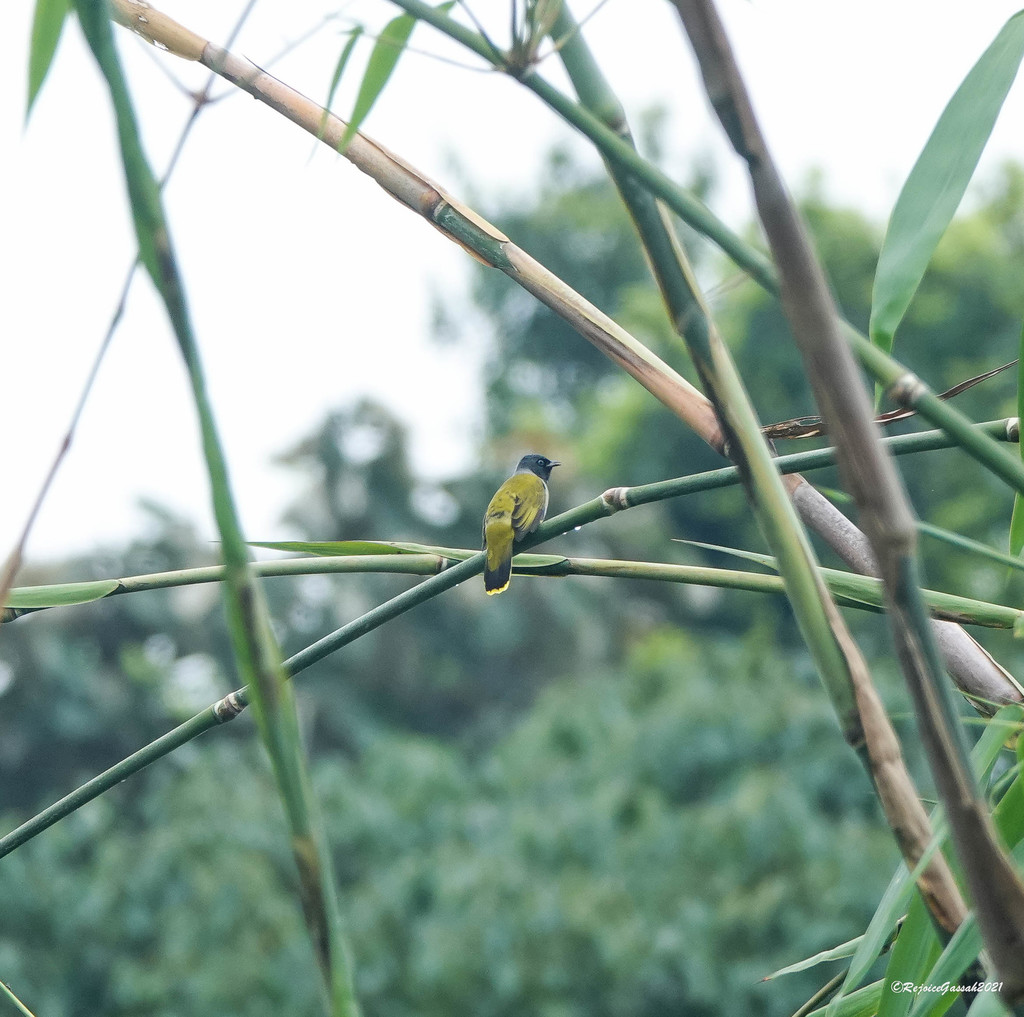
Black-headed Bulbul
Photo © Rejoice Gassah
Photo © Rejoice Gassah — CC BY 4.0 — Source: iNaturalist #101751102Identification
The black-headed bulbul is a small passerine measuring 16–18 cm in length and weighing 20–30 g. Its most distinctive feature is a glossy bluish-black head that contrasts sharply with predominantly olive-yellow plumage on the body. The species has blue eyes and a broad yellow tip to the tail, which are helpful distinguishing marks. A rare grey morph exists in which the olive-yellow plumage is largely replaced by grey. The black-headed bulbul resembles the black-crested bulbul, but can be reliably separated by its blue eyes, yellow tail tip, and notably the complete absence of a crest—a feature always present in its congener.
Range & Habitat
This bulbul is found in forests across south-eastern Asia, with its range spanning from north-eastern India and Bangladesh through Southeast Asia to the Greater Sunda Islands and the western Philippines. Four recognized subspecies occupy different regions within this range, from western Sumatran islands to islands such as Bawean and Maratua off Borneo. The species was formally described in 1788, though the original type locality was initially misidentified as the Sandwich Islands before being correctly designated as Sumatra in 1912.
Behaviour & Diet
The black-headed bulbul is a social bird, commonly occurring in small flocks of 6–8 individuals. Its diet consists mainly of small fruits and berries, though it opportunistically supplements this with insects. This feeding ecology makes it well-adapted to the forest environment it inhabits across its range.
Best Time & Places to See It
Travellers seeking this species should focus on forested habitats throughout south-eastern Asia, particularly in regions from north-eastern India and Bangladesh eastward through the Greater Sunda Islands and into the western Philippines. The bird's preference for small fruiting trees and berry-bearing vegetation means productive viewing locations are often near fruiting trees within forest areas. Its gregarious nature and tendency to occur in flocks of several individuals increases the likelihood of observation when the species is encountered.
Photography Tips
The black-headed bulbul's striking glossy bluish-black head contrasting with olive-yellow plumage makes it an attractive photographic subject. The broad yellow tail tip is a useful diagnostic field mark that should be captured when possible. The bird's small size (16–18 cm) and tendency to feed in flocks offers opportunities for both individual portraits and group compositions. Photographers should note that juvenile birds may not show the reliable blue eye colour of adults, so confirmation of identification should rely on plumage features such as the crest-less head and yellow tail tip.
Hat Noppharat Thara-Mu Ko Phi Phi National Park
Ao Nang, Thailand
+253 birds+9 mammals
Where limestone karsts rise dramatically from turquoise waters, Hat Noppharat Thara-Mu Ko Phi Phi National Park unfolds across a mosaic of beach, mangrove forest, and island…
VIEW NATIONAL PARKKhao Yai National Park
Prachantakham District, Thailand
+377 birds+46 mammals
Evergreen dipterocarp forest blankets the rolling terrain of this national park in eastern Thailand, where limestone hills rise abruptly from the forest floor and seasonal streams…
VIEW NATIONAL PARKKhao Laem Ya-Mu Ko Samet National Park
Mueang Rayong District, Thailand
+159 birds+3 mammals
Where limestone hills meet the Gulf of Thailand, Khao Laem Ya–Mu Ko Samet National Park stitches together a mosaic of terrestrial and marine worlds that few…
VIEW NATIONAL PARKKhao Laem National Park
Sangkhla Buri District, Thailand
+197 birds
Where the Vajiralongkorn Reservoir sprawls across the forested valleys of Kanchanaburi's northern borderlands, Khao Laem National Park protects a landscape where limestone ridges rise dramatically from…
VIEW NATIONAL PARKTaman Negara Bukit Lambir National Park
Miri, Malaysia
+153 birds+7 mammals
Rainforest cascades down sandstone ridges where crystal streams carve through ancient geology, creating a landscape of profound biological richness in Sarawak's interior. This 68-square-kilometre sanctuary protects…
VIEW NATIONAL PARKGunung Mulu National Park
Long Seridan, Malaysia
+280 birds+39 mammals
Where granite monoliths pierce the rainforest canopy of Sarawak, an ancient limestone karst landscape reveals one of Southeast Asia's most biodiverse strongholds. Soaring peaks cloaked in…
VIEW NATIONAL PARKXishuangbanna National Nature Reserve
Xishuangbanna Dai Autonomous Prefecture, China
+173 birds+2 mammals
Where subtropical monsoon forests meet the margins of the Yunnan plateau, Xishuangbanna National Nature Reserve sprawls across a landscape of dramatic relief—deep river valleys carved by…
VIEW NATURE RESERVENo community photos yet. Log in to add the first one.
No community observations of this species yet.