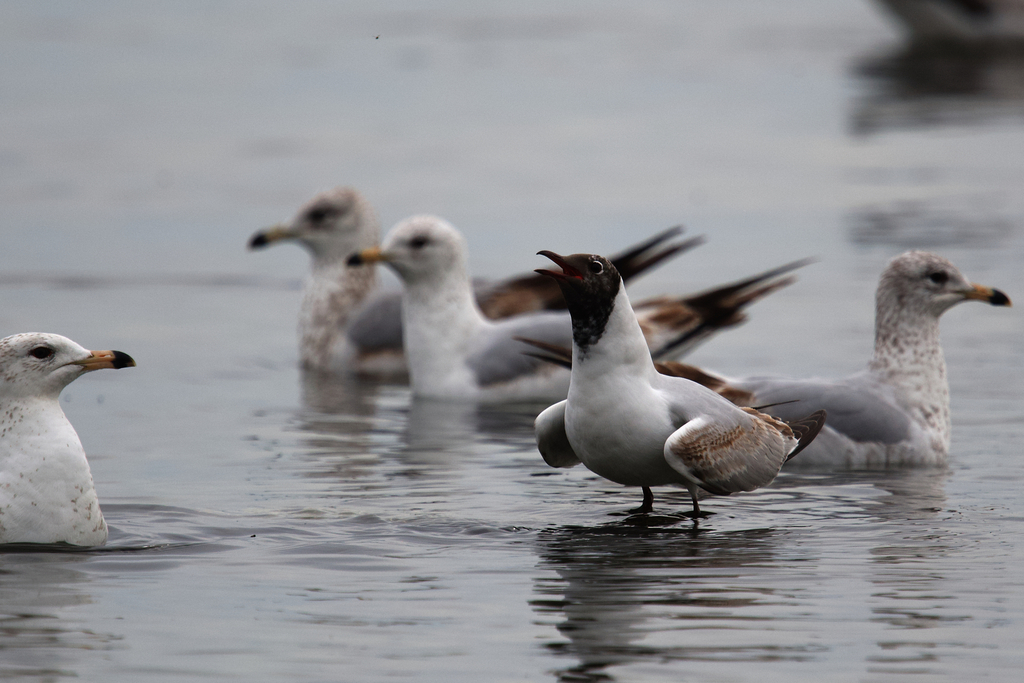
Black-headed Gull
Photo © Owen Strickland
Photo © Owen Strickland — CC BY 4.0 — Source: iNaturalist photo #499705038Identification
The black-headed gull is a small gull measuring 34–39 cm in length with a wingspan of 100–110 cm. In summer plumage, adults display a chocolate-brown head (appearing black from a distance), white neck and underparts, pale grey wings and back, black-tipped primary feathers, and distinctive red bill and legs. The most reliable field mark in flight is the white leading edge of the outer primaries combined with the dark underside of the inner primaries—a feature that distinguishes it from the similar Bonaparte's gull, which has white underwings. In winter, adults lose the brown hood, retaining only two dark spots above and behind the eye.
Juvenile birds show considerable plumage variation as they mature over two years. Fledglings display mottled brown spots across the body with a black tail band. By their first summer, young birds develop a partial brown hood of variable extent. Second-winter plumage resembles adult winter plumage, though some individuals retain brown marks on wings and tail tips. Males are on average heavier than females, weighing 186–400 g compared to females at 166–350 g, though there is considerable overlap between the sexes.
Range & Habitat
Black-headed gulls breed across the Palearctic from Iceland and Ireland eastward to Japan and eastern China, making them one of the most abundant gull species globally with a population of 2–3 million pairs. Europe supports the largest concentrations, with Great Britain and Poland each hosting between 250,000 and 300,000 pairs. The breeding range has expanded westwards over the past century, with colonisation of Iceland in 1911, Greenland in 1969, and northeastern Canada in 1977.
Most populations are migratory, moving south and west away from regions that freeze hard in winter, reaching northern Africa and southern Asia. However, many birds winter in milder areas of northwestern Europe, particularly in Great Britain, which receives around 3 million winter visitors from colder regions like Scandinavia and Russia. The species breeds in colonies in large reed beds, marshes, or on lake islands, nesting on the ground in colonies ranging from a few pairs to several thousand, occasionally exceeding 10,000 pairs. This is not a pelagic species and is rarely seen far from coasts.
Behaviour & Diet
Black-headed gulls are highly gregarious birds, particularly in winter, when they congregate both at feeding sites and evening roosts. They are long-lived species, with recorded lifespans exceeding 32 years in the wild. The species reaches sexual maturity after two years, and individuals take on progressively more adult plumage characteristics during this period. Summer plumage typically occurs from March to July, while winter plumage prevails from late July through March or April.
Best Time & Places to See It
Black-headed gulls are abundant and widely distributed, making them relatively easy to observe across their range. Winter is an excellent season for viewing, particularly in northwestern Europe, where large numbers congregate in milder areas. Great Britain, Poland, and other parts of central and western Europe offer reliable opportunities. The species is present year-round in many locations, though seasonal movements mean populations in specific areas fluctuate throughout the year.
Photography Tips
Photograph adults in summer plumage to capture the distinctive chocolate-brown hood, white underparts, and red bill and legs. The white leading edge of the outer primary feathers is a key diagnostic feature worth documenting in flight shots. Winter birds offer different photographic opportunities with their cleaner white heads and the characteristic dark spots behind the eye. Include comparisons with Bonaparte's gulls if possible to highlight the contrasting wing patterns. Juvenile and first-year birds display particularly variable plumage, so documenting the range of individual variation can be rewarding.
Delta de l’Ebre Natural Park
Mabamba Swamp
Murchison Falls National Park
Queen Elizabeth National Park
Aberdare National Park
Abijata-Shalla Lakes National Park
Abruzzo, Lazio and Molise National Park
Alaska Maritime National Wildlife Refuge
Alligator River National Wildlife Refuge
Nothing matches these filters.
No community photos yet. Log in to add the first one.