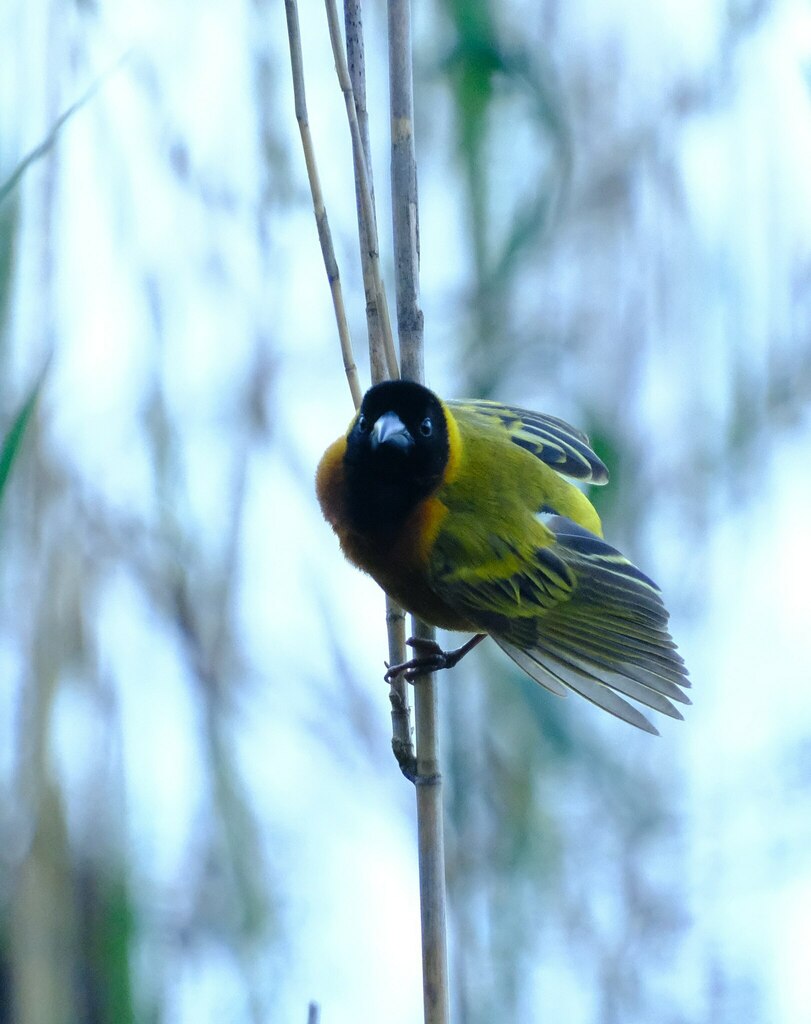
Black-headed Weaver
Photo © Jan Vršovský
Photo © Jan Vršovský — CC BY-SA 4.0 — Source: iNaturalist #166665368Identification
The black-headed weaver, also known as the yellow-backed weaver, is easily identified in breeding plumage. Males display a striking black head contrasting sharply with a bright yellow nuchal collar and plain greenish mantle. The underparts are pale yellow suffused with variable amounts of chestnut. This combination distinguishes it from related species such as the village weaver and golden-backed weaver, which lack the yellow nuchal collar or have different mantle coloration.
Females and non-breeding males present a different appearance, lacking the distinctive black head. They resemble female masked weavers but can be distinguished by their dark eyes and darker bill. The buffy breast plumage also separates them from non-breeding golden-backed weavers, providing useful field marks for accurate identification outside the breeding season.
Range & Habitat
The black-headed weaver is found across West, Central, and East Africa, with five recognized subspecies distributed throughout the region. The species has even been introduced to the Iberian Peninsula. It is a resident breeder in damp areas of tropical Africa, showing a preference for savanna and similar habitats, typically near water sources where it can find suitable conditions for nesting and foraging.
This weaver exhibits a characteristic behavior of positioning itself on Acacia trees, often selecting perches approximately three meters away from land. This strategic placement helps reduce predation risk, allowing the birds to maintain vigilance while remaining at a safe distance from ground-based threats.
Behaviour & Diet
As with most weavers, the black-headed weaver is primarily a seed-eating bird, though specific dietary details are limited in available sources. The species is notably gregarious and social, typical of weaver species, and is known for its characteristic weaving behavior—constructing intricate woven nests from grasses and plant fibers. Males in breeding plumage are particularly conspicuous and active during the breeding season.
Best Time & Places to See It
For travelers and photographers seeking the black-headed weaver, the breeding season offers the best opportunity to observe males in their striking plumage. The species is most easily found in wetland areas and savanna habitats near permanent water sources across its range in West, Central, and East Africa. Acacia woodlands near water are particularly productive locations for sightings.
Photography Tips
The bright contrasting colors of breeding males—particularly the black head and yellow collar against the greenish mantle—make them rewarding photographic subjects. Photograph birds near Acacia trees at dawn when light is favorable and activity is highest. The yellow nuchal collar and pale underparts provide excellent contrast for digital photography. Non-breeding birds are more cryptic, so patience and attention to the subtle plumage details mentioned above will improve your chances of successful identification and documentation.
Serengeti National Park
Tanzania
+558 birds+57 mammals
Across Tanzania's northern plateau, where volcanic soils meet acacia woodland and open grassland, unfolds one of Earth's most dynamic ecosystems. The Serengeti National Park sprawls across…
VIEW NATIONAL PARKRubondo Island National Park
Tanzania
+99 birds+8 mammals
Across the waters of Lake Victoria's northeastern arm, Rubondo Island rises as a freshwater wilderness where papyrus swamps grade into acacia woodlands and dense thickets of…
VIEW NATIONAL PARKL’Albufera Natural Park
València, Spain
+321 birds+18 mammals
Where shallow lagoons meet Mediterranean coastal marshland, L'Albufera Nature Park unfolds as one of Spain's most vital wetland complexes. This protected landscape, designated under IUCN Category…
VIEW NATURAL PARKDoñana National Park
Hinojos, Spain
+300 birds+13 mammals
Where the Guadalquivir River delta spreads into the Atlantic, vast marshes, cork woodlands, and coastal dunes converge to create one of southwestern Europe's most biodiverse wetland…
VIEW NATIONAL PARKVirunga National Park
Uganda
+418 birds+13 mammals
Where the Western Rift Valley fractures the landscape of North Kivu, Virunga National Park sprawls across terrain as geologically dramatic as it is ecologically vital. Volcanic…
VIEW NATIONAL PARKBwindi Impenetrable National Park
Kanyashogi, Uganda
+603 birds+26 mammals
Steep ridges cloaked in montane forest rise from Uganda's southwestern borderlands, where the landscape grows so dense and tangled that early explorers named it impenetrable. At…
VIEW NATIONAL PARKVolcanoes National Park
Musanze District, Uganda
+152 birds+6 mammals
Where volcanic cones rise sharply above the montane forests of northern Uganda, Volcanoes National Park protects one of East Africa's most dramatic high-altitude ecosystems. The park's…
VIEW NATIONAL PARKKidepo Valley National Park
Uganda
+478 birds+24 mammals
Where the Narus and Kidepo rivers carve through northeastern Uganda's semi-arid lowlands, a landscape of sparse acacia woodland, grassland, and riverine thickets creates one of East…
VIEW NATIONAL PARKMurchison Falls National Park
Uganda
+608 birds+33 mammals
Where the Victoria Nile compresses through a narrow gorge and explodes across a 45-meter precipice, the landscape speaks in thunder. Murchison Falls National Park sprawls across…
VIEW NATIONAL PARKMgahinga Gorilla National Park
Cyanika, Uganda
+429 birds+6 mammals
Where the Virunga Mountains rise steeply from the Uganda–Rwanda–Democratic Republic of Congo frontier, montane forest cloaks the volcanic slopes in a dense, moisture-laden embrace. Mgahinga Gorilla…
VIEW NATIONAL PARKLake Mburo National Park
Uganda
+505 birds+24 mammals
Rolling acacia woodland and scattered lakes define this intimate savanna preserve in southwestern Uganda, where the rift valley's geological drama shapes every water source and grassland.…
VIEW NATIONAL PARKTsavo East National Park
Athi ward, Kenya
+468 birds+50 mammals
Across the semi-arid lowlands of southeastern Kenya, where acacia woodland fragments into scrubland and the landscape rolls toward the Indian Ocean horizon, lies one of Africa's…
VIEW NATIONAL PARKToro-Semliki Proposed National Park
Uganda
+474 birds+5 mammals
Where the Albertine Rift's western escarpment rises above the Semliki River valley, a vast mosaic of forest, savanna and wetland converges to create one of East…
VIEW NATIONAL PARKQueen Elizabeth National Park
Uganda
+672 birds+30 mammals
Across the southwestern escarpment of Uganda, where the Western Rift Valley descends through ancient volcanic terrain, Queen Elizabeth National Park sprawls across more than 8,300 square…
VIEW NATIONAL PARKMabamba Swamp
Memere, Uganda
+464 birds+2 mammals
Across the Central Region of Uganda spreads one of Africa's most biodiverse freshwater wetlands, a sprawling nature reserve of roughly 283 square kilometres where papyrus swamps…
VIEW NATURE RESERVEZiwa Rhino and Wildlife Ranch
Nakasongola, Uganda
+359 birds+11 mammals
Where papyrus wetlands merge into sprawling savanna, Uganda's central landscape opens into one of East Africa's most vital rhino recovery zones. Ziwa Rhino and Wildlife Ranch…
VIEW WILDLIFE SANCTUARYMontes de Málaga Natural Park
Málaga, Spain
+159 birds+7 mammals
Where cork oak and pine forest sweep across the rugged hills inland from the Costa del Sol, the Montes de Málaga Nature Park unfolds as a…
VIEW NATURAL PARKRuma National Park
Suba, Kenya
+250 birds+8 mammals
Where the Winam Gulf narrows toward the Kenyan mainland, Ruma National Park rises as a sanctuary of evergreen woodland set within the humid tropics of Homa…
VIEW NATIONAL PARKNo community photos yet. Log in to add the first one.
No community observations of this species yet.