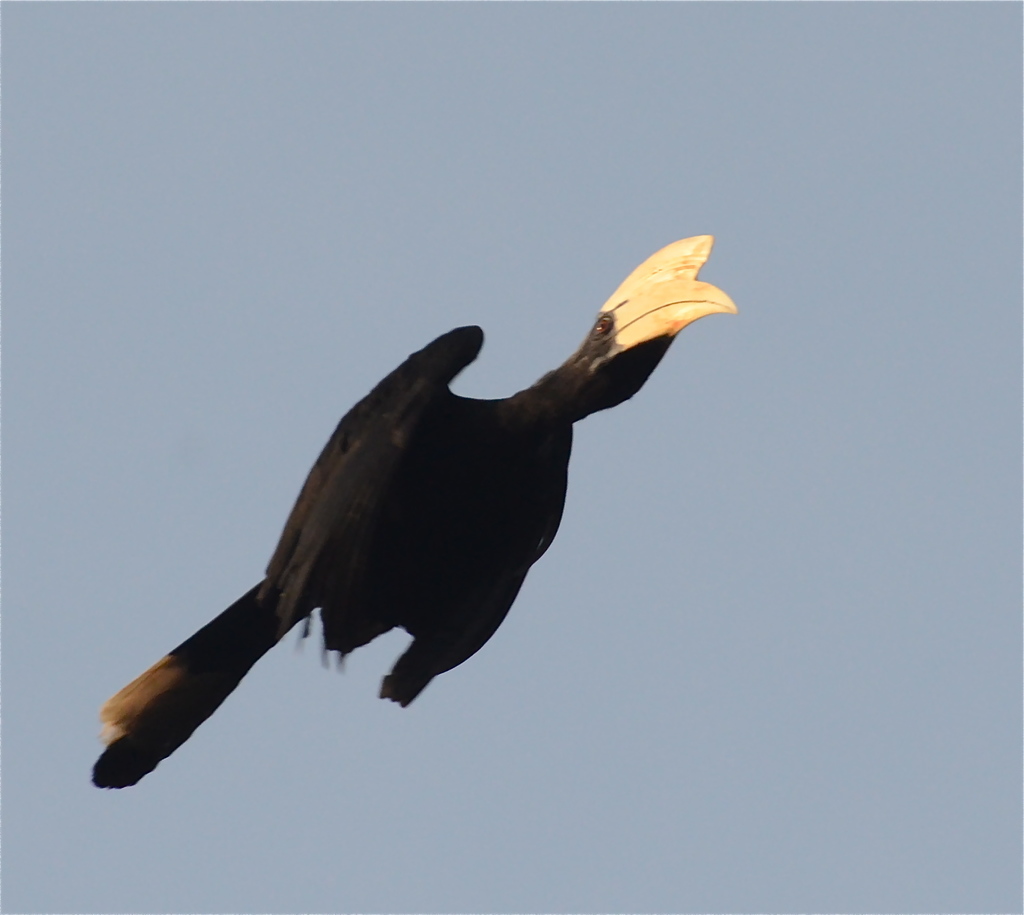
Black Hornbill
Photo © Jay Pruett
Photo © Jay Pruett — CC BY 4.0 — Source: iNaturalist #108885578Identification
The black hornbill is a striking member of the hornbill family, instantly recognizable by its predominantly dark plumage and distinctive bill. Sexual dimorphism is evident in bill coloration: males display a yellowish bill, while females have a darker grey bill. This characteristic difference provides a useful field mark for distinguishing the sexes in the field, particularly when observing perched birds or during breeding season.
Range & Habitat
The black hornbill is found across several Southeast Asian countries including Brunei Darussalam, Indonesia, Malaysia, Singapore, and Thailand. As a lowland specialist, this species is adapted to life in the lower elevation forests of the region, where it depends on the availability of large fruit-bearing trees for survival and reproduction.
Behaviour & Diet
This species is a dedicated frugivore with an impressive dietary range, consuming over 50 different fruit species throughout its range. Figs and Vitex pinnata are among its most commonly exploited food sources, though it also regularly feeds on Sterculia cordata and the distinctive spiky durian fruit (Durio graveolens). The black hornbill plays a crucial ecological role as a major seed disperser, particularly for Durio graveolens—a relationship so significant that local peoples have incorporated the bird into their common names for the fruit. The Kenyah and Dayak peoples call it "durian anggang" (hornbill durian), while Malay speakers refer to it as "durian burong" or "durian burung" (bird durian). The species also disperses seeds for Vitex pinnata.
Black hornbills are highly selective in their breeding behaviour, closely tied to resource availability. They will only begin nesting when sufficient fruit supplies are present and suitable large trees are available. During periods of low fruit availability, they may curtail breeding for several years at a time. Known for their endurance, these birds are capable of flying for hours at a time, allowing them to cover considerable distances in search of fruiting trees.
Best Time & Places to See It
The black hornbill's breeding season is contingent on fruit availability rather than fixed calendar periods, making advance planning challenging. Birdwatchers should focus on lowland forest areas where large fruiting trees are abundant. The species is present year-round throughout its range in Brunei, Indonesia, Malaysia, Singapore, and Thailand, but sightings are most reliable during periods of abundant fruit production.
Photography Tips
Patience is essential when photographing black hornbills, as their breeding behaviour is unpredictable and fruit availability varies seasonally. The contrasting bill coloration between males and females offers excellent opportunities for behavioral photography that illustrates sexual dimorphism. Their habit of flying for extended periods means that capturing in-flight images requires anticipation and quick reflexes. Photographing birds feeding in fruiting trees at dawn, when light is favourable and activity is highest, offers the best chances for compelling images.
Bako National Park
Kuching, Malaysia
+210 birds+17 mammals
Weathered sandstone cliffs rise dramatically from the South China Sea, their ochre faces sculpted by millennia of wind and tide into a landscape of extraordinary geological…
VIEW NATIONAL PARKTaman Negara National Park
Kampong Samas, Malaysia
+393 birds+48 mammals
Where ancient rainforest meets limestone peaks, one of Southeast Asia's oldest protected wilderness preserves sprawls across 4,343 square kilometers of primordial landscape. Dipterocarp giants tower overhead,…
VIEW NATIONAL PARKTaman Negara Bukit Lambir National Park
Miri, Malaysia
+153 birds+7 mammals
Rainforest cascades down sandstone ridges where crystal streams carve through ancient geology, creating a landscape of profound biological richness in Sarawak's interior. This 68-square-kilometre sanctuary protects…
VIEW NATIONAL PARKGunung Mulu National Park
Long Seridan, Malaysia
+280 birds+39 mammals
Where granite monoliths pierce the rainforest canopy of Sarawak, an ancient limestone karst landscape reveals one of Southeast Asia's most biodiverse strongholds. Soaring peaks cloaked in…
VIEW NATIONAL PARKKerinci Seblat National Park
Kerinci, Indonesia
+228 birds+16 mammals
Across nearly 67,000 square kilometres of Sumatra's spine, a mountainous realm of equatorial rainforest rises from steaming lowlands to volcanic peaks shrouded in cloud. Kerinci Seblat…
VIEW NATIONAL PARKGunung Palung National Park
Kayong Utara, Indonesia
+38 birds+1 mammals
Rainforest swells across the steep terrain of West Kalimantan, where ancient volcanic ridges rise abruptly from lowland swamps and weathered plateaus. Gunung Palung National Park encompasses…
VIEW NATIONAL PARKWay Kambas National Park
Lampung Timur, Indonesia
+237 birds+20 mammals
Across the low swamplands of eastern Lampung, where freshwater wetlands merge into tidal mangrove forests along the Sunda Strait, sprawls one of Sumatra's most vital sanctuaries.…
VIEW NATIONAL PARKNo community photos yet. Log in to add the first one.
No community observations of this species yet.