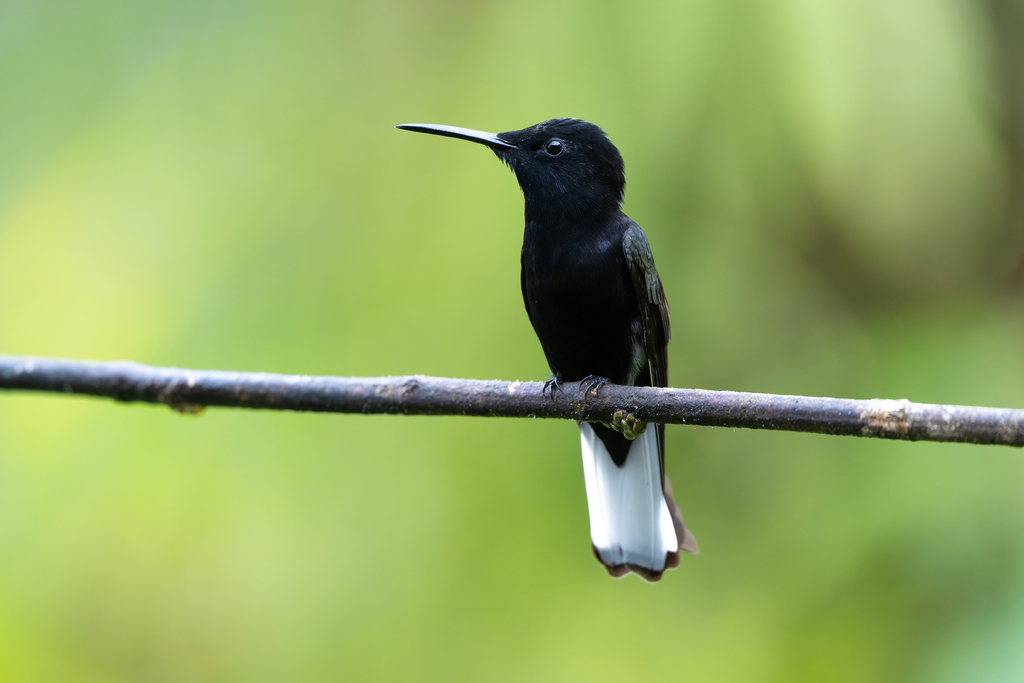
Black Jacobin
Photo © Adam Jackson
Photo © Adam Jackson — CC0 1.0 — Source: iNaturalist photo #587604533Identification
The black jacobin is a small hummingbird, measuring 12 to 13 cm in length and weighing approximately 9 grams for males and 8 grams for females. Adults of both sexes are predominantly black, with distinctive bronzy-olive coloring on the lower back and upper tail and wing coverts. The flanks are white, while the inner tail feathers are black and the outer tail feathers white with black tips, creating a striking contrast in flight. Juveniles are notably different, displaying dark plumage with a wide cinnamon band across the center and sides of the throat and a white belly, along with white outer tail feathers.
Range & Habitat
The black jacobin is found across southeastern South America, with its primary range extending from Bahia in Brazil southward through Rio Grande do Sul and into eastern Uruguay, with separate populations in southeastern Paraguay and northeastern Argentina. The species shows a preference for woodlands, gardens, and cultivated areas such as coffee and cacao plantations that contain tall trees. It inhabits elevations ranging from sea level up to 1,400 meters, and scattered records indicate occasional sightings beyond its primary range.
Behaviour & Diet
The black jacobin is a migratory species, though migration patterns remain poorly understood. Generally, the species moves southward during the austral winter, though winter records also document movements to the northwest in Brazil's cerrado biome. These hummingbirds forage throughout all levels of their habitat, feeding primarily on nectar from native and introduced flowers, bromeliads, and various shrubs. Despite their highly territorial nature—aggressively defending food sources against competitors—congregations of 50 or more individuals have been observed feeding together on patches of Dombeya wallichii during July. The black jacobin supplements its diet with small insects captured in flight and gleaned from leaves and spider webs.
Best Time & Places to See It
The black jacobin is common throughout Brazil and is protected within many nature reserves across its range. The species is most active during its breeding season, which extends from July through May, with July particularly notable for the large feeding congregations that form around flowering shrubs. The bird's readiness to occupy man-made habitats means that gardens, plantations, and cultivated areas offer excellent viewing opportunities alongside natural woodland habitats.
Photography Tips
Photographers should listen for the black jacobin's distinctive vocalizations—a rapid series of high-pitched hissing notes, along with short "tsik" or "chik" calls and trilling sounds—to locate birds in dense vegetation. The contrast between the male's glossy black plumage and white flanks provides excellent photographic potential, particularly when backlighting captures the bronzy-olive tones of the lower back. July feeding congregations at flowering Dombeya wallichii shrubs offer opportunities for photographing multiple individuals, while the white outer tail feathers in flight create distinctive visual markers for tracking subjects.
Tijuca National Park
Brazil
+317 birds+13 mammals
Where the Atlantic forest rises steeply from Rio de Janeiro's urban edge, Tijuca National Park encompasses a landscape of dramatic granite peaks, cascading waterfalls, and closed-canopy…
VIEW NATIONAL PARKEmas National Park
Brazil
+333 birds+23 mammals
Across the high plateaux of central Brazil, where the cerrado grasslands roll toward distant horizons under an immense sky, Emas National Park anchors one of South…
VIEW NATIONAL PARKSerra do Cipó National Park
Brazil
+379 birds+5 mammals
Where granite escarpments rise above the Atlantic Forest transition zone in southeastern Brazil, Serra do Cipó National Park unfolds across a landscape of dramatic ridges, cascading…
VIEW NATIONAL PARKItatiaia National Park
Brazil
+519 birds+12 mammals
Where granite peaks pierce the Atlantic rainforest canopy in southeastern Brazil, Itatiaia National Park rises as one of the country's oldest and most ecologically vital protected…
VIEW NATIONAL PARKPeixe National Park Lagoon
Brazil
+293 birds+4 mammals
Where the coastal plains of Rio Grande do Sul meet the Atlantic, Peixe National Park Lagoon sprawls across nearly 2,200 square kilometres of shallow waters, reed…
VIEW NATIONAL PARKSuperagui National Park
Brazil
+246 birds+2 mammals
Where the Atlantic rainforest meets the subtropical coast of Paraná, Superagui National Park sprawls across more than 1,000 square kilometres of one of Brazil's most biodiverse…
VIEW NATIONAL PARKSaint-Hilaire/Lange National Park
Brazil
+225 birds
Subtropical Atlantic forests rise and fall across the plateaus of inland Paraná, where Saint-Hilaire/Lange National Park protects nearly 578 square kilometres of Brazil's most biodiverse woodland…
VIEW NATIONAL PARKSerra do Itajaí National Park
Brazil
+227 birds+2 mammals
Where the Atlantic rainforest rises steeply from the coastal plains of Santa Catarina, Serra do Itajaí National Park spreads across 1,136 square kilometres of montane wilderness…
VIEW NATIONAL PARKSerra da Bocaina National Park
Brazil
+441 birds+5 mammals
Where the escarpment of the Serra da Bocaina rises sharply from the Atlantic coastal plain, tropical rainforest cloaks steep mountainsides that climb toward peaks exceeding 2,000…
VIEW NATIONAL PARKIguaçu National Park
Brazil
+387 birds+17 mammals
Where the Paraná Plateau plunges toward the Atlantic watershed, six thousand square kilometers of subtropical rainforest cling to steep gorges and river valleys in this corner…
VIEW NATIONAL PARKSerra do Teixeira National Park
Brazil
+160 birds+5 mammals
Rugged plateaus and deep escarpments define this 3,112-square-kilometre sweep of the Brazilian Northeast, where the crystalline bedrock of the Borborema Plateau rises abruptly from the surrounding…
VIEW NATIONAL PARKPau Brasil National Park
Brazil
+211 birds
Tropical Atlantic forest cloaks the rolling terrain of northeastern Bahia, where Pau Brasil National Park protects nearly 390 square kilometers of one of Brazil's most biodiverse…
VIEW NATIONAL PARKSerra dos Órgãos National Park
Brazil
+446 birds+13 mammals
Granite peaks thrust skyward through the Atlantic Forest canopy in the mountains immediately north of Rio de Janeiro, their bare rock faces rising above a landscape…
VIEW NATIONAL PARKChapada Diamantina National Park
Brazil
+346 birds+5 mammals
Where granite peaks and sandstone cliffs rise abruptly from the Brazilian interior, Chapada Diamantina National Park sprawls across 4,215 square kilometers of some of Brazil's most…
VIEW NATIONAL PARKSerra do Gandarela National Park
Brazil
+333 birds+3 mammals
Where granite massifs rise through Atlantic Forest in southeastern Brazil's highlands, Serra do Gandarela National Park protects nearly 1,000 square kilometres of montane terrain that few…
VIEW NATIONAL PARKBrasília National Park
Plano Piloto, Brazil
+338 birds+15 mammals
Cerrado grassland and scattered woodland sweep across the central Brazilian plateau where this national park sprawls across more than a thousand square kilometres of the Federal…
VIEW NATIONAL PARKEl Palmar National Park
Distrito Sexto, Argentina
+244 birds+14 mammals
Across the Paraná River floodplain in northeastern Argentina, palms rise from wetland and grassland in a landscape shaped by water and time. El Palmar National Park…
VIEW NATIONAL PARKIguazú National Park
Puerto Iguazú, Argentina
+346 birds+15 mammals
Where the Paraná Plateau plunges toward the Atlantic watershed, nearly 800 square kilometers of subtropical rainforest drape across Misiones Province in a landscape carved by millennia…
VIEW NATIONAL PARKNo community photos yet. Log in to add the first one.
No community observations of this species yet.