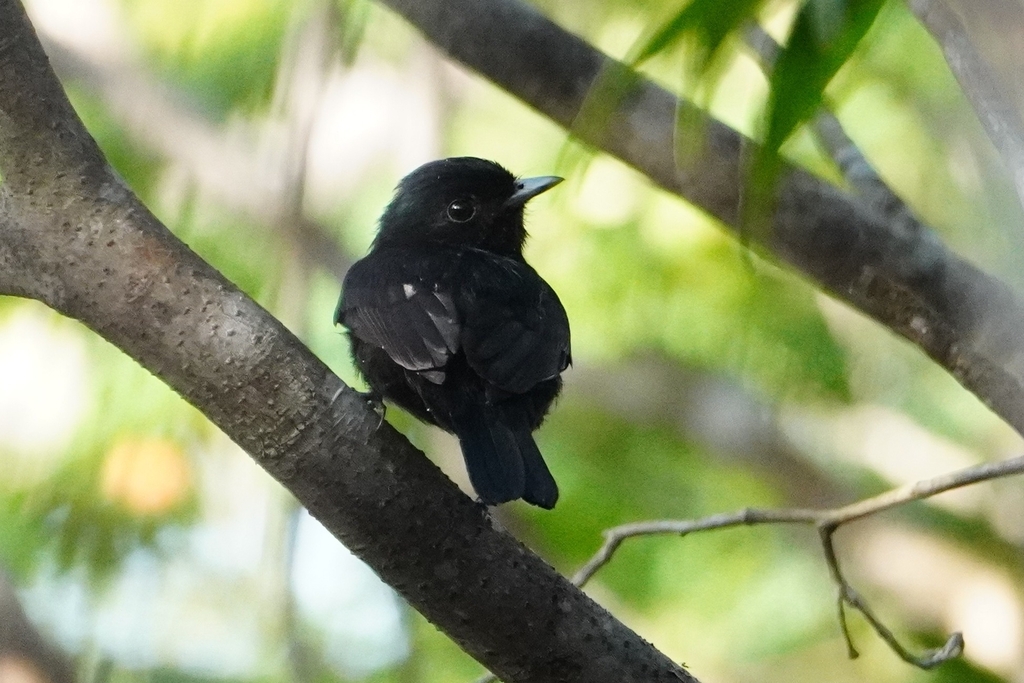
Black Manakin
Photo © Ben Costamagna
Photo © Ben Costamagna — CC BY 4.0 — Source: iNaturalist #259158508Identification
The black manakin is a small passerine, measuring 12 to 13 cm in length and weighing 12.5 to 18 grams. Sexual dimorphism is pronounced in this species. Males are striking in their almost entirely glossy black plumage, though the wings and tail are noticeably duller and browner than the body. Females present a completely different appearance, with dark olive upperparts, a grayish throat, and yellowish olive underparts. Both sexes share distinctive features: a dark brown iris, dark olive-gray legs and feet, and a notably heavy bill. Males have a pale bluish-gray bill, while females show a blackish upper mandible contrasting with a pale bluish-gray lower mandible.
Range & Habitat
The black manakin exhibits a highly disjunct distribution across the northwestern Amazon Basin and central Brazilian Amazonia. Its range spans eight countries: Colombia, Venezuela, Guyana, Suriname, French Guiana, Brazil, Peru, and Bolivia. One substantial population extends from Meta Department in Colombia eastward across northern Brazil and Venezuela, encompassing much of Guyana and northern Suriname. A second large population occupies central Amazonian Brazil, with smaller scattered populations in Peru and Bolivia. The species inhabits diverse semi-open landscapes including savanna woodlands, gallery forests, thickets, and stunted várzea, particularly on nutrient-poor sandy soils. Elevational range varies by region, reaching up to 1,200 meters in Venezuela but remaining mostly below 700 meters elsewhere.
Behaviour & Diet
The black manakin is a year-round resident throughout its range. It forages primarily on fruits and insects, gleaning prey from foliage and branches with short aerial sallies from a perch. Although typically solitary, two or three individuals may feed in the same tree, and the species regularly participates in mixed-species feeding flocks. Males display at leks to attract females, though their courtship is notably unspectacular, consisting mainly of calling and chasing. The species produces a variety of loud, sharp vocalizations including skee, kip-kip-kip-krrr (with numerous variations), a dry rattling trrrrrrrrrup, and a high-pitched chirping writ wit wit that varies in pitch.
Best Time & Places to See It
Year-round residency makes the black manakin potentially observable throughout the year in suitable habitat. However, its patchy distribution and variable abundance across its range should inform planning. The species is considered fairly common in Colombia and Venezuela, and locally fairly common in Peru, making these countries promising destinations for sightings. In Brazil, it is fairly common in the two large defined ranges but rare to uncommon between them. The best approach involves seeking out gallery forests, savanna woodlands, and várzea habitat in these regions, listening for its distinctive loud calls that often betray its presence in the canopy.
Photography Tips
The glossy black plumage of males presents both opportunities and challenges for photographers. Use faster shutter speeds to freeze movement, as males are active foragers. Backlighting can accentuate the iridescent quality of male plumage. The contrast between male and female plumage makes photographing both sexes particularly rewarding for comprehensive documentation. Early morning, when feeding activity peaks and light conditions are optimal, offers the best opportunities. The species' preference for perching and making short sallies to snatch prey provides predictable windows for photography. Patient observation of a single feeding area may yield multiple passes by individuals, increasing your chances of obtaining sharp, well-composed images.
Anavilhanas National Park
Mapinguari National Park
Natural Sierra de Chiribiquete National Park
Natural Sierra de la Macarena National Park
Serra da Cutia National Park
Serra do Divisor National Park
Viruá National Park
Nothing matches these filters.
No community photos yet. Log in to add the first one.
No community observations of this species yet.