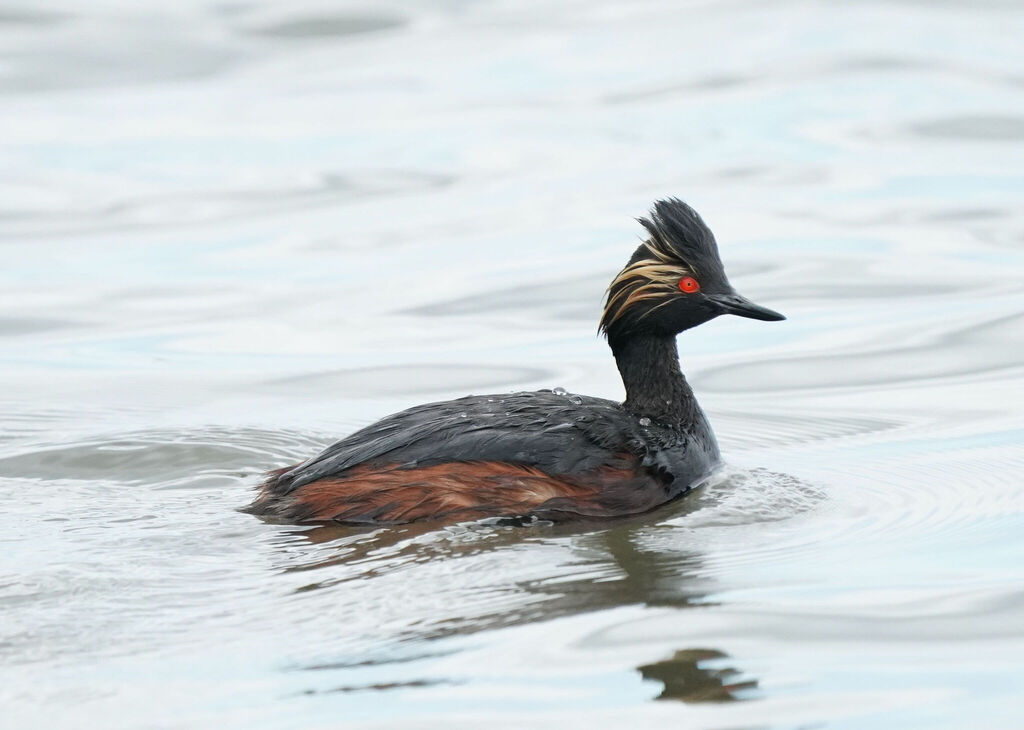
Black-necked Grebe
Photo © Pam Hardy
Photo © Pam Hardy — CC BY 4.0 — Source: iNaturalist photo #653974131Identification
The black-necked grebe is a striking water bird, measuring 28–34 centimetres in length with a wingspan of 52–60 centimetres depending on subspecies. In breeding plumage, it is unmistakable: the head, neck, and breast are glossy black to blackish-brown, contrasted by distinctive ochre-coloured feathers that fan behind the eye and over the ear coverts, giving the bird its "eared" alternative name. The eye is vivid bright red with an orange-yellow orbital ring, while the thin, upturned bill is black. The flanks display tawny rufous to maroon-chestnut colouring, and the abdomen is white.
Non-breeding plumage is far more subdued: the bird becomes greyish-black above with a distinctive vertical stripe on the back of the neck, while the body is predominantly white or whitish. Juveniles are browner in their darker areas. Males are on average heavier than females, weighing 215–450 grams.
Range & Habitat
The black-necked grebe is present across parts of Africa, Eurasia, and the Americas, making it one of the most geographically widespread grebe species. This aquatic bird favours open lakes and water bodies suitable for nesting and feeding. It shows a remarkable capacity for long-distance migration, travelling as far as 6,000 kilometres to reach moulting areas, and becomes flightless for at least a month during this period to moult safely. During moult, the grebe can double in weight, requiring access to productive feeding grounds.
Behaviour & Diet
The black-necked grebe is an accomplished forager employing multiple techniques to obtain food. Insects, which constitute the majority of its diet, are caught either on the water surface or in flight, and the bird occasionally gleans foliage. To supplement its diet, it dives to catch crustaceans, molluscs, tadpoles, small frogs, and fish. When moulting at saline lakes, it feeds predominantly on brine shrimps.
Breeding biology is adapted to life on water: the bird constructs a floating cup nest with a protective disc cover on open lakes, nesting both colonially and solitarily depending on location. The breeding season varies by location, with females typically laying one clutch of three to four eggs, sometimes increased through brood parasitism. After a 21-day incubation, chicks fledge in approximately three weeks, with parents splitting chick-rearing duties after about ten days.
Best Time & Places to See It
The black-necked grebe is likely the world's most numerous grebe species, classified as least concern by the IUCN despite significant migration hazards. The best viewing opportunities depend on local breeding seasons and migration patterns, which vary across its wide geographic range spanning Africa, Eurasia, and the Americas. Look for breeding birds on open lakes during the breeding season, and watch for migrants during movement periods. Saline lakes are particularly productive during moulting periods.
Photography Tips
Photograph breeding birds to capture their spectacular plumage: the vivid red eye, ochre ear-coverts, and glossy black neck provide striking contrast and colour. The bird's aquatic lifestyle means shooting from the water level or low angles will enhance impact. Early morning light will illuminate the eye and emphasize the iridescent quality of breeding plumage. Non-breeding birds are far more subtle; patience and longer lenses are essential for capturing details of the grey and white winter dress. Since the species avoids flight, it is relatively approachable on water, but approach slowly to avoid disturbance, particularly during breeding season when birds are nesting openly on lakes.
Private Full-Day Birdwatching Tour from Lisbon to the Sado Estuary
Private Full-Day Birdwatching Tour from Lisbon to the Tagus Estuary
Nothing matches these filters.
Abijata-Shalla Lakes National Park
Abruzzo, Lazio and Molise National Park
Addo Elephant National Park
Agulhas National Park
Alaska Maritime National Wildlife Refuge
Alligator River National Wildlife Refuge
Alpilles Regional Nature Park
Alta Murgia National Park
Altai Tavan Bogd National Park
Nothing matches these filters.
No community photos yet. Log in to add the first one.
No community observations of this species yet.