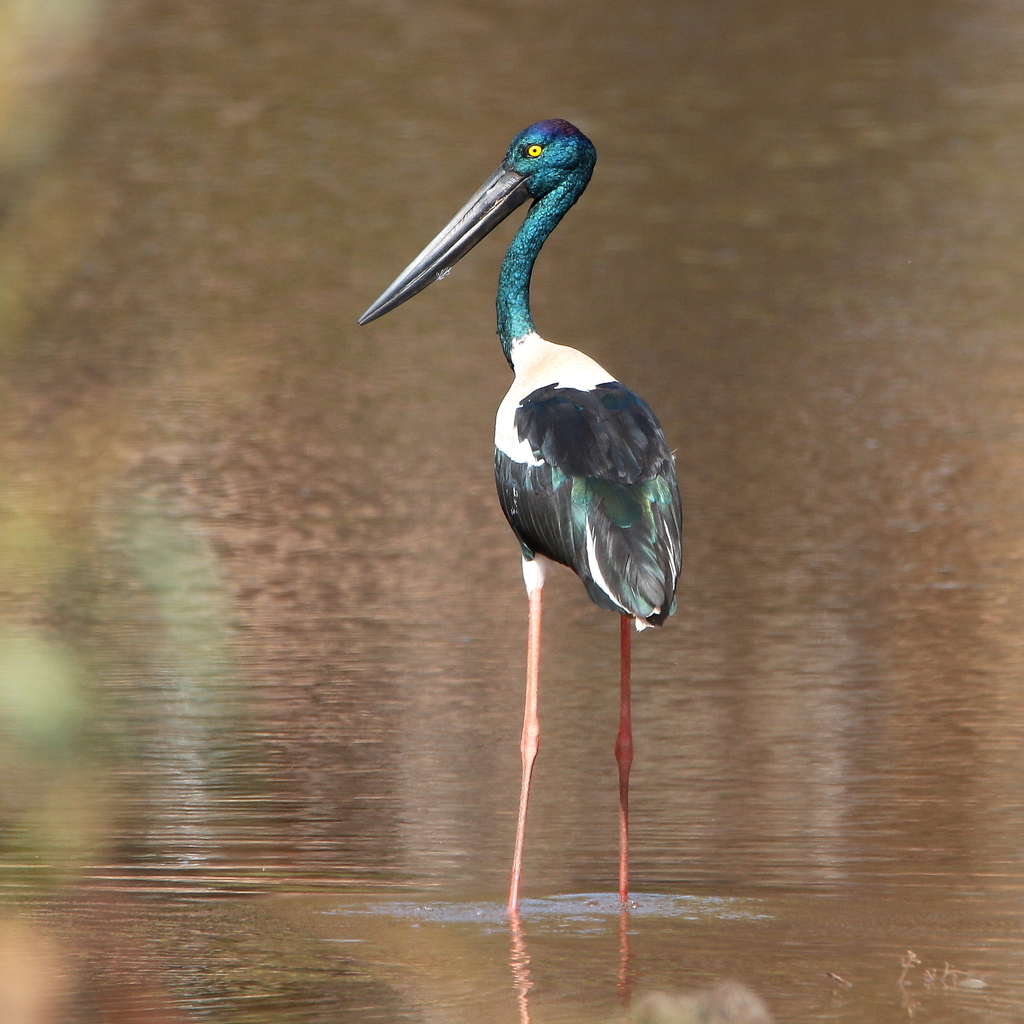
Black-necked Stork
Photo © Graham Winterflood
Photo © Graham Winterflood — CC BY-SA 4.0 — Source: iNaturalist #91692603Identification
The black-necked stork is a large wading bird standing 110–137 cm tall with a wingspan of 190–218 cm. Adults are unmistakable: glossy bluish-black iridescent head, neck, secondary flight feathers and tail contrast sharply with a bright white back and belly. The crown is coppery-brown, the bill is black with a slightly concave upper edge, and legs are bright red. A key field mark for sexing is iris colour—females have yellow irises while males have dark brown irises, making this one of the few stork species showing marked sexual dimorphism. In flight, the bird appears distinctive with a black bar running through the white wings, black neck and tail creating a striking silhouette as it flies with neck outstretched.
Juveniles differ noticeably from adults, undergoing plumage changes as they mature. Younger birds have a brownish iris, smaller and straighter beak, fluffy appearance, brown head and neck with white belly, and dark legs. Older juveniles develop a mottled appearance with partly developed iridescence, dark-brown outer primaries contrasting with white inner primaries that form a shoulder patch when wings are closed, and dark to pale-pink legs.
Range & habitat
This resident stork is distributed across the Indian subcontinent and Southeast Asia, with a disjunct population in Australia. In India, it is widespread in the west, central highlands, and northern Gangetic plains extending east into the Assam valley, though rare in peninsular India and Sri Lanka. It occurs as an occasional straggler in southern and eastern Pakistan and is a confirmed breeding species in central lowland Nepal, extending through Southeast Asia into New Guinea.
The largest population occurs in Australia, ranging from the Ashburton River near Onslow in Western Australia across northern Australia to north-east New South Wales, extending inland through the Kimberley area and Northern Territory with records reaching the north-west plains of New South Wales. The species inhabits wetland habitats and fields of crops such as rice and wheat where it forages for prey. Compared to other large waterbirds, black-necked storks are least abundant in locations with high diversity of large waterbird species.
Behaviour & diet
The black-necked stork is one of the few stork species that are strongly territorial when feeding and breeding. It forages for a wide range of animal prey in wetlands and agricultural areas, exploiting the rich feeding opportunities provided by rice and wheat fields alongside natural wetland habitats.
Best time & places to see it
In Asia, seek this species in wetland areas and agricultural regions across India, Nepal, and Southeast Asia. Australia offers the most reliable populations, particularly in northern coastal regions and inland waterways from Western Australia through the Northern Territory and Queensland. Wetland habitats with suitable feeding grounds offer the best chances of encounter.
Photography tips
The striking contrast between white and iridescent black plumage provides excellent photographic opportunities. Capture the bird in flight to showcase the distinctive black bar through white wings and the outstretched neck. The bright red legs and bill stand out well against darker backgrounds. If you can observe pairs together, attempt to photograph both sexes to document the diagnostic iris colour difference—yellow in females, dark brown in males. Early morning light will enhance the glossy iridescent qualities of the black plumage.
Lunugamvehera National Park
Sri Lanka
+204 birds+14 mammals
Dry scrubland and shallow wetlands converge in Sri Lanka's southeastern lowlands, where Lunugamvehera National Park anchors one of the island's most ecologically vital landscapes. The park's…
VIEW NATIONAL PARKOrang National Park
Rangagarapathar, India
+298 birds+1 mammals
Where the Brahmaputra's floodplains meet the foothills of Assam, Orang National Park unfolds across a mosaic of riverine grasslands, forests and wetlands that pulse with the…
VIEW NATIONAL PARKRanthambhore National Park
Sawai Madhopur, India
+294 birds+20 mammals
Granite ridges and ravines carved through the Aravalli Range frame this protected landscape in eastern Rajasthan, where deciduous forest mingles with open scrubland and seasonal water…
VIEW NATIONAL PARKMount Coolum National Park
Sunshine Coast, Australia
+124 birds+3 mammals
Rising abruptly from the hinterland plateau of Queensland's Sunshine Coast, Mount Coolum commands attention as a distinctive volcanic remnant clothed in open eucalypt woodland and heathland…
VIEW NATIONAL PARKKakadu National Park
Kakadu, Australia
+273 birds+46 mammals
Kakadu National Park is Australia’s largest national park and one of the world’s most remarkable protected areas, covering nearly 20,000 square kilometres in the tropical north…
VIEW NATIONAL PARKDaintree National Park
Dedin, Australia
+362 birds+37 mammals
Daintree National Park is one of the world’s oldest and most biologically diverse tropical rainforests, protecting an extraordinary landscape where ancient forests meet the Great Barrier…
VIEW NATIONAL PARKLockyer National Park
Australia
+130 birds+5 mammals
Steep ridges and weathered escarpments rise from the Brisbane Valley in southeastern Queensland, where Lockyer National Park sprawls across 267 square kilometres of eucalypt woodland and…
VIEW NATIONAL PARKGheebulum Kunungai National Park
Moreton Island, Australia
+168 birds+7 mammals
Sand dunes rise and fall across Moreton Island's eastern shore, a landscape sculpted by wind and ocean currents into one of Australia's most dynamic coastal ecosystems.…
VIEW NATIONAL PARKAnnan River (Yuku Baja-Muliku) National Park
Australia
+78 birds
Where the Annan River winds through northeastern Queensland's coastal hinterland, a compact national park of roughly 246 square kilometers protects a mosaic of subtropical rainforest, eucalypt…
VIEW NATIONAL PARKEndeavour River National Park
Philadelphia, Australia
+203 birds+1 mammals
Where the Endeavour River winds through northeastern Queensland's tropical lowlands, a compact mosaic of rainforest, open woodland, and riverine corridor creates one of Australia's most ecologically…
VIEW NATIONAL PARKRinyirru National Park
Lakefield, Australia
+258 birds+7 mammals
Where the savanna grasslands of far north Queensland meet seasonal wetlands and eucalypt woodlands, Rinyirru National Park sprawls across more than 12,500 square kilometres of rugged,…
VIEW NATIONAL PARKBribie Island National Park
Brisbane, Australia
+284 birds+20 mammals
Across tidal flats and shallow waterways north of Brisbane, Bribie Island National Park spreads across nearly four hundred square kilometres of subtropical coastal wilderness—a patchwork of…
VIEW NATIONAL PARKPanna National Park
Badgadi Kalan, India
+271 birds+17 mammals
Where granite gorges slice through central India's Vindhyan plateau, a landscape of stark beauty unfolds across nearly six hundred square kilometers. The Ken River carves through…
VIEW NATIONAL PARKKaziranga National Park
Kohora, India
+422 birds+26 mammals
Dawn breaks over the floodplains of the Brahmaputra, where tall grasslands stretch endlessly beneath monsoon-heavy skies. This sprawling wilderness of northeastern Assam is a mosaic of…
VIEW NATIONAL PARKKeoladeo National Park
Shreenagar Rural, India
+326 birds+14 mammals
Where shallow wetlands shimmer beneath vast Rajasthani skies, one of Asia's finest bird sanctuaries pulses with extraordinary life. This former maharaja's hunting reserve, now spanning 29…
VIEW NATIONAL PARKLitchfield National Park
Australia
+175 birds+15 mammals
Where weathered sandstone plateaus rise above the savanna woodlands of Australia's Top End, Litchfield National Park unfolds as a landscape of dramatic contrasts shaped by a…
VIEW NATIONAL PARKGreat Sandy National Park
Australia
+306 birds+40 mammals
Where coastal dunes rise inland from the Queensland coastline, Great Sandy National Park encompasses a landscape of remarkable ecological diversity shaped by subtropical humid conditions year-round.…
VIEW NATIONAL PARKGirringun National Park
Australia
+231 birds+10 mammals
Where granite gorges cleave through subtropical woodland in North Queensland, Girringun National Park unfolds across rugged terrain shaped by millions of years of weathering and erosion.…
VIEW NATIONAL PARKWooroonooran National Park
Australia
+240 birds+28 mammals
Where the Great Dividing Range rises sharply inland from Queensland's tropical coast, Wooroonooran National Park encompasses a landscape of steep, forested gorges and cascading waterways carved…
VIEW NATIONAL PARKNoosa National Park
Marcus Beach, Australia
+216 birds+8 mammals
Subtropical eucalypt woodland and open forest meet coastal heathland along the Noosa Peninsula, where the temperate waters of the Tasman current moderate the Queensland climate into…
VIEW NATIONAL PARKBoodjamulla National Park
Australia
+142 birds+3 mammals
Where red sandstone gorges carve through the semi-arid interior of far north Queensland, Boodjamulla National Park reveals a landscape shaped by seasonal water availability and ancient…
VIEW NATIONAL PARKPurnululu National Park
Australia
+114 birds
Towering sandstone domes and dramatic gorges carved by seasonal watercourses define this remote corner of the Kimberley, where ancient rock formations create a maze of narrow…
VIEW NATIONAL PARKNo community photos yet. Log in to add the first one.
No community observations of this species yet.