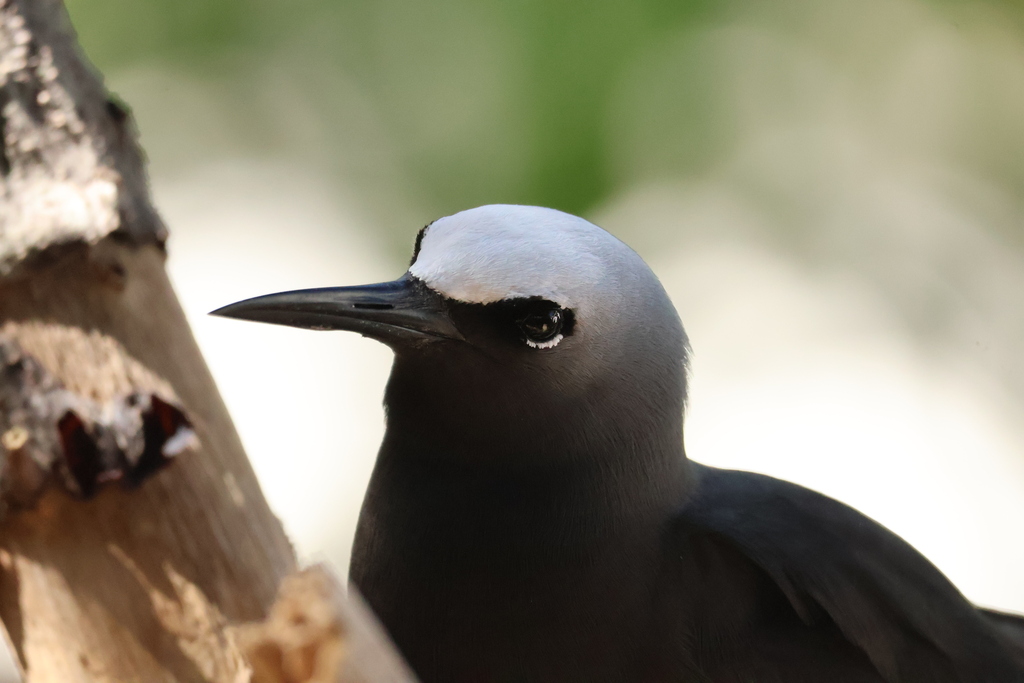
Black Noddy
Photo © Patrick Connolly
Photo © Patrick Connolly — CC BY 4.0 — Source: iNaturalist photo #574610269Identification
The black noddy is a medium-sized tern measuring 35–37 cm in length with a wingspan of 66–72 cm and weighing 98–144 g. It is characterized by dark plumage contrasting with a distinctive pale white crown, earning it the alternative name "white-capped noddy". Small white crescents appear under each eye, with a white spot above. The bird has long, tapering wings and a truncated tail, with a sharply pointed black bill and fully webbed black feet (orange in the Hawaiian subspecies). It closely resembles the lesser noddy but can be distinguished by slightly darker overall plumage and dark lores rather than pale ones.
Range & Habitat
The black noddy has a worldwide distribution across tropical and subtropical seas. Seven subspecies are recognized, ranging from the Sulu Sea through the Pacific Ocean to the Hawaiian Islands, Micronesia, the Tuamotu Archipelago, and across the Caribbean and Atlantic. The species is found from Clipperton Island off western Mexico to the Kermadec Islands in the southwestern Pacific. At sea, birds are typically seen within 80 km of their breeding colonies, returning to them or other islands to roost at night.
Behaviour & Diet
Black noddies derive their common name from their distinctive breeding display, in which both sexes constantly dip their heads. They are remarkably tolerant of humans and can even be picked up off the nest. These birds feed on fish and squid, which they gather by flying low over the sea surface and picking prey items directly from the water. They often associate with other seabirds in areas where predatory fish drive small prey to the surface. Nests consist of level platforms constructed in tree branches from dried leaves covered with bird droppings, with Pisonia trees being particularly favored. A single egg is laid each season, and nests are reused in subsequent years. The abundant guano produced by these colonies significantly enriches soil on coral islands, playing an important role in supporting island plant communities.
Best Time & Places to See It
Black noddies can be reliably found at their established breeding colonies throughout the tropical and subtropical Pacific, Caribbean, and Atlantic. The Rock Islands of Palau, Hawaiian archipelago, and various Micronesian locations offer excellent opportunities for observation. Since birds return to colonies at night, dawn and dusk visits to known roosting sites increase chances of sightings. The species' tolerance of human presence makes it approachable compared to many other seabirds.
Photography Tips
The black noddy's dark plumage against pale tropical skies and blue water provides striking contrast for photography. Photograph birds during their characteristic head-dipping displays at breeding colonies for behaviorally interesting images. Early morning and late afternoon light enhances the subtle distinction between the dark body plumage and pale crown. Since these birds are exceptionally tolerant of humans, you can approach closely for detailed shots of the distinctive white eye markings and pointed bill. Capture birds in flight low over water to showcase their long, tapering wings in action.
Hawaiʻi Volcanoes National Park
Hawaiʻi County, United States
+84 birds+2 mammals
Where volcanic slopes descend toward the Pacific across more than five thousand square kilometers, Hawaiʻi Volcanoes National Park presents one of Earth's most dynamic laboratories of…
VIEW NATIONAL PARKMorrocoy National Park
Municipio Silva
+290 birds
Where the Caribbean coast of northwestern Venezuela meets protected coastal waters, a mosaic of mangrove forests, sandy beaches, and coral reef systems defines Morrocoy National Park.…
VIEW NATIONAL PARKDaintree National Park
Dedin, Australia
+362 birds+37 mammals
Daintree National Park is one of the world’s oldest and most biologically diverse tropical rainforests, protecting an extraordinary landscape where ancient forests meet the Great Barrier…
VIEW NATIONAL PARKGheebulum Kunungai National Park
Moreton Island, Australia
+168 birds+7 mammals
Sand dunes rise and fall across Moreton Island's eastern shore, a landscape sculpted by wind and ocean currents into one of Australia's most dynamic coastal ecosystems.…
VIEW NATIONAL PARKEndeavour River National Park
Philadelphia, Australia
+203 birds+1 mammals
Where the Endeavour River winds through northeastern Queensland's tropical lowlands, a compact mosaic of rainforest, open woodland, and riverine corridor creates one of Australia's most ecologically…
VIEW NATIONAL PARKWhitsunday Islands National Park
Whitsundays, Australia
+163 birds+9 mammals
Crystalline waters lap against seventy-four islands where rainforest canopies tumble down to pristine beaches and coral gardens flourish in the shallows. This archipelago off Queensland's coast…
VIEW NATIONAL PARKParque Nacional Arrecife Alacranes
Chicxulub, Mexico
+93 birds
Coral formations rise from turquoise shallows off the Yucatán Peninsula, their limestone skeletons built over millennia into a living archipelago where the Caribbean meets the Gulf…
VIEW NATIONAL PARKGreat Sandy National Park
Australia
+306 birds+40 mammals
Where coastal dunes rise inland from the Queensland coastline, Great Sandy National Park encompasses a landscape of remarkable ecological diversity shaped by subtropical humid conditions year-round.…
VIEW NATIONAL PARKDry Tortugas National Park
Monroe County, United States
+211 birds+1 mammals
Seventy miles west of Key West, where the Gulf of Mexico surrenders to the Atlantic, lies a constellation of low coral keys that rise barely above…
VIEW NATIONAL PARKHaleakalā National Park
Maui County, United States
+66 birds+4 mammals
Ascending from sea level to over 10,000 feet across a mere thirty miles, Haleakalā National Park commands one of the Pacific's most dramatic elevation gradients, where…
VIEW NATIONAL PARKNational Park of American Samoa
Leusoaliʻi, United States
+31 birds+1 mammals
The volcanic ridges of American Samoa rise steeply from the Pacific, their slopes cloaked in tropical rainforest that cascades down to a coast where reef systems…
VIEW NATIONAL PARKKīlauea Point National Wildlife Refuge
Kilauea, United States
+79 birds+1 mammals
At the northernmost tip of Kauai, where the Pacific trades collide with volcanic rock, Kīlauea Point National Wildlife Sanctuary crowns a dramatic headland overlooking one of…
VIEW WILDLIFE SANCTUARYMidway Atoll National Wildlife Refuge
United States
+91 birds+1 mammals
Straddling the international date line roughly midway between North America and Asia, this atoll sanctuary rises from the North Pacific as a cluster of coral and…
VIEW WILDLIFE SANCTUARYNo community photos yet. Log in to add the first one.
No community observations of this species yet.