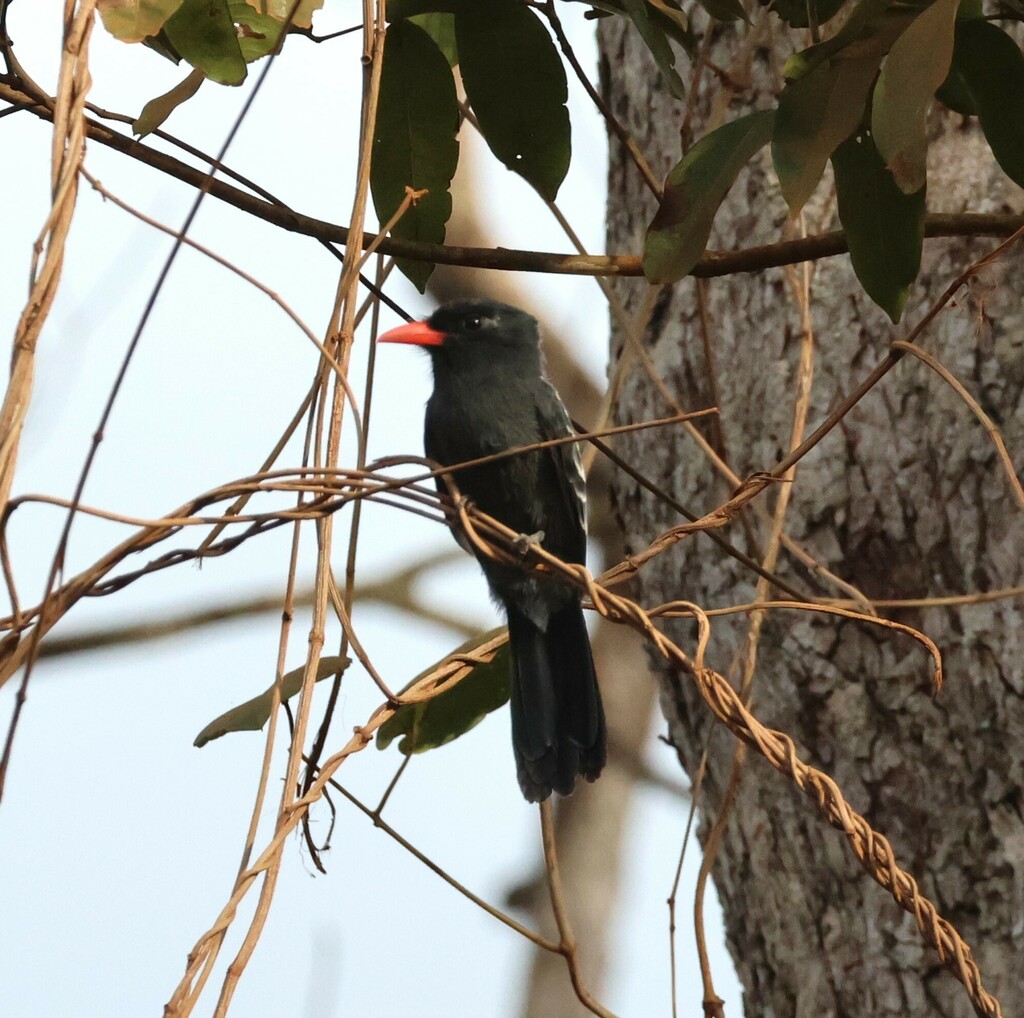
The black nunbird (Monasa atra) is a species of near-passerine bird in the family Bucconidae, the puffbirds, nunlets, and nunbirds. It is found in Brazil, French Guiana, Guyana, Suriname, and Venezuela. == Taxonomy and systematics == The black nunbird was described by the French polymath Georges-Louis Leclerc, Comte de Buffon in 1780 in his Histoire Naturelle des Oiseaux from a specimen collected in Cayenne, French Guiana. The bird was also illustrated in a hand-colored plate engraved by François-Nicolas Martinet in the Planches Enluminées D'Histoire Naturelle that was produced under the supervision of Edme-Louis Daubenton to accompany Buffon's text. Neither the plate caption nor Buffon's description included a scientific name but in 1783 the Dutch naturalist Pieter Boddaert coined the binomial name Calculus ater in his catalogue of the Planches Enluminées. The black nunbird is now placed in the genus Monasa that was introduced by the French ornithologist Louis Pierre Vieillot in 1816. The generic name is from the Ancient Greek monas meaning "solitary". The specific epithet atra is from the Latin ater meaning "black". The black nunbird is monotypic. Some authors treat it, the black-fronted nunbird (M. nigrifrons) and the white-fronted nunbird (M. morphoeus) as a superspecies. == Description ==…
Viruá National Park
Brazil
+389 birds+6 mammals
Across the northern frontier of Roraima, where the forest canopy rises from ancient Amazonian lowlands, Viruá National Park protects nearly 3,700 square kilometres of terra firme…
VIEW NATIONAL PARKAnavilhanas National Park
Brazil
+468 birds+8 mammals
Across the Rio Negro in central Amazonas, an archipelago of over a thousand islands rises from the world's largest rainforest river system, creating a labyrinth of…
VIEW NATIONAL PARKNo community photos yet. Log in to add the first one.
No community observations of this species yet.