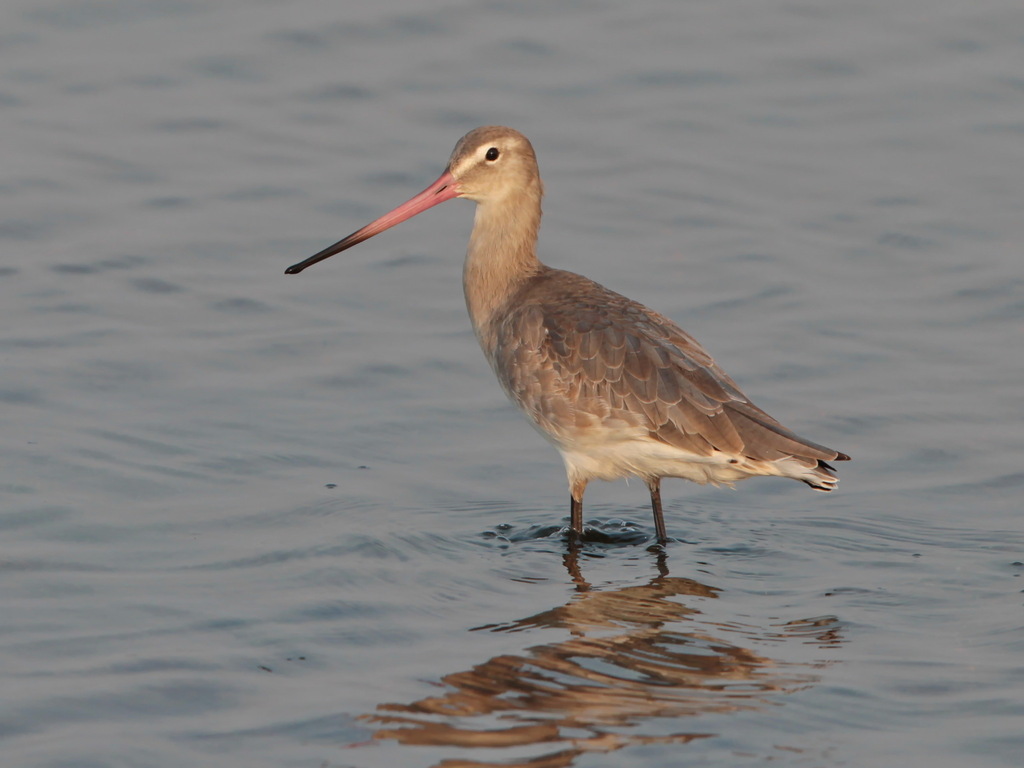
Black-tailed Godwit
Photo © Ian Dugdale
Photo © Ian Dugdale — CC BY 4.0 — Source: iNaturalist photo #546724112Identification
The black-tailed godwit is a large wader measuring 42 cm from bill to tail, with a wingspan of 70–82 cm. It is instantly recognisable in flight by its bold black and white wingbar and white rump, features visible at all times of year. The species has a characteristically long, straight bill (7.5 to 12 cm) and long legs that make it stand noticeably taller than the similar bar-tailed godwit.
In breeding plumage, the head, neck and chest display striking orange coloration, with males showing brighter and more extensive orange than females. During winter, adults adopt a uniform brown-grey breast and upperparts. The bill has a yellowish or orange-pink base with a dark tip during breeding season, turning pink in winter. Juveniles show a pale orange wash on the neck and breast. The most common call is a strident "weeka weeka weeka."
Range & Habitat
Black-tailed godwits breed across a discontinuous range stretching from Iceland through Europe to the far east of Russia, with four recognised subspecies. Their breeding habitat includes river valley fens, lake edges, damp meadows, moorlands and bogs, with populations increasingly using secondary habitats such as lowland wet grasslands, coastal grazing marshes and even agricultural fields in parts of western Europe.
The species is considerably more likely to be found on inland wetlands than its coastal cousin, the bar-tailed godwit. Wintering birds are highly dispersed, with Icelandic populations spending winter in the United Kingdom, Ireland, France and the Netherlands, while European birds migrate to west Africa, and Asian populations reach as far as Australia and New Zealand. On wintering grounds, they favour swamps, floods, irrigated paddy fields, inland pools and marshes.
Behaviour & Diet
Black-tailed godwits are gregarious birds that migrate in substantial flocks to their wintering grounds across western Europe, Africa, south Asia and Australia. In spring, they feed largely in grasslands before moving to muddy estuaries after breeding and for winter. Young birds from European populations typically remain in Africa after their first winter, returning to Europe only at the age of two years.
The species exhibits strong sexual dimorphism in breeding plumage, with males displaying brighter orange colouration than females, though otherwise the sexes are similar. Females are approximately 5% larger than males with bills 12–15% longer. First-year mortality is significant at 37.6%, declining to 32% in the second year and 36.9% thereafter, though the species is known to be long-lived, with records of individuals reaching over 29 years of age.
Best Time & Places to See It
Black-tailed godwits can be found year-round in parts of Ireland and Great Britain, though the breeding and wintering populations are distinct. In northern European breeding grounds, the species is present from spring through summer. Inland wetlands, grasslands and marshes are the best habitats to search, particularly river valleys, lake edges and coastal grazing marshes. Flocking behaviour makes larger concentrations more likely at important stopover sites during migration periods.
The world population is estimated at 634,000 to 805,000 birds, classified as Near Threatened. Wintering grounds offer excellent opportunities for observation, particularly in west African countries, the Indian subcontinent, and across the Mediterranean region. Breeding populations are most active during spring and early summer in Iceland and northern Europe.
Photography Tips
The bird's bold black and white wingbar is the most dramatic field mark and is best captured in flight photography. Focus on capturing the white rump and distinctive wing pattern, which are visible regardless of season. The striking orange breeding plumage provides excellent colour contrast, particularly when photographing males during the breeding season.
In breeding habitat, patience near wet grasslands and marshy areas during spring will reward photographers with opportunities to capture the species' characteristic upright posture and long-legged stance. The uniform brown-grey winter plumage is more subtle, requiring attention to the bird's proportions—the notably long, straight bill and tall stance—to distinguish it from similar species. Early morning light in spring grasslands will illuminate the orange head and neck colouration most effectively.
Private Full-Day Birdwatching Tour from Lisbon to the Tagus Estuary
Week-long Birdwatching Programme in Northern & Central Portugal
Nothing matches these filters.
Mabamba Swamp
Murchison Falls National Park
Queen Elizabeth National Park
Abel Tasman National Park
Abijata-Shalla Lakes National Park
Alaska Maritime National Wildlife Refuge
Amboseli National Park
Arabuko Sokoke Forest Reserve
Avesnois Regional Nature Park
Nothing matches these filters.
No community photos yet. Log in to add the first one.
No community observations of this species yet.