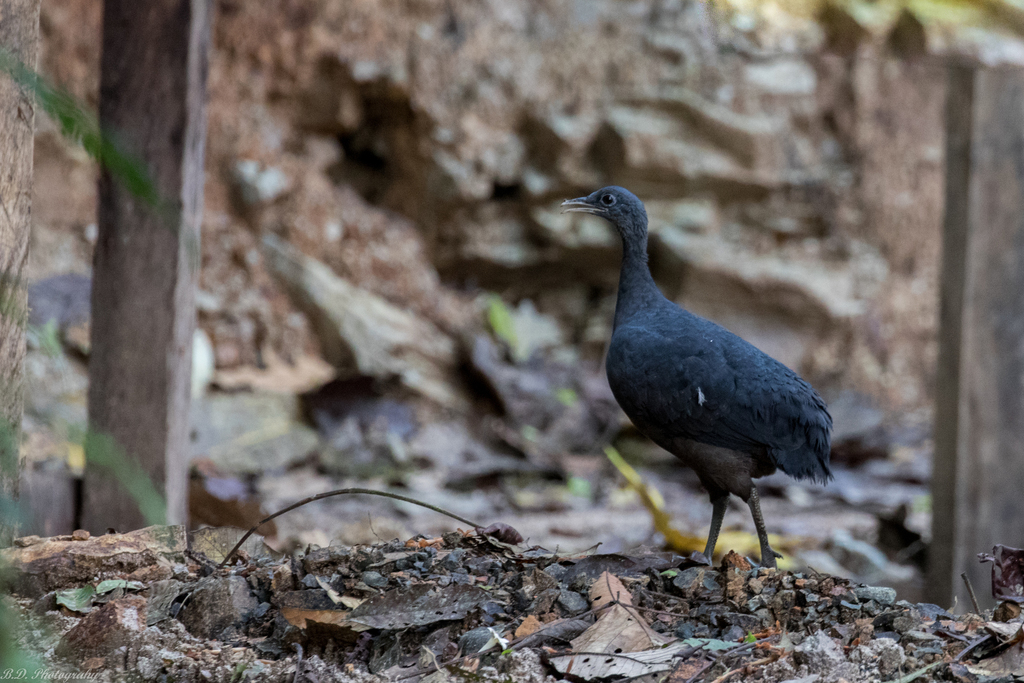
Black Tinamou
Photo © Blair Dudeck
Photo © Blair Dudeck — CC BY 4.0 — Source: iNaturalist #44319424Identification
The black tinamou is a stocky, ground-dwelling bird measuring 40–46 cm in length, with females slightly larger than males. Despite its name, it is primarily slate grey rather than black, with uniform grey upperparts, sooty brown lower breasts and flanks, and a rufescent vent. Its greater wing coverts are sometimes edged with brown, and it has a black maxilla contrasting with a light grey mandible, blue-grey legs, and dark brown eyes. Adolescent birds are similar in coloration but display whitish spots on their wing coverts. The species produces a distinctive tremulous, descending whistle lasting about one second, similar to that of the white-throated tinamou.
Range & Habitat
The black tinamou is found in humid foothill and montane forests of the South American Andes across Colombia, Ecuador, and Peru. Two subspecies occupy different elevational zones: T. o. hershkovitzi inhabits the Colombian Andes at 1,400–2,100 metres, while T. o. osgoodi occurs on the east slope of the Peruvian Andes at 900–1,400 metres, locally reaching 2,100 metres. The species has been recorded in several protected areas including Megantoni National Sanctuary, Manú National Park, and Sira Communal Reserve in Peru; Sumaco Napo-Galeras National Park in Ecuador; and Cueva de los Guácharos National Park in Colombia.
Behaviour & Diet
Very little is documented about black tinamou behavior, though it is presumed to be similar to other tinamou species. The bird is primarily ground-dwelling, and nuts have been found in the crop of examined specimens, indicating a diet that likely includes seeds and plant matter typical of tinamous. Tinamous are notable within their infraclass as the only members capable of flight, albeit poorly, and are the closest living relatives to prehistoric flying birds.
Best Time & Places to See It
The black tinamou is now rare throughout its range, with few recent records from Colombia and formerly locally common areas in Peru. The species is rated as Vulnerable, with fewer than 10,000 individuals estimated to remain. Protected reserves offer the best chance of encounters, particularly Manú National Park and Megantoni National Sanctuary in Peru. Adults in breeding condition have been recorded between March and November, with chicks observed in February, potentially offering seasonal advantages for observation.
Photography Tips
Photographing the black tinamou presents significant challenges given its rarity, ground-dwelling habits, and preference for dense forest understorey. The bird's cryptic slate-grey plumage provides excellent camouflage in montane forest settings, making detection difficult. Early morning hours may offer better light in the forest interior and coincide with increased vocalization. Patient observation combined with knowledge of the species' whistled calls will improve chances of locating individuals. A telephoto lens is essential for distant work in dense vegetation, and high ISO settings will be necessary given the dim forest environment.
Sumaco Napo-Galeras National Park
Loreto, Ecuador
+563 birds+4 mammals
Where Ecuador's Amazon transitions into cloud forest, a massive shield volcano rises from the emerald lowlands of Orellana Province, anchoring one of the continent's most biodiverse…
VIEW NATIONAL PARKAntisana National Park
Quijos, Ecuador
+432 birds+21 mammals
Where the eastern Andean slopes descend into the Amazon basin, Antisana National Park sprawls across roughly 2,500 square kilometers of some of South America's most dramatic…
VIEW NATIONAL PARKNatural Serranía de los Churumbelos National Park
Santa Rosa, Colombia
+70 birds+2 mammals
Where the western cordillera of Colombia rises toward the Pacific watershed, the Serranía de los Churumbelos unfolds across more than 3,200 square kilometers of some of…
VIEW NATIONAL PARKManu National Park
Manu, Peru
+892 birds+26 mammals
Across the eastern slopes of the Peruvian Andes, tropical rainforest descends into the Amazon basin with a complexity that few terrestrial ecosystems match. Manu National Park…
VIEW NATIONAL PARKNo community photos yet. Log in to add the first one.
No community observations of this species yet.