Identification
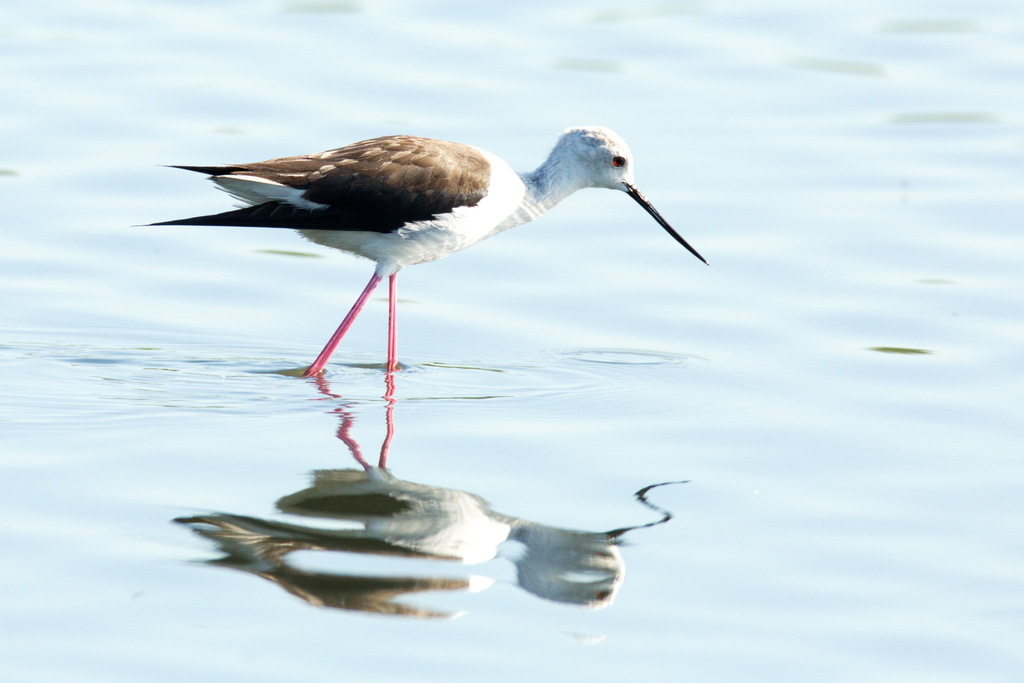
The black-winged stilt is an unmistakable wader with strikingly long, thin pink legs that seem almost impossibly elongated for its slender body. Adults measure 33–36 cm in length and are boldly patterned in black and white, with a long, rather thin black bill. Males display a glossy black back, often with a greenish sheen, while females have a browner-toned back that contrasts sharply with black flight feathers. Both sexes have white underparts and a white head and neck, though the amount of black on the head varies between individuals and seasons—males typically show more extensive black plumage, particularly in summer, while females tend to have less black year-round. In winter, males often lose their black head feathers entirely. Immature birds are greyish overall with a sandy hue on the wings and whitish feather fringes that create a pale line in flight.
Range & Habitat
The black-winged stilt is a widely distributed wader found across Europe, Asia, and Africa. The species prefers breeding habitats of marshes, shallow lakes, and ponds, where it nests during the breeding season. Some populations are migratory, moving to coastal areas in winter, while birds in warmer regions tend to be resident or undertake only short-range movements. In Europe, the species is a regular spring overshoot vagrant, periodically appearing north of its usual range; in recent decades it has established breeding populations in previously unoccupied northern regions, with successful breeding recorded in Britain since 1987.
Behaviour & Diet
Like other stilts and avocets, the black-winged stilt is a wading bird adapted to feeding in shallow water. Its extremely long legs allow it to wade in deeper water than many other waders, while its thin bill is used to probe and pick food from the water surface and shallow substrate. The species is social and often seen in small groups or pairs, particularly during breeding season when they form pair bonds to raise their young in marshy wetland habitats.
Best Time & Places to See It
The black-winged stilt is best observed in its breeding habitat of marshes and shallow wetlands during the spring and summer months. In Europe, spring overshoots may bring birds north of their normal range. Coastal areas are favored by wintering populations in migratory regions. Travellers interested in seeing this species should visit wetland reserves and coastal lagoons during the appropriate season for their geographic location.
Photography Tips
The stilt's striking black-and-white plumage and impossibly long pink legs make it highly photogenic. Position yourself low and near the water's edge to emphasize those distinctive legs against the water or wetland background. Early morning and late afternoon light will enhance the subtle greenish gloss on males' backs. The bird's preference for shallow water habitats provides excellent opportunities for reflection shots. Be patient in marshes and shallow lakes, as stilts often remain in open areas where they can be approached carefully and photographed with clear views of their elegant silhouette.