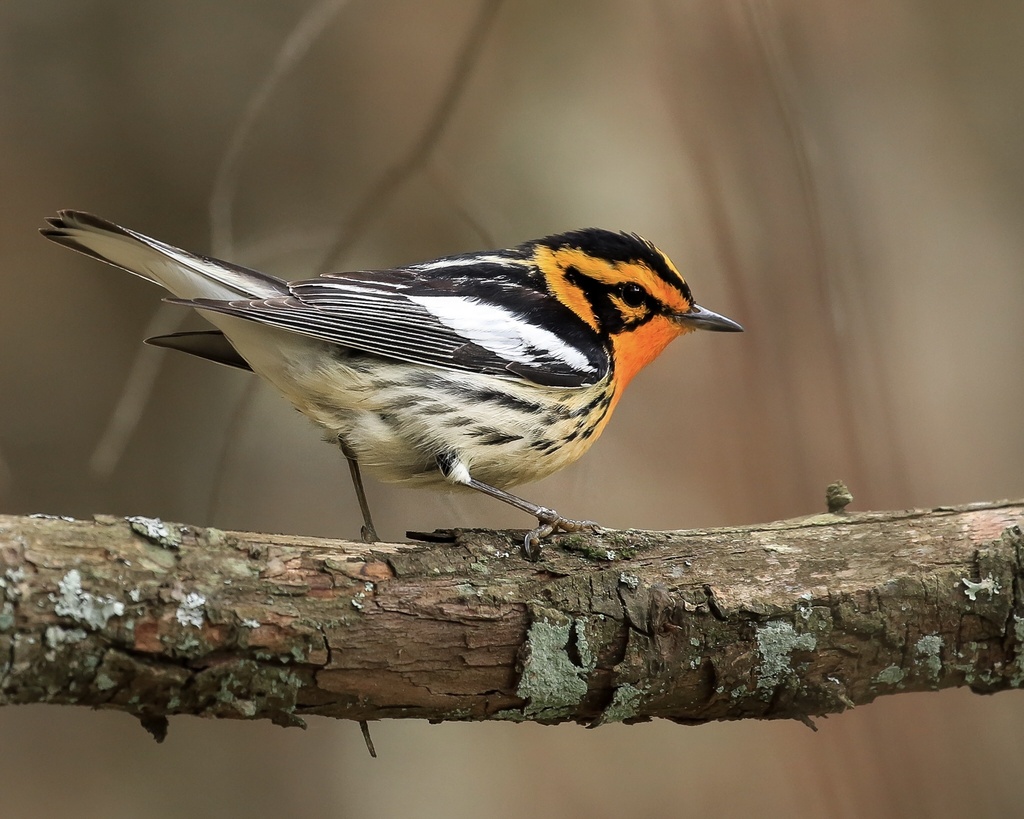
Blackburnian Warbler
Photo © Matt Felperin
Photo © Matt Felperin — CC BY 4.0 — Source: iNaturalist photo #367011938The Blackburnian warbler (Setophaga fusca) is a small New World warbler. They breed in eastern North America, from southern Canada, westwards to the southern Canadian Prairies, the Great Lakes region and New England, to North Carolina. They are migratory, wintering in southern Central America and South America, and are very rare vagrants to western Europe. The common name honors the English botanist Anna Blackburne. == Taxonomy == The Blackburnian warbler was formally described in 1776 by the German zoologist Philipp Statius Müller under the binomial name Motacilla fusca. The specific epithet is Latin meaning "dusky", "black" or "brown". Müller based his account on a handcoloured plate of the "Figuier étranger" that had been engraved by François-Nicolas Martinet to accommpany the Comte de Buffon's multivolume work Histoire Naturelle des Oiseaux. The type location is French Guiana. The Blackburnian warbler is now placed in the genus Setophaga that was introduced by the English naturalist William Swainson in 1827. The genus name Setophaga combines the Ancient Greek σης/sēs, σητος/sētos meaning "moth" with -φαγος/-phagos meaning "-eating". The species is monotypic: no subspecies are recognised. The common name was introduced in 1785 by the Welsh naturalist Thomas Pennant to honour Anna Blackburne, an English botanist.…
Acadia National Park
Algonquin Provincial Park
Alligator River National Wildlife Refuge
Antisana National Park
Arenal Volcano National Park
Barra del Colorado National Wildlife Refuge
Baru Volcano National Park
Bic National Park
Big Bend National Park
Nothing matches these filters.
No community photos yet. Log in to add the first one.
No community observations of this species yet.