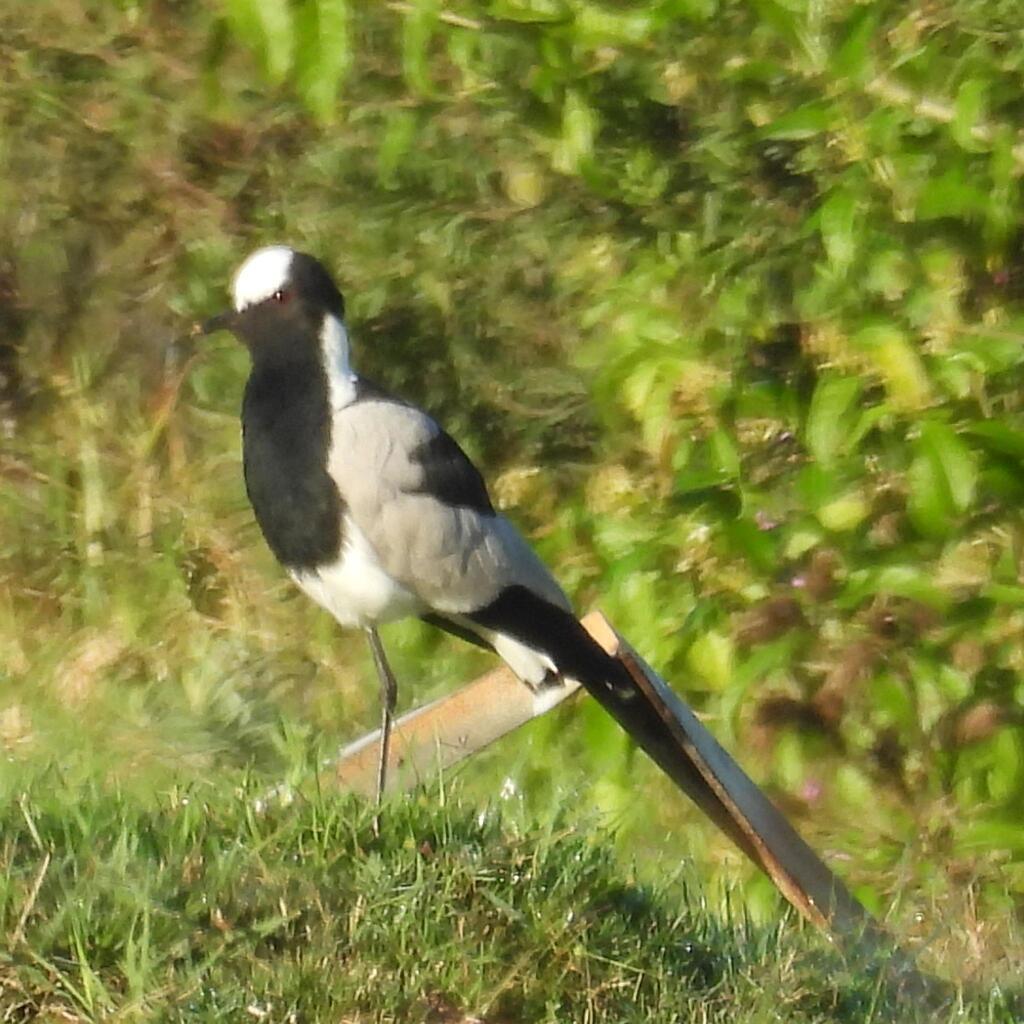
Blacksmith Lapwing
Photo © Henry de Lange
Photo © Henry de Lange — CC BY 4.0 — Source: iNaturalist #277293346Identification
The Blacksmith Lapwing is one of Africa's most distinctive waders, impossible to miss with its bold pied plumage in black, grey and white. These striking patterns likely serve as warning colours to potential predators. The species is characterized by bright red eyes and, uniquely among most plovers, a sharp black spur on the wrist joint of each wing—a formidable weapon deployed aggressively in defence of young. The bill is black, while the legs show black or white-grey dappling. Females are generally larger and heavier than males, though the sexes are otherwise similar in appearance. The Blacksmith Lapwing belongs to an exclusive group of only five lapwing species worldwide that share this combination of red eyes, bold pied plumage, and carpal spurs.
Range & Habitat
This species occurs commonly across a broad swathe of sub-Saharan Africa, from Kenya through central Tanzania to southern and southwestern Africa. The Blacksmith Lapwing shows a strong association with wetlands of virtually any size—it may be attracted to even tiny damp areas such as water seeping from a broken trough. In South Africa, populations are most numerous in mesic grassland regions and less common in higher-rainfall areas. Notably, the species expanded its range dramatically during the 20th century following dam construction and intensive agricultural development, establishing itself in the Western Cape where it was entirely absent until the 1930s. The species avoids mountainous terrain. Like some other lapwings, populations in Zambia and Zimbabwe may shift seasonally in response to rainfall patterns, departing during wet years and returning in dry ones.
Behaviour & Diet
Blacksmith Lapwings are highly territorial and aggressive during breeding season, often reacting defensively toward other lapwings and African jacanas that enter their wetland domains. They breed in spring, nesting in shallow depressions on bare ground or short grass positioned close to water, with nests typically spaced at least 400 metres apart. Breeding timing and site selection may be opportunistic, responding to local conditions. The species is renowned for its fierce protection of chicks, employing dramatic aerial dives—often targeting the head—to repel intruders, wielding their sharp carpal spurs with determination. Young birds gradually separate from parents and do not return to their natal areas once independent. Diet consists of aquatic and terrestrial invertebrates, hunted across their wetland habitats.
Best Time & Places to See It
The Blacksmith Lapwing's range and partial migratory patterns make timing and location variable. In southern Africa, they are most reliably found year-round in mesic grassland regions, particularly around wetlands, dams, and shallow water bodies. The Western Cape in South Africa, where populations have flourished since the 1930s, offers excellent opportunities. During winter months, birds may appear on estuarine mud flats. In East Africa, Kenya and Tanzania provide consistent sightings. Since these birds do not undertake large-scale regular migrations, year-round observation is generally possible within suitable habitat, though local movements may occur in response to rainfall patterns.
Photography Tips
The Blacksmith Lapwing's bold black-and-white plumage and red eyes create striking photographic subjects in good light. Position yourself near shallow wetlands, dams, or grassy areas with standing water during breeding season to capture territorial and parental behaviour, including impressive aerial defence displays. Early morning light will enhance the contrast of their pied pattern. If photographing near nests or chicks, maintain a safe distance—these birds are highly aggressive defenders and will dive at intruders. The carpal spur is a distinctive detail worth capturing in flight shots. Patient observers may document dramatic family interactions as parents guard their young.
Aberdare National Park
Addo Elephant National Park
Agulhas National Park
Amboseli National Park
Arabuko Sokoke Forest Reserve
Arusha National Park
Augrabies Falls National Park
Bangweulu National Park
Bontebok National Park
Nothing matches these filters.
No community photos yet. Log in to add the first one.
No community observations of this species yet.