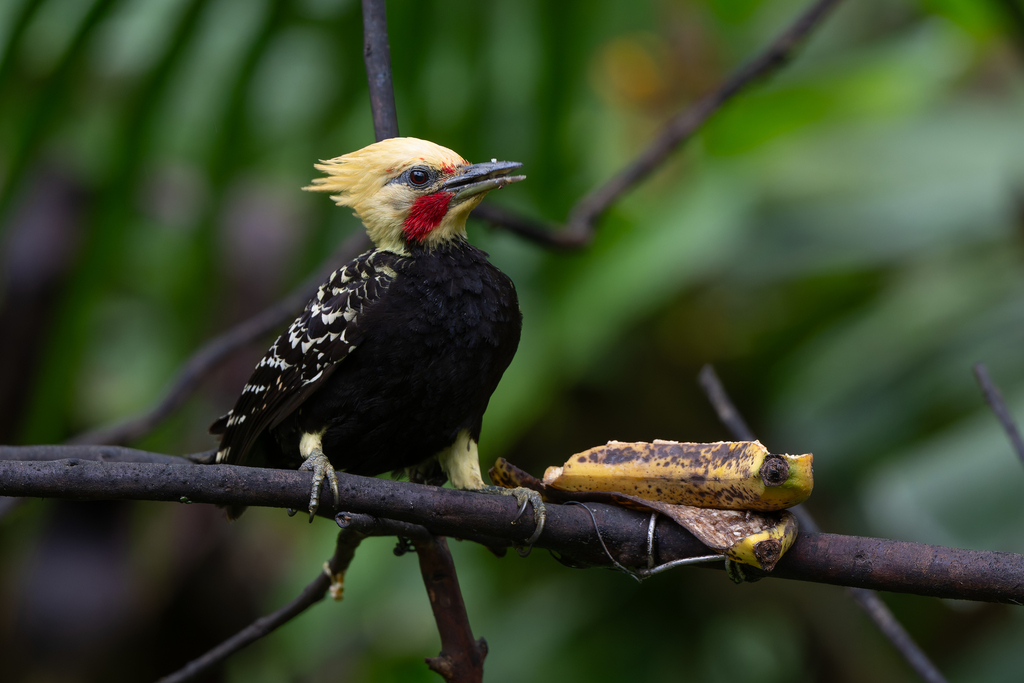
Blond-crested Woodpecker
Photo © Adam Jackson
Photo © Adam Jackson — CC0 1.0 — Source: iNaturalist photo #589882906Identification
The blond-crested woodpecker is a medium-sized woodpecker, 27–30 cm long, with striking plumage that makes it relatively easy to identify in the field. Males display a distinctive wide, bright red malar area and cheek that sometimes extends around the eye and occasionally includes the lower forehead. Females lack this red colouring, instead showing black streaks on the malar and cheek. Both sexes share a pale creamy buff to yellowish-white head with a long, pointed crest—the bird's namesake feature. The back is black, contrasting sharply with a pale yellow to buffish-white lower back and rump. The underparts are predominantly black, with pale barring visible on the flanks and undertail coverts. The thighs are pale yellow to buffish with black spotting. Adults have a horn-coloured or blue-grey bill, red to red-brown iris, and blue-grey legs.
The species produces a resonant, loud 'tsew' or 'wee' call repeated up to seven times, along with well-spaced 'wheep' notes, an aggressive 'tttrrr', and a raucous 'wícket wícket'. Its drumming is characteristically weak, consisting of evenly pitched short rolls.
Range & Habitat
The blond-crested woodpecker is found in Argentina, Brazil, and Paraguay, with two subspecies occupying distinct but adjacent ranges. The nominate subspecies occurs from southern Bahia south to Rio Grande do Sul in Brazil, extending into eastern Paraguay and Argentina's Misiones Province. The northern subspecies C. f. intercedens inhabits western Bahia, Goiás, and Minas Gerais in east-central Brazil. The species is a year-round resident throughout its range.
This woodpecker favours humid forest interiors and edges, gallery forests, savannas, and caatinga scrubland, also adapting to orchards. It is generally not uncommon and locally fairly common, occurring in several protected areas across its range.
Behaviour & Diet
The blond-crested woodpecker is primarily arboreal, foraging at middle and canopy levels, though it also descends to the ground. Its diet consists mainly of arboreal ants and carpenter ants, supplemented with termites and significant amounts of fruits and berries. It captures insects by gleaning, probing, pecking, and hammering through bark. The species usually feeds in pairs or small groups and serves as an important pollinator and seed disperser for its forest ecosystem.
Breeding occurs between April and June in eastern Brazil and between October and November in Argentina. The species excavates nest cavities in trees or arboreal ant nests, though further details of its breeding biology remain undocumented.
Best Time & Places to See It
The blond-crested woodpecker is a year-round resident, making it potentially observable throughout the year within its range. Visitors should focus on humid forests, gallery forests, and forest edges from southern Brazil through Paraguay to northeastern Argentina. The species' presence in several protected areas provides reliable viewing opportunities. Look for it in the mid-storey and canopy, listening for its distinctive loud calls.
Photography Tips
The bird's pale head and dark body provide excellent contrast for photography. Males' bright red facial markings are particularly striking and should be highlighted; position yourself to capture the sun illuminating this feature. Early morning feeding sessions, when the species forages in pairs or small groups, offer good opportunities for behaviour shots. The bird's habit of gleaning insects from bark allows for dynamic feeding photographs. A telephoto lens (400–600 mm) is recommended for capturing crisp images from a respectful distance in its preferred mid-canopy foraging zones.
Tijuca National Park
Brazil
+317 birds+13 mammals
Where the Atlantic forest rises steeply from Rio de Janeiro's urban edge, Tijuca National Park encompasses a landscape of dramatic granite peaks, cascading waterfalls, and closed-canopy…
VIEW NATIONAL PARKItatiaia National Park
Brazil
+519 birds+12 mammals
Where granite peaks pierce the Atlantic rainforest canopy in southeastern Brazil, Itatiaia National Park rises as one of the country's oldest and most ecologically vital protected…
VIEW NATIONAL PARKSuperagui National Park
Brazil
+246 birds+2 mammals
Where the Atlantic rainforest meets the subtropical coast of Paraná, Superagui National Park sprawls across more than 1,000 square kilometres of one of Brazil's most biodiverse…
VIEW NATIONAL PARKSaint-Hilaire/Lange National Park
Brazil
+225 birds
Subtropical Atlantic forests rise and fall across the plateaus of inland Paraná, where Saint-Hilaire/Lange National Park protects nearly 578 square kilometres of Brazil's most biodiverse woodland…
VIEW NATIONAL PARKSerra do Itajaí National Park
Brazil
+227 birds+2 mammals
Where the Atlantic rainforest rises steeply from the coastal plains of Santa Catarina, Serra do Itajaí National Park spreads across 1,136 square kilometres of montane wilderness…
VIEW NATIONAL PARKSerra da Bocaina National Park
Brazil
+441 birds+5 mammals
Where the escarpment of the Serra da Bocaina rises sharply from the Atlantic coastal plain, tropical rainforest cloaks steep mountainsides that climb toward peaks exceeding 2,000…
VIEW NATIONAL PARKIguaçu National Park
Brazil
+387 birds+17 mammals
Where the Paraná Plateau plunges toward the Atlantic watershed, six thousand square kilometers of subtropical rainforest cling to steep gorges and river valleys in this corner…
VIEW NATIONAL PARKSerra dos Órgãos National Park
Brazil
+446 birds+13 mammals
Granite peaks thrust skyward through the Atlantic Forest canopy in the mountains immediately north of Rio de Janeiro, their bare rock faces rising above a landscape…
VIEW NATIONAL PARKChapada dos Guimarães National Park
Brazil
+450 birds+1 mammals
Where weathered sandstone plateaus rise above the cerrado grasslands of central Brazil, Chapada dos Guimarães National Park protects 624 square kilometres of ecological transition zone that…
VIEW NATIONAL PARKBrasília National Park
Plano Piloto, Brazil
+338 birds+15 mammals
Cerrado grassland and scattered woodland sweep across the central Brazilian plateau where this national park sprawls across more than a thousand square kilometres of the Federal…
VIEW NATIONAL PARKAraucárias National Park
Brazil
+231 birds+3 mammals
Where the southern Brazilian highlands rise into cool temperate forest, Araucárias National Park protects one of the Atlantic Forest's most distinctive ecosystems across 506 square kilometres…
VIEW NATIONAL PARKNo community photos yet. Log in to add the first one.
No community observations of this species yet.