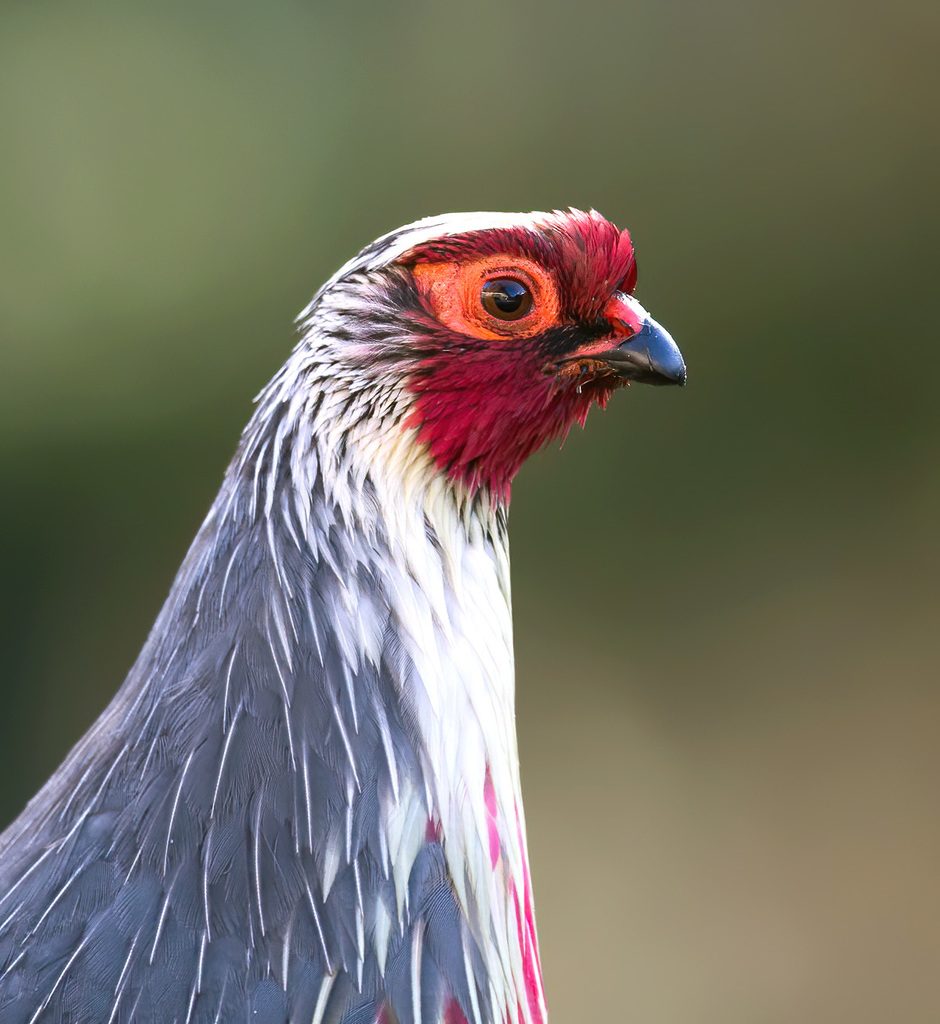
Blood Pheasant
Photo © Morten Ross
Photo © Morten Ross — CC BY 4.0 — Source: iNaturalist photo #110503704Identification
The blood pheasant is a relatively small, short-tailed pheasant, about 17 inches (43 cm) in length, with a strong black bill and a small crest of variously coloured feathers. Males are distinctly marked with dark ash plumage above featuring white shafts, while the wing coverts are tinged with green with broad white strokes. The most striking feature is the blood-red coloring: deep crimson feathers on the chin, and on the breast and belly, lance-shaped feathers with green tips and crimson margins that collectively resemble dashes of blood scattered across the underparts. The tail consists of 12 subequal feathers with white shafts and whitish ends, while the coverts are a rich crimson red. Both sexes have red feet and a distinctive bare ring around the eye, typically crimson but orange in some subspecies.
Females are more uniformly colored than males, appearing overall dull brown with some gray on the nape. The species exhibits considerable subspecific variation, particularly in males, with differences in the amount of red or black on the throat, forehead, neck, chest, and tail, as well as the presence or absence of rufous in the wings. Up to fifteen subspecies have been recognized, though the exact number remains disputed among ornithologists.
Range & Habitat
The blood pheasant is widespread across the lower Himalayas, ranging from North and East India through Nepal and Bhutan to South China and northern Myanmar. It inhabits mountainous terrain, preferring coniferous and mixed forests along with scrub areas near the snowline. The species is notably monogamous, unlike the common pheasant, and has remarkable adaptations to high-elevation environments, including specialized physiological responses to hypoxia and high ultraviolet radiation.
Blood pheasants are altitudinally migratory, moving their range seasonally in response to snow cover. They occupy higher elevations during summer months and descend to lower elevations as snow increases during fall and winter, effectively following the snowline as they forage.
Behaviour & Diet
Breeding season begins at the end of April, when males initiate courtship displays that are notably vigorous, including flying at each other breast-to-breast, biting wattles, and performing high leaps with kicks. Female mate choice depends on factors such as tail length, ear tuft length, and the presence of black points on the wattle, rather than wattle size, color, or plumage brightness. Blood pheasants reach sexual maturity in just one year.
In early May, females construct shallow, pot-like nests lined with moss, pine needles, and feathers, typically located under paddy straw heaps, in brush, small caves, or tree holes near the ground. Clutches contain 4-14 yellowish-white eggs with brown speckles, laid at two to three-day intervals. The incubation period lasts 27-33 days, during which males defend the territory against rival males. Blood pheasants feed primarily on moss, ferns, pine shoots, and lichens, moving with the snowline while foraging.
Best Time & Places to See It
The blood pheasant, the state bird of Sikkim, India, can be encountered throughout its range in the Himalayan region and adjacent mountain ranges. Spring, particularly from late April onwards, is the best time to observe them, as males are actively engaged in courtship displays. The species' preference for high-elevation coniferous and mixed forests near the snowline means that summer months provide access to higher-altitude populations, while winter birding at lower elevations may yield sightings of seasonally descended birds.
Photography Tips
The blood pheasant's striking crimson and ash plumage provides excellent photographic opportunities, particularly when males are displaying during breeding season. Early morning hours in coniferous forest habitats offer the best lighting and increased activity levels. Photographers should focus on capturing the distinctive blood-red markings on the breast and belly, the rich crimson tail coverts, and the characteristic bare eye-ring. The bird's relatively small size and preference for dense scrub and forest understory mean that patience and careful stalking are essential, along with a telephoto lens to avoid disturbing this monogamous species, especially during the vulnerable 27-33 day incubation period.
Langtang National Park
Helambu, Nepal
+364 birds+14 mammals
Where the southern slopes of the Himalayan highlands descend toward the subtropical valleys of central Nepal, Langtang National Park sprawls across one of the subcontinent's most…
VIEW NATIONAL PARKSagarmatha National Park
Khumjung, Nepal
+219 birds+7 mammals
Soaring peaks and deep glacial valleys define this alpine wilderness in northeastern Nepal, where the terrain rises from forested foothills into a realm of high-altitude tundra…
VIEW NATIONAL PARKKhangchendzonga National Park
Sakkyong, India
+290 birds+1 mammals
Where the eastern Himalayas surge toward their crowning peaks, Khangchendzonga National Park embraces a landscape of almost overwhelming vertical drama. Rising from subtropical river valleys into…
VIEW NATIONAL PARKGiant Panda National Park
Mianyang, China
+447 birds+47 mammals
Where the eastern slopes of China's Sichuan plateau descend into cloud-wrapped valleys, one of Asia's most biodiverse landscapes unfolds across more than 350,000 square kilometres. This…
VIEW NATIONAL PARKSanjiangyuan National Park
Nagqu, China
+187 birds+25 mammals
Where the headwaters of three great Asian rivers emerge from a high alpine plateau, the landscape unfolds in tundra and dwarf shrubland—a world of austere beauty…
VIEW NATIONAL PARKWolong National Nature Reserve
Wenchuan County, China
+333 birds+17 mammals
Where the Qingyi River cuts through the eastern flanks of the Minshan Range, a temperate montane forest cloaks steep valleys in dense canopy that thins dramatically…
VIEW NATURE RESERVEBaima Snow Mountain National Nature Reserve
Diqing Tibetan Autonomous Prefecture, China
+204 birds+3 mammals
High-altitude ridges and steep-sided valleys define this reserve in northwestern Yunnan, where elevations surge from around 3,000 metres to peaks above 4,100 metres. The terrain supports…
VIEW NATURE RESERVENo community photos yet. Log in to add the first one.
No community observations of this species yet.