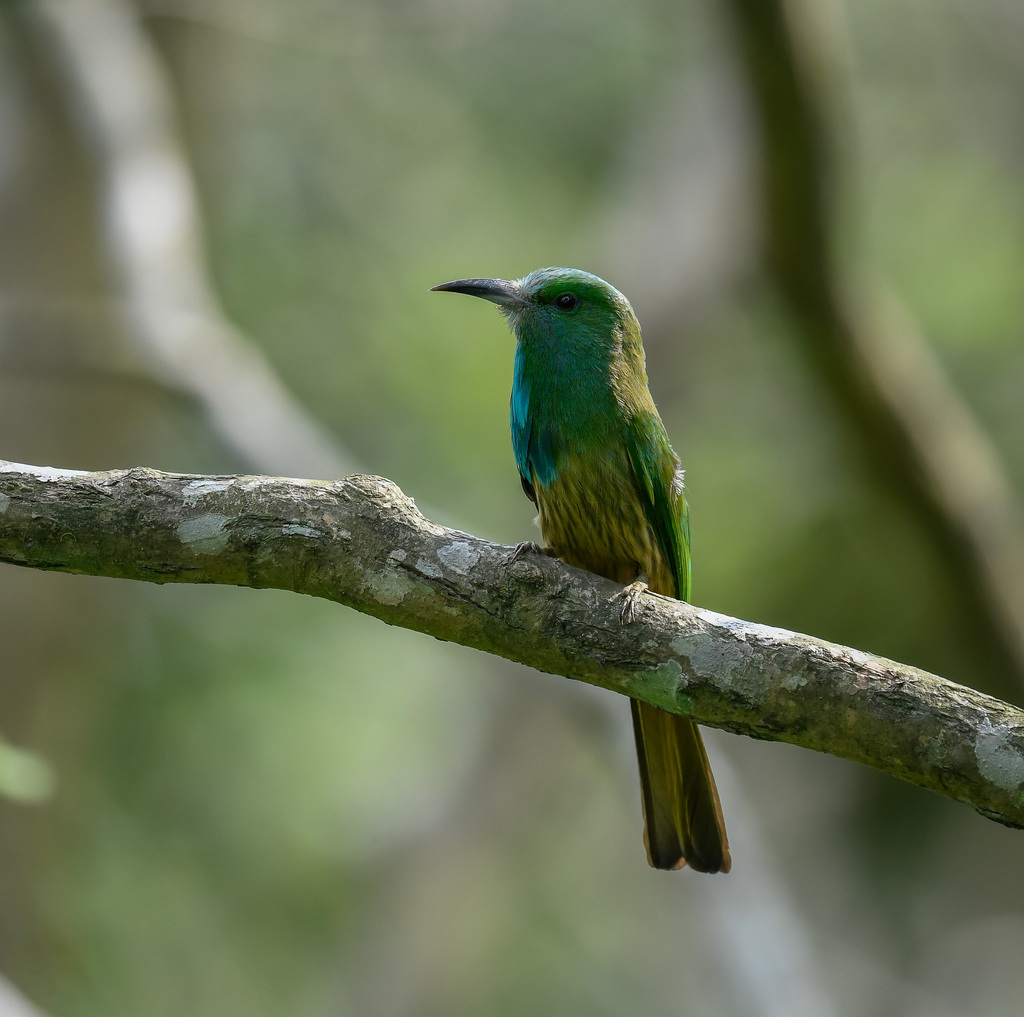
Blue-bearded Bee-eater
Photo © Rejoice Gassah
Photo © Rejoice Gassah — CC BY 4.0 — Source: iNaturalist #304895180Identification
The blue-bearded bee-eater is the largest member of the bee-eater family, measuring 31 to 35 cm in length and weighing 70 to 93 grams. Its most distinctive feature is the elongated blue throat feathers that give it a bearded appearance when fluffed out—particularly pronounced in males, whose throat feathers reflect ultraviolet light more intensely than those of females. The bird's plumage is predominantly grass green with a striking turquoise forehead, face, and chin. Its belly ranges from yellowish to olive with streaks of green or blue.
Other key identification features include a large, sickle-shaped bill and a square-ended tail that lacks the characteristic wire-like extensions of smaller bee-eaters' central tail feathers. Populations in peninsular India tend to be paler green than their northeastern Indian counterparts. The bird's undulating, barbet-like flight style is another useful fieldmark for identification.
Range & Habitat
The blue-bearded bee-eater is found across much of the Indian subcontinent and parts of Southeast Asia, with its main range in the Malayan region extending westward into peninsular India. The species is patchily distributed and easily overlooked. Notable populations occur in hill regions including the Satpuras, Western Ghats, Eastern Ghats, Nilgiris, Chota Nagpur, and Sub-Himalayan forests.
This species favours thin to fairly thick forest in medium elevations, typically below 2000 metres, particularly areas with clearings. It is found singly or in small groups of up to three birds, and its patchy distribution means that careful observation is required to locate it in suitable habitat.
Behaviour & Diet
The blue-bearded bee-eater has a loud call but is less active and vocal than smaller bee-eater species. Its calls include cackling, hornbill-like sounds, a dry "Kit-tik... Kit-tik" series, and hollow nasal "kyao" notes. Pairs engage in duetting with cackling and rattling that ends in short purring notes. The species breeds from February to August in India, with courtship involving ritual feeding, bowing, and tail fanning. Birds excavate deep tunnels in mud banks for nesting, laying four spherical white eggs.
The blue-bearded bee-eater feeds mainly on bees, employing a remarkable hunting strategy: it provokes Giant honey bee colonies to release their guard bees, then catches them mid-air as they pursue the bird. While primarily hunting via aerial sallies, the bird occasionally gleans insects from bark and has been observed near flowering Erythrina and Salmalia trees, possibly foraging for attracted insects. It sometimes joins mixed-species foraging flocks.
Best Time & Places to See It
The breeding season from February to August offers the best opportunity to locate this species, as birds are more vocal and active during courtship and nesting. Search suitable medium-altitude forest clearings in the Western Ghats, Eastern Ghats, Nilgiris, or other hill regions where the species is recorded. Early morning and late afternoon are productive times, though patience is essential given the bird's patchy distribution and relatively quiet nature compared to other bee-eaters.
Listen for its distinctive loud calls—the cackling, rattling duets, and nasal "kyao" notes are often the best way to locate pairs. The bird's preference for thicker forest with clearings means systematically exploring suitable habitat rather than relying on chance encounters.
Photography Tips
The blue-bearded bee-eater's large size and striking blue-throated plumage make it a rewarding subject when located. Position yourself near known nesting sites or feeding areas during the breeding season when birds are more active. The bird's undulating flight and aerial hunting technique require fast shutter speeds to capture sharp images of hunting sequences.
The ultraviolet-reflective throat feathers of males are a subtle but beautiful detail worth highlighting—photograph birds with good lighting to capture the iridescent quality of the blue feathers. Use moderate telephoto lenses to maintain distance without disturbing breeding birds at their nest sites. Early morning light will render the grass-green plumage and turquoise facial markings at their most vibrant.
Orang National Park
Rangagarapathar, India
+298 birds+1 mammals
Where the Brahmaputra's floodplains meet the foothills of Assam, Orang National Park unfolds across a mosaic of riverine grasslands, forests and wetlands that pulse with the…
VIEW NATIONAL PARKEravikulam National Park
Devikulam, India
+192 birds+7 mammals
High in the Western Ghats of Kerala, where monsoon mists cling to slopes that rise above 2,000 metres, Eravikulam National Park preserves one of South India's…
VIEW NATIONAL PARKKhao Yai National Park
Prachantakham District, Thailand
+377 birds+46 mammals
Evergreen dipterocarp forest blankets the rolling terrain of this national park in eastern Thailand, where limestone hills rise abruptly from the forest floor and seasonal streams…
VIEW NATIONAL PARKKhao Laem National Park
Sangkhla Buri District, Thailand
+197 birds
Where the Vajiralongkorn Reservoir sprawls across the forested valleys of Kanchanaburi's northern borderlands, Khao Laem National Park protects a landscape where limestone ridges rise dramatically from…
VIEW NATIONAL PARKKanha Tiger Reserve
Kanha Kisli F.V., India
+321 birds+23 mammals
Where sal forests give way to emerald meadows and crystalline streams carve through ancient valleys, one of India's finest wilderness reserves unfolds across the Maikal Range.…
VIEW NATIONAL PARKBandhavgarh National Park
Garhpuri, India
+285 birds+17 mammals
Where granite ridges rise dramatically above sal and bamboo forests, one of India's most pristine tiger reserves unfolds across the Vindhyan plateau. Ancient rock formations tower…
VIEW NATIONAL PARKKaziranga National Park
Kohora, India
+422 birds+26 mammals
Dawn breaks over the floodplains of the Brahmaputra, where tall grasslands stretch endlessly beneath monsoon-heavy skies. This sprawling wilderness of northeastern Assam is a mosaic of…
VIEW NATIONAL PARKPampadum Shola National Park
Vattavada, India
+258 birds+14 mammals
Where misty shola forests cling to the high plateaus of the Nilgiri Mountains, ancient evergreen remnants create a world apart. This 2,316-hectare reserve protects one of…
VIEW NATIONAL PARKBandipur National Park
Hirehalli, India
+302 birds+19 mammals
Where the Western Ghats descend into the Deccan plateau, ancient deciduous forests blanket a landscape carved by the Nugu River. Bandipur unfolds across 880 square kilometres…
VIEW NATIONAL PARKNagarahole Tiger Reserve
Nalkeri Forest, India
+323 birds+23 mammals
Where granite escarpments rise above dense deciduous forests and the Kabini River carves through pristine wilderness, one of India's most biodiverse landscapes unfolds across the Western…
VIEW NATIONAL PARKHainan Tropical Rainforest National Park
Haikou, China
+69 birds+1 mammals
Tropical forests blanket the volcanic slopes of central Hainan, where moisture-laden winds from the South China Sea collide with mountainous terrain to create some of China's…
VIEW NATIONAL PARKXishuangbanna National Nature Reserve
Xishuangbanna Dai Autonomous Prefecture, China
+173 birds+2 mammals
Where subtropical monsoon forests meet the margins of the Yunnan plateau, Xishuangbanna National Nature Reserve sprawls across a landscape of dramatic relief—deep river valleys carved by…
VIEW NATURE RESERVENo community photos yet. Log in to add the first one.
No community observations of this species yet.