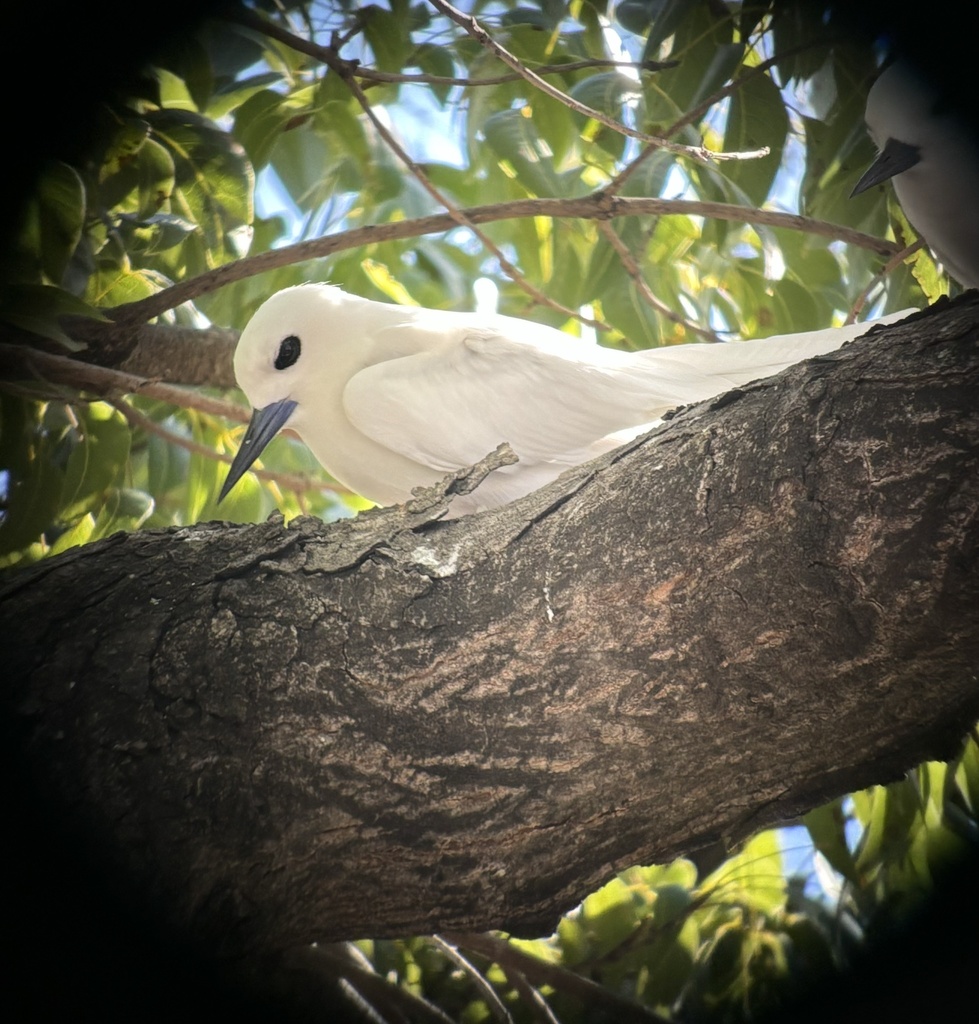
Blue-billed White Tern
Photo © Nancy Overholtz
Photo © Nancy Overholtz — CC BY-SA 4.0 — Source: iNaturalist #199957337The blue-billed white tern (Gygis candida) is a small seabird found in Pacific and Indian oceans. This species was previously considered as conspecific with the Atlantic white tern (Gygis alba) and the little white tern (Gygis microrhyncha), but is now recognised as a separate species. It is known as manu-o-kū in Hawaiian. In the Cook Islands, it is known as the kakaia. == Taxonomy == The blue-billed white tern was first formally described by the German ornithologist Johann Friedrich Gmelin in 1789. The species epithet is from Latin candidus (white). There are two recognized subspecies of the blue-billed white tern: Gygis candida candida (Gmelin, 1789) – Indian Ocean – (Seychelles, Mascarene Islands, Chagos Archipelago and Maldives) and tropical Pacific Ocean (Lord Howe Island, Norfolk Island, Kermadec Islands, Hawaii, Clipperton Island, Cocos Island and Malpelo Island) Gygis candida leucopes (Holyoak and Thibault, 1976) – Henderson Island, Pitcairn Island == Description == A medium-sized all-white tern. The eyes are narrow and are dark in colour. The bill is black in color with blue in the base, hence its name. The shape of the bill is thick and "daggerlike" with a sharp-pointed tip. Legs are slaty-blue in color, with yellow or white webs.…
Haleakalā National Park
Maui County, United States
+66 birds+4 mammals
Ascending from sea level to over 10,000 feet across a mere thirty miles, Haleakalā National Park commands one of the Pacific's most dramatic elevation gradients, where…
VIEW NATIONAL PARKNational Park of American Samoa
Leusoaliʻi, United States
+31 birds+1 mammals
The volcanic ridges of American Samoa rise steeply from the Pacific, their slopes cloaked in tropical rainforest that cascades down to a coast where reef systems…
VIEW NATIONAL PARKMidway Atoll National Wildlife Refuge
United States
+91 birds+1 mammals
Straddling the international date line roughly midway between North America and Asia, this atoll sanctuary rises from the North Pacific as a cluster of coral and…
VIEW WILDLIFE SANCTUARYNo community photos yet. Log in to add the first one.
No community observations of this species yet.