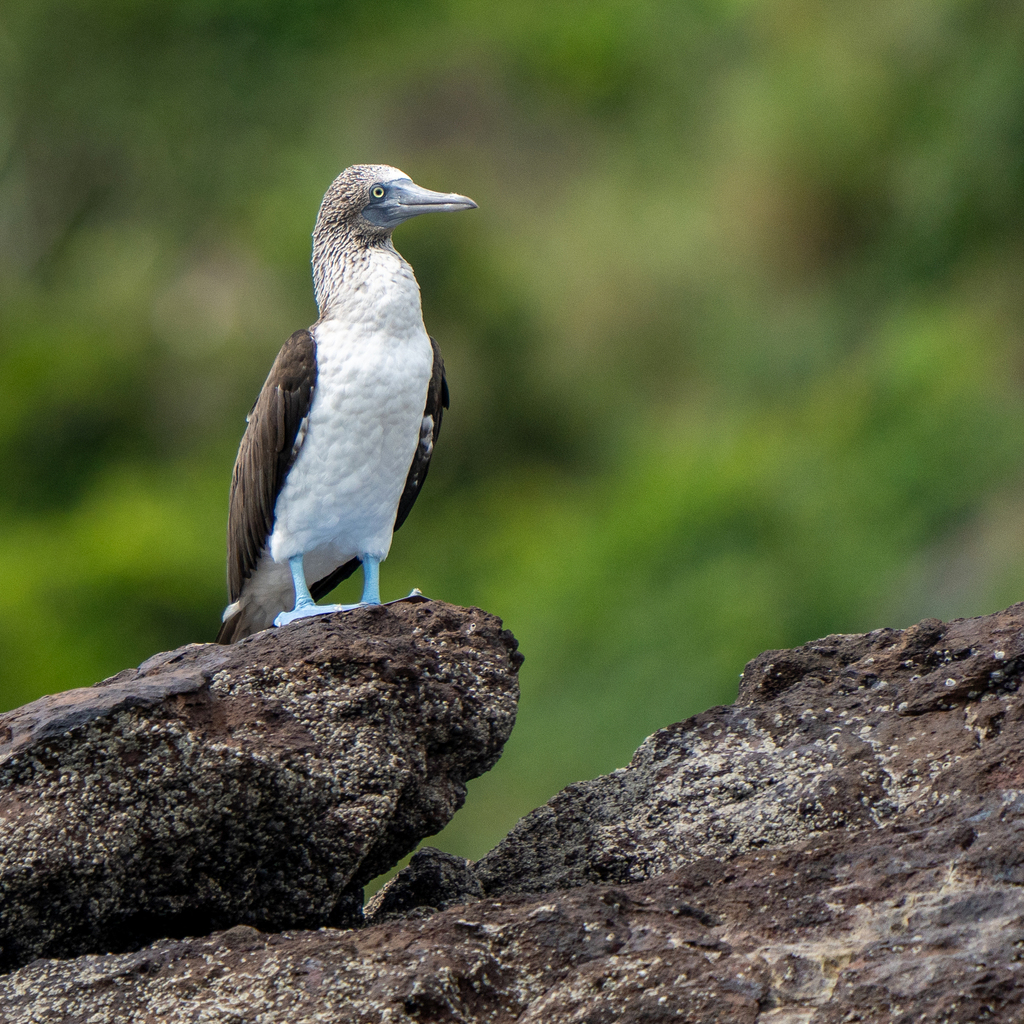
Blue-footed Booby
Photo © Anthony Batista
Photo © Anthony Batista — CC BY 4.0 — Source: iNaturalist photo #564295414Identification
The blue-footed booby is an unmistakable seabird, averaging 81 cm (32 in) long with a wingspan up to 1.5 m (5 ft). Females are slightly larger than males. The species is instantly recognizable by its strikingly brilliant blue feet, which range in color from pale turquoise to deep aquamarine—males and younger birds display lighter feet than females. The bird's plumage consists of long, pointed brown wings contrasting with a light brown head and neck streaked with white, while the belly and underside are pure white. Its distinctive yellow eyes are set forward on either side of the bill, providing excellent binocular vision. Young chicks wear soft white down with black beaks and feet.
Range & Habitat
The blue-footed booby is native to subtropical and tropical regions of the eastern Pacific Ocean, distributed along continental coasts from California through the Gulf of California, south along western Central and South America to Peru. Remarkably, about half of all breeding pairs nest on the Galápagos Islands. The species is strictly marine, coming ashore only to breed and rear young along rocky Pacific coasts. Breeding birds nest in large colonies on bare black lava in small ground divots, with some individuals defending two or three potential nesting sites before establishing a preference weeks before egg-laying.
Behaviour & Diet
The blue-footed booby's most famous behaviour is the male's elaborate mating display, in which he lifts his brilliantly colored feet up and down while strutting before a potential mate. This vibrant footwear is not merely decorative—the blue coloration comes from carotenoid pigments in their fish diet, and the intensity of the blue serves as an indicator of the bird's immunological health and diet quality. The species feeds primarily on fish, which it obtains through dramatic headlong dives into the water; to accommodate this hunting style, its nostrils are permanently closed and it breathes through the corners of its mouth. While some birds hunt alone, they typically hunt in groups. Blue-footed boobies usually lay one to three eggs per breeding season and practice asynchronous hatching, where eggs hatch at different times rather than simultaneously, creating size disparities between siblings that can lead to facultative siblicide during periods of food scarcity.
Best Time & Places to See It
The Galápagos Islands offer the most reliable and spectacular opportunities to observe blue-footed boobies, as they host roughly half of the global breeding population. The species can also be found along the Pacific coasts of Central and South America, from the Gulf of California southward to Peru. Young birds typically begin breeding between ages 1–6 years, and limited natal dispersal means birds return to breed near their birthplace, creating stable, long-established colonies ideal for observation and study.
Photography Tips
Photographers should focus on capturing the bird's signature blue feet, which are most vibrant and visually striking in breeding birds with the highest-quality diets. The male's courtship display—with feet lifted high in his strutting walk—provides dynamic action shots. The bird's clumsy terrestrial movements and apparent fearlessness of humans allow relatively close approach, making detailed portraits feasible. The contrast between the white underside, brown wings, and brilliant blue feet creates strong compositional opportunities. Shooting during breeding season when birds are actively displaying and nesting will yield the most engaging images.
Corcovado National Park
Puerto Jiménez, Costa Rica
+444 birds+48 mammals
Where the Osa Peninsula juts into the Pacific, rainforest descends almost to the tide line, and Corcovado National Park protects one of Central America's most intact…
VIEW NATIONAL PARKManuel Antonio National Park
Quepos, Costa Rica
+426 birds+22 mammals
Where tropical rainforest descends steeply to a rocky Pacific coastline, Manuel Antonio National Park distills Central American biodiversity into one of Costa Rica's most compressed and…
VIEW NATIONAL PARKPiedras Blancas National Park
Golfito, Costa Rica
+386 birds+24 mammals
Where the Golfo Dulce meets the southwestern Pacific coast of Costa Rica, Piedras Blancas National Park protects a dramatic transition zone where lowland rainforest descends toward…
VIEW NATIONAL PARKSanta Rosa National Park
Santa Elena, Costa Rica
+359 birds+30 mammals
Where Pacific-facing slopes descend from volcanic uplands toward the Guanacaste lowlands, Santa Rosa National Park unfolds across a mosaic of tropical dry forest, gallery woodland, and…
VIEW NATIONAL PARKParque Nacional de Galápagos
Santo Tomás, Ecuador
+139 birds+23 mammals
Volcanic peaks and weathered lava fields dominate this remote archipelago in the Pacific, where the interplay of cold ocean currents and tropical latitude creates an ecological…
VIEW ISLAND & ARCHIPELAGOCoiba National Park
Montijo, Panama
+260 birds+10 mammals
An archipelago of volcanic and sedimentary islands rises from the Pacific waters off Panama's southwestern coast, its densest rainforest canopy unbroken for millennia. Coiba National Park…
VIEW NATIONAL PARKDarién National Park
Tucutí, Panama
+534 birds+13 mammals
Where the spine of Central America crumbles into wetland and rainforest, Darién National Park sprawls across more than 20,000 square kilometres of some of the tropics'…
VIEW NATIONAL PARKMarino Golfo de Chiriquí National Park
Boca Chica, Panama
+82 birds+2 mammals
Where mangrove forests meet tropical Pacific waters, Marino Golfo de Chiriquí National Park spans 463 square kilometers of one of Central America's most biodiverse coastal systems.…
VIEW NATIONAL PARKEl Vizcaíno
Laguna San Ignacio, Mexico
+317 birds+29 mammals
Where the Baja California peninsula thins into a tapestry of salt lagoons and coastal desert, one of Mexico's most biodiverse reserves sprawls across half a million…
VIEW BIOSPHERE RESERVEParque Nacional Isla Isabel
Santiago Ixcuintla, Mexico
+107 birds+2 mammals
A volcanic island sanctuary rises from the Pacific waters off Nayarit's coast, where three dormant cones define a landscape of sharp ridges, coastal cliffs, and sheltered…
VIEW NATIONAL PARKChannel Islands National Park
Santa Barbara County, United States
+330 birds+15 mammals
A chain of eight volcanic islands rises from the cold Pacific waters off the California coast, their rugged sea cliffs and windswept terrain shaped by millions…
VIEW NATIONAL PARKHavasu National Wildlife Refuge
Lake Havasu City, United States
+291 birds+8 mammals
Where the Colorado River widens into a vast reservoir in the Sonoran Desert, Havasu National Wildlife Sanctuary protects one of the most critical wetland ecosystems in…
VIEW WILDLIFE SANCTUARYFarallon National Wildlife Refuge
San Francisco, United States
+384 birds+16 mammals
Windswept granite peaks rising abruptly from the Pacific, the Farallon Islands form a wildlife sanctuary of extraordinary seabird abundance and ecological significance just twenty-seven miles west…
VIEW WILDLIFE SANCTUARYSalton Sea National Wildlife Refuge
Imperial County, United States
+289 birds+4 mammals
Across the floor of California's inland desert, where summer temperatures soar and rainfall is measured in tenths of inches, lies an improbable oasis of shallow water…
VIEW WILDLIFE SANCTUARYMarino Ballena National Park
Bahía Ballena, Costa Rica
+336 birds+8 mammals
Where mangrove forests meet coral-fringed shorelines along Costa Rica's southern Pacific coast, Marino Ballena National Park encompasses a marine and terrestrial mosaic that ranks among Central…
VIEW NATIONAL PARKMarino Las Baulas National Park
Santa Cruz, Costa Rica
+246 birds+9 mammals
Where the Pacific meets a mosaic of dry forest and mangrove estuary, this coastal national park protects one of Central America's most dynamic wildlife theatres. The…
VIEW NATIONAL PARKNo community photos yet. Log in to add the first one.
No community observations of this species yet.