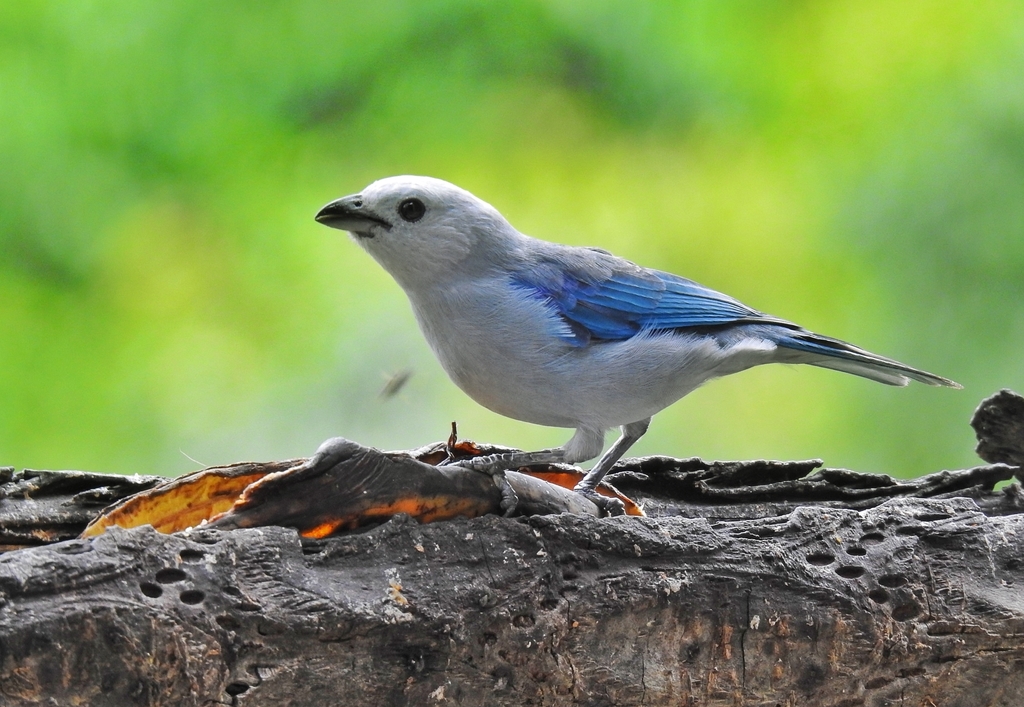
Blue-gray Tanager
Photo © Esteban Poveda
Photo © Esteban Poveda — CC BY 4.0 — Source: iNaturalist photo #100875160Identification
The blue-gray tanager is a medium-sized songbird measuring 16–18 cm in length and weighing 30–40 g. Adults are distinctive for their light bluish head and underparts contrasting with darker blue upperparts and a shoulder patch in a contrasting shade of blue. The bill is short and notably thick. Sexual dimorphism is minimal in adults, though immature birds are considerably duller in plumage. The exact hue of blue varies across the bird's range, with subspecies displaying shoulder patches that may be lavender, dark blue, or whitish, while the rest of the plumage ranges from grayish to greenish or purplish-blue.
Range & Habitat
This South American tanager ranges from Mexico south through the Amazon Basin to northeast Bolivia and northern Brazil, occupying all of the Amazon except the very south. The species has been introduced to Lima, Peru, and Florida, United States. It favours open woodland, cultivated areas, and gardens, and thrives around human habitation. While blue-gray tanagers persist in forests, they are particularly abundant in secondary forest resulting from slash-and-burn agriculture followed by abandonment, and readily move into abandoned pastureland.
Behaviour & Diet
This common, restless, and noisy species is highly confiding around humans. Blue-gray tanagers are usually found in pairs, though they sometimes gather in small groups. They produce a squeaky, twittering song interspersed with tseee and tsuup call notes. The species lives mainly on fruit but supplements its diet with nectar, insects, and other arthropods, readily taking cultivated fruits such as papayas. Breeding occurs in open habitats, with females laying one to three (usually two) dark-marked whitish to gray-green eggs in a deep cup nest positioned high in a tree fork or building crevice. Incubation lasts 14 days, with fledging occurring after another 17 days.
Best Time & Places to See It
The blue-gray tanager is widespread and common throughout its large range, making it relatively easy to locate. Look for this species in open woodlands, cultivated areas, gardens, and human settlements across its South American range. Secondary forests and abandoned pastures are particularly productive habitats. The bird's confiding nature and noisy behaviour make it conspicuous, and the restless flitting of pairs or small groups will often draw an observer's attention.
Photography Tips
The blue-gray tanager's striking plumage of contrasting blue tones provides excellent photographic potential. Frame the bird to capture both the light bluish head and underparts alongside the darker blue upperparts and distinctive shoulder patch. The short, thick bill is a useful identifying feature to include in close-ups. Since the species is confiding and often found in gardens and around human habitation, opportunities for photography in open settings are frequent. Early morning activity is typically productive for capturing both still portraits and behavioural shots as pairs forage for fruit.
Amacayacu National Park
Amazônia National Park
Anavilhanas National Park
Antisana National Park
Arenal Volcano National Park
Bahuaja Sonene National Park
Barbilla National Park
Barra del Colorado National Wildlife Refuge
Baru Volcano National Park
Nothing matches these filters.
No community photos yet. Log in to add the first one.
No community observations of this species yet.