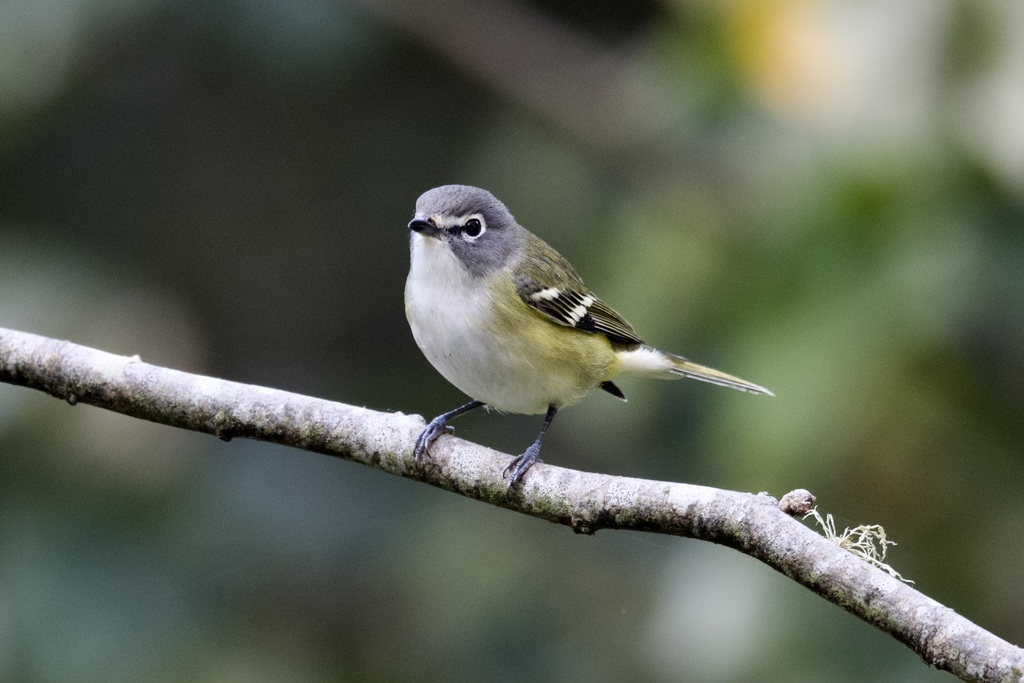
Blue-headed Vireo
Photo © Dario Taraborelli
Photo © Dario Taraborelli — CC0 1.0 — Source: iNaturalist photo #325189922Identification
The blue-headed vireo is a small songbird easily recognized by its distinctive deep blue-grey crown, olive-green upper body, and two bold yellow wing bars. Both males and females share nearly identical plumage and size, and juveniles closely resemble adults, making sex and age determination challenging in the field. At 5.0–5.8 inches long with a wingspan of 7.9–9.4 inches, it's a compact vireo weighing just 0.46–0.67 ounces. The bird can be distinguished from the closely related Cassin's vireo by its brighter yellow wing patches, larger bill, and darker blue-grey (rather than brownish-grey) crown.
Range & Habitat
This migratory songbird breeds across a vast range spanning Canada and the northeastern United States, with two subspecies showing different patterns. The nominate subspecies breeds from northeastern British Columbia across the prairies to southern Pennsylvania and New Jersey, wintering in Mexico and northern Central America. The larger alticola subspecies breeds in the Appalachian Mountains from Maryland to northern Georgia, undertaking a shorter migration to Gulf State wintering grounds. Blue-headed vireos favor cool temperate forests where evergreens—spruce, fir, hemlock, and pine—mix with deciduous understory of alder, willow, poplar, birch, or maple. In winter, they inhabit mixed pine-hardwood forests, coastal swamps, and shrubby thickets.
Behaviour & Diet
Like other vireos, the blue-headed vireo is characterized by its usually dull greenish coloring and simple, monotonous song. The species maintains relatively low, dispersed population densities year-round, with densities varying by forest type. During migration, blue-headed vireos often flock with different sparrow species, though rarely with members of their own kind. In the wild, they live an average of approximately 7 years and 5 months.
Best Time & Places to See It
Blue-headed vireos typically arrive at their breeding grounds in mid-April. They inhabit evergreen-dominated forests in spring, later moving to deciduous woodlands as leaves emerge. Recent habitat challenges have arisen in eastern North America, where invasive hemlock woolly adelgids have killed many hemlocks that vireos rely on for early-season nesting before deciduous trees leaf out. Migration periods offer good viewing opportunities along flyways and in mixed woodlands.
Photography Tips
Photographers should look for the bird's distinctive blue-grey head and yellow wing bars as identifying features. The species' small size and tendency to stay in foliage can make photography challenging; patience and early morning activity when vireos forage are recommended. Spring migration and breeding season offer the best opportunities, as birds are vocal and active during territorial establishment and nesting preparation.
Acadia National Park
Alaska Maritime National Wildlife Refuge
Algonquin Provincial Park
Alligator River National Wildlife Refuge
Banff National Park
Bic National Park
Big Bend National Park
Biscayne National Park
Blackwater National Wildlife Refuge
Nothing matches these filters.
No community photos yet. Log in to add the first one.
No community observations of this species yet.