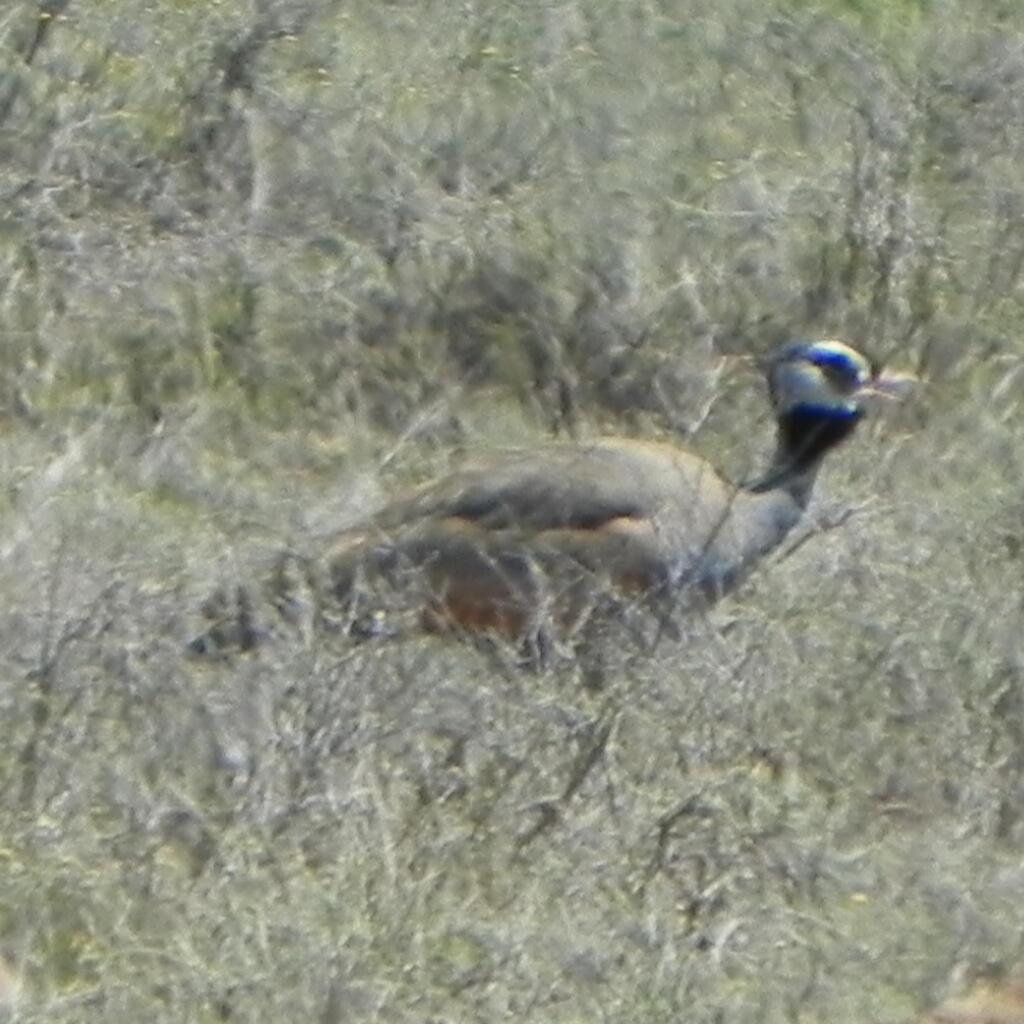
Blue Korhaan
Photo © Henry de Lange
Photo © Henry de Lange — CC BY 4.0 — Source: iNaturalist #365977375Identification
The blue korhaan is a fairly large ground-dwelling bird, measuring 50 to 58 cm in length, with the sturdy body, large head, long neck and long legs characteristic of bustards. Males display striking plumage: a black forehead and crown, white sides to the head, bluish-grey neck, throat, breast and belly, and brown back, wings and tail. Females are similar but duller, with greyish (rather than blue-grey) underparts and buff ear coverts. Both sexes have distinctive yellow legs and feet. The bird's presence is often announced before it is seen, as its voice is a series of distinctive throaty "krok-kau" calls, usually heard around dawn and often uttered in flight.
Range & habitat
The blue korhaan is native to South Africa and the western fringes of Lesotho, with its range extending from Pretoria and Mbombela southwards to Bhisho across an area of approximately 356,000 km². The species inhabits grassland at altitudes between 1,500 and 3,000 metres. It favours short grass habitats scattered with karoo-type dwarf shrubs and termite mounds, but few trees, typically within a kilometre of water. The bird also occurs in previously cultivated and fallow areas, winter crops and pastureland.
Behaviour & diet
Blue korhaans are largely terrestrial birds that typically occur in pairs or small family groups. When disturbed, they crouch down and walk or run away with head lowered, though they will flush into flight when truly alarmed, flying considerable distances. They forage on the ground for a varied diet including insects, lizards, scorpions, seeds, flowers and leaves.
Breeding takes place mainly in October and November. The nest is a simple scoop on the ground, often concealed in thick foliage, where females lay one to three eggs. Incubation lasts approximately 26 days, and family groups may remain together for up to two years.
Best time & places to see it
The blue korhaan is most vocal around dawn, making early morning the best time to locate birds by their distinctive calls. October and November are optimal months for observing breeding activity. Throughout its range in South Africa's highveld regions, look for the species in short-grass plateaus and grasslands with scattered low shrubs and termite mounds, particularly near water sources. The bird's preference for flat topography and short grass makes suitable habitat relatively easy to identify.
Photography tips
Photographers should focus on dawn hours when birds are most active and vocal. The blue korhaan's striking male plumage—particularly the contrasting black crown, white head sides and blue-grey underparts—photographs well in good light. Since the bird tends to crouch and run rather than flush immediately, patient stalking across open grassland may yield closer approaches than in more densely vegetated areas. The yellow legs and feet provide useful identification features in photographs. Capturing birds in flight during their characteristic dawn calling sessions offers dynamic photographic opportunities.
No community photos yet. Log in to add the first one.
No community observations of this species yet.