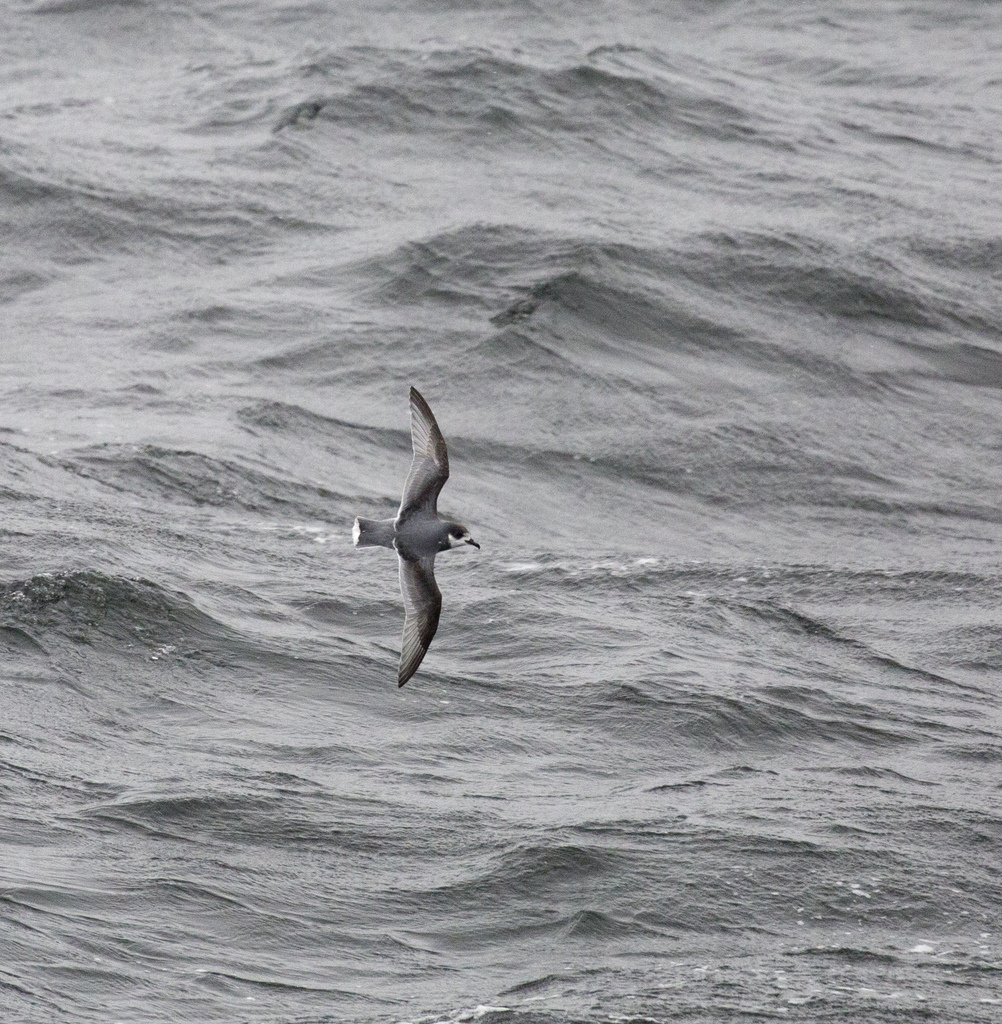
Blue Petrel
Photo © patrickc
Photo © patrickc — CC BY 4.0 — Source: iNaturalist #331930729The blue petrel (Halobaena caerulea) is a small seabird in the shearwater and petrel family, Procellariidae. This small petrel is the only member of the genus Halobaena, but is closely allied to the prions. It is distributed across the Southern Ocean but breeds at a few island sites, all close to the Antarctic Convergence zone. == Taxonomy == The blue petrel was first described in 1777 by the German naturalist Georg Forster in his book A Voyage Round the World. He had accompanied James Cook on Cook's second voyage to the Pacific. Forster did not give the blue petrel a binomial name, but when the German naturalist Johann Friedrich Gmelin updated Carl Linnaeus's Systema Naturae in 1789 he included a brief description of the bird, coined the binomial name Procellaria caerulea and cited Forster's book. The blue petrel is now the only species placed in the genus Halobaena that was introduced for the blue petrel in 1856 by French naturalist Charles Lucien Bonaparte. The name Halobaena combines the Ancient Greek hals, halos meaning "sea" with bainō meaning "to tread". The specific epithet caerulea is from Latin caeruleus meaning "blue". The word "petrel" is derived from Saint Peter and the story…
Volunteer Point
Stanley, Falkland Islands
+70 birds+3 mammals
Windswept grasslands meet volcanic black sand beaches where three penguin species converge in the South Atlantic's most theatrical wildlife theatre. This remote peninsula on East Falkland…
VIEW NATURE RESERVECabo de Hornos National Park
Cape Horn, Chile
+88 birds+9 mammals
Where the Andes plunge into the Southern Ocean and the Drake Passage churns between two continents, Cabo de Hornos National Park sprawls across one of Earth's…
VIEW NATIONAL PARKDeception Island
Gabriel de Castilla Base, Antarctica
+26 birds+10 mammals
Steaming geothermal vents pierce a landscape of blackened volcanic sand and ice, where the earth's raw power still trembles beneath your feet. This horseshoe-shaped caldera, flooded…
VIEW ISLAND & ARCHIPELAGOHalf Moon Island
Cámara Base, Antarctica
+25 birds+8 mammals
Jagged volcanic peaks rise from the cobalt waters of the South Shetland Islands, their slopes carpeted in moss and lichen where hardy vegetation clings to windswept…
VIEW ISLAND & ARCHIPELAGOSalisbury Plain
South Georgia, South Georgia and the South Sandwich Islands
+33 birds+4 mammals
Where tussock grasses bow to relentless Antarctic winds and glacial meltwater carves braided channels through obsidian volcanic soil, one of Earth's most remote wildlife sanctuaries reveals…
VIEW PROTECTED LANDSCAPESt. Andrews Bay
South Georgia, South Georgia and the South Sandwich Islands
+34 birds+6 mammals
Where windswept tundra dissolves into obsidian beaches, one of the planet's most extraordinary wildlife theaters unfolds across St. Andrews Bay. This remote corner of South Georgia…
VIEW PROTECTED LANDSCAPEFortuna Bay
Stromness, South Georgia and the South Sandwich Islands
+37 birds+5 mammals
Where tussock grasslands sweep down to black-sand beaches and elephant seals haul out in thunderous colonies, the raw sub-Antarctic landscape reveals itself in its most dramatic…
VIEW PROTECTED LANDSCAPEPrion Island
Prince Olav Harbour, South Georgia and the South Sandwich Islands
+36 birds+2 mammals
Windswept tussock grasslands rise sharply from boulder-strewn beaches where the Southern Ocean hurls its grey swells against black volcanic rock. This remote speck in South Georgia's…
VIEW ISLAND & ARCHIPELAGOCooper Bay
Cooper Bay, South Georgia and the South Sandwich Islands
+28 birds+5 mammals
Where black-sand beaches meet towering cliffs striped with cascading meltwater, one of the Southern Ocean's most dramatic amphitheaters reveals itself. Cooper Bay cuts a deep indent…
VIEW PROTECTED LANDSCAPEElsehul Bay
Bird Island Station, South Georgia and the South Sandwich Islands
+33 birds+4 mammals
Granite peaks rise sheer from the Southern Ocean, their weathered faces streaked with cascading meltwater and cloaked in tussock grass that bends beneath relentless winds. This…
VIEW PROTECTED LANDSCAPENo community photos yet. Log in to add the first one.
No community observations of this species yet.