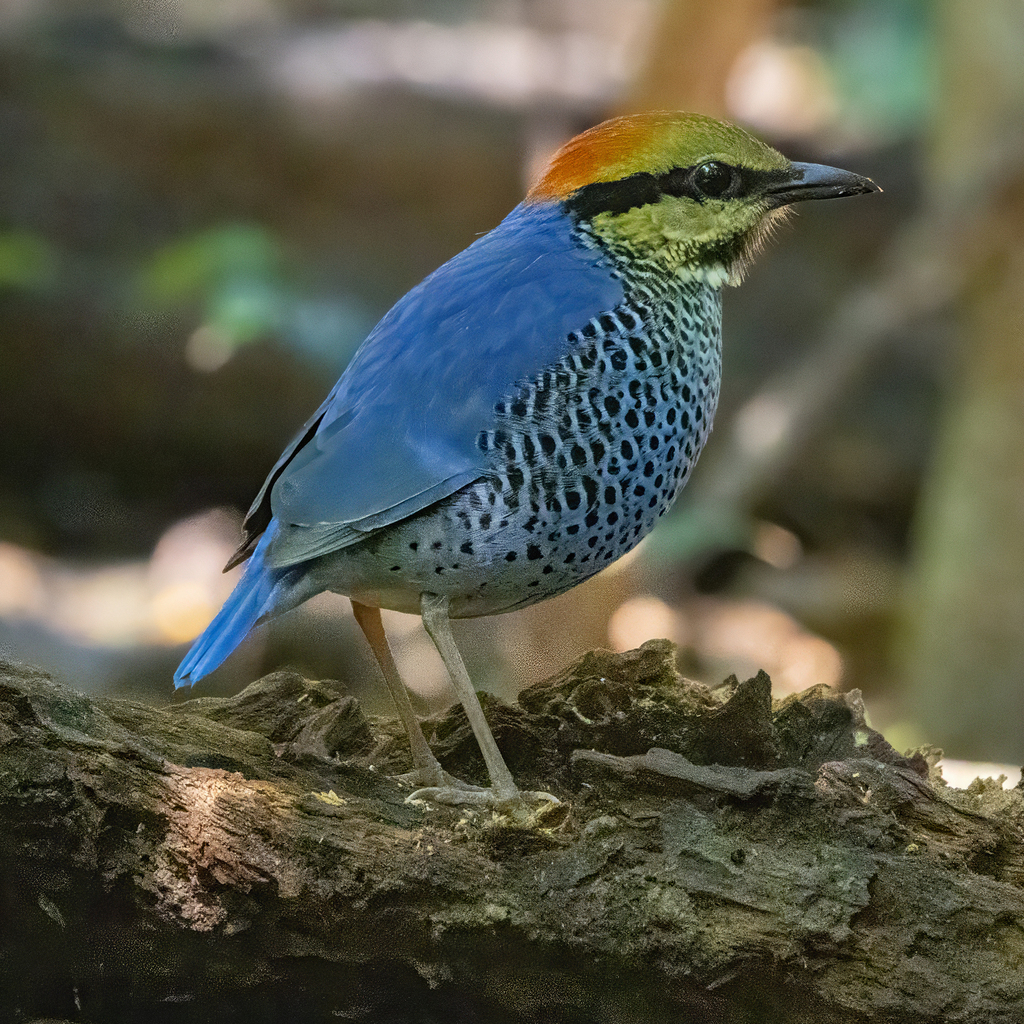
Blue Pitta
Photo © Dan Vickers
Photo © Dan Vickers — CC BY 4.0 — Source: iNaturalist #344423032Identification
The blue pitta is a compact, medium-sized forest bird measuring approximately 23 cm in length, with the stocky proportions and long legs characteristic of pittas. Males are particularly striking, featuring a bright yellow forehead and crown, contrasting with a vivid orange nape. A bold black stripe runs through each eye, and a shorter, less prominent stripe marks the chin. The male's back and tail are deep blue, while the breast is pale bluish and speckled with black. Females are more subdued, with grey backs and pale grey, black-speckled breasts. Both sexes have dark grey bills and pale pink legs. The species has a distinctive call—a long, drawn-out "pleoow-whit" or "choocoo-whip" that ends abruptly, a useful aid for locating these elusive birds.
Range & Habitat
The blue pitta is distributed across the northeastern Indian subcontinent, southern China, and Indochina, with three recognized subspecies occupying slightly different regions. H. c. cyaneus ranges from northeastern India and eastern Bangladesh through Myanmar, northern Laos, Vietnam, and southern Thailand to southern China. H. c. aurantiacus is found in eastern Thailand and southwestern Cambodia, while H. c. willoughbyi occurs in central Laos and southern Vietnam. The species inhabits forests from sea level up to approximately 2,000 metres elevation.
This is quintessentially a forest bird, preferring lowland and montane moist evergreen forests with bamboo growth, particularly near streams and ravines where moisture is abundant. However, it also adapts to drier tropical forests, demonstrating some habitat flexibility. It is particularly abundant on the Bolaven Plateau in Laos, though it remains scarce in India and China while being common throughout much of its broader range.
Behaviour & Diet
Blue pittas are notoriously shy and secretive, typically encountered as solitary birds foraging alone on the forest floor—even juveniles forage independently except when visited by parents. Being diurnal, they take advantage of daylight to locate their cryptic prey, though they often work in the darker recesses of the forest. They feed by methodically searching through leaf litter and probing the ground with their beaks, flicking away vegetation to uncover beetles and beetle larvae, spiders, snails, worms, and grubs.
Interestingly, despite their wariness, blue pittas will respond to playback recordings of their calls, making this a useful technique for observers. Breeding occurs seasonally, taking place in May and June in India and Myanmar, and between June and October in Thailand. Nests are large, bulky dome-shaped structures with side entrances, concealed within tangled vegetation.
Best Time & Places to See It
The Bolaven Plateau in Laos offers the best opportunity to encounter blue pittas, where the species is particularly abundant. The bird is present in various protected areas throughout its range. For those in India and China, patience and persistence are required, as the species is scarce in these regions. The breeding season (May to October, depending on location) may offer increased activity and responsiveness to calls, though the bird remains elusive year-round.
Photography Tips
Photographing blue pittas demands patience and skill. Focus on moist forest habitats near streams and ravines during early morning hours when light is best and the bird's diurnal activity peaks. Move slowly and quietly through the forest floor environment where they forage. Playing recordings of their distinctive call may prompt them to respond and become temporarily more visible. Males are far more photogenic than females due to their vibrant blue and yellow plumage, but expect frequent periods of searching between sightings. A telephoto lens is essential given the bird's wariness.
Khao Yai National Park
Prachantakham District, Thailand
+377 birds+46 mammals
Evergreen dipterocarp forest blankets the rolling terrain of this national park in eastern Thailand, where limestone hills rise abruptly from the forest floor and seasonal streams…
VIEW NATIONAL PARKKhao Laem National Park
Sangkhla Buri District, Thailand
+197 birds
Where the Vajiralongkorn Reservoir sprawls across the forested valleys of Kanchanaburi's northern borderlands, Khao Laem National Park protects a landscape where limestone ridges rise dramatically from…
VIEW NATIONAL PARKNo community photos yet. Log in to add the first one.
No community observations of this species yet.