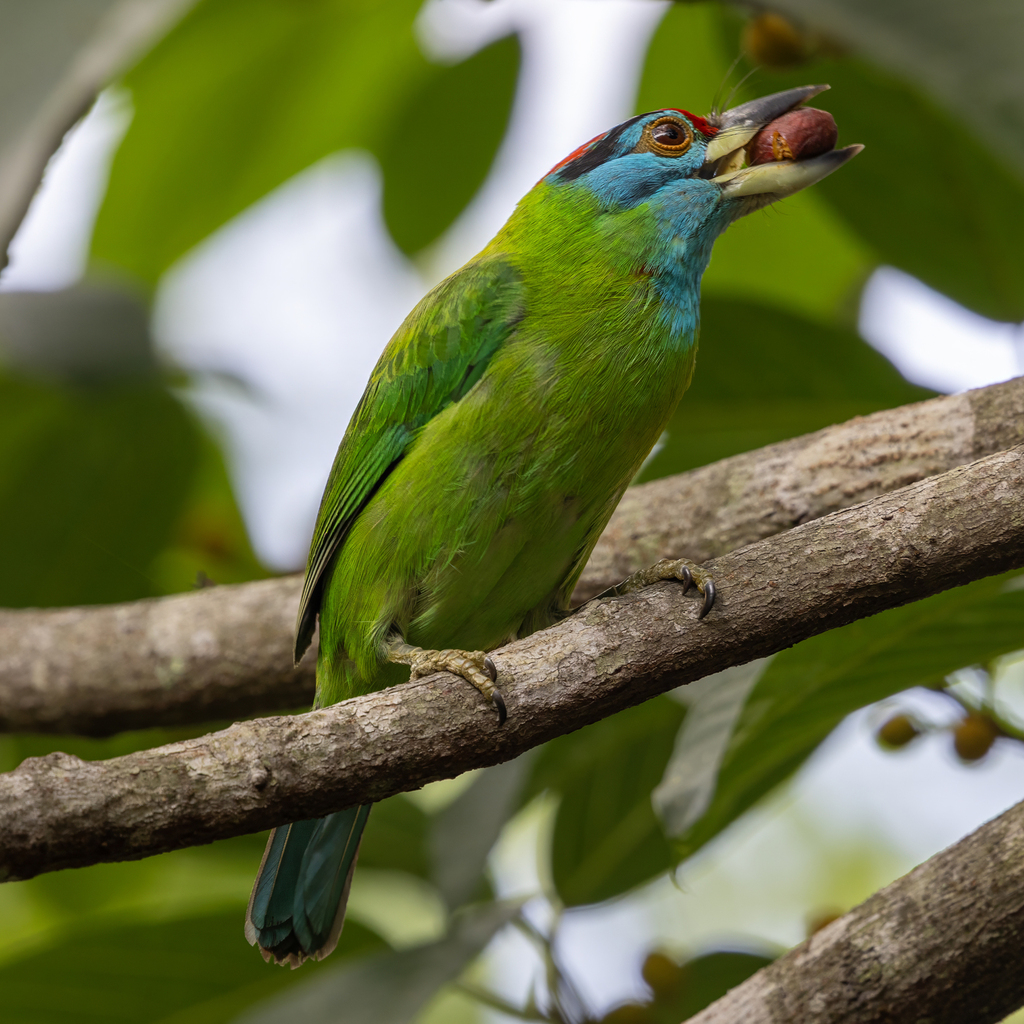
Blue-throated Barbet
Photo © Dan Vickers
Photo © Dan Vickers — CC BY 4.0 — Source: iNaturalist #344442725Identification
The Blue-throated Barbet is a stocky, medium-sized barbet, roughly the size of a myna, measuring 19–22 cm in length. Its most striking features are found on the head and neck: a bright red forehead, a distinctive black stripe across the crown, and a red rear crown create a bold facial pattern. The sides of the face, chin, and upper neck are pale blue, with red patches visible on the sides of the neck at the base of this blue coloring. The rest of the body is predominantly green, with lighter yellow-green undersides and a short tail that may show a bluish cast beneath. The eye-ring varies from brown to greenish-brown, orange-brown, or yellow, while the iris is reddish-brown. The stout, conical bill is pale at the base with a dark upper mandible and tip. Sexes are similar, though females are slightly heavier than males. Juveniles resemble adults but display muted and duller coloration, with red tinged orange and black appearing blue-black or dusky.
Range & Habitat
The Blue-throated Barbet is a non-migratory resident breeder distributed across the Lower Himalayas from northeastern Pakistan through northern and northeastern India, extending into the hill ranges of Southeast Asia. Two subspecies are recognized: the Red-crowned form from northeastern Pakistan to western, northern Myanmar and southwestern Yunnan, and the Blue-crowned form from southeastern Myanmar to southeastern Yunnan and northern Indochina.
This species inhabits lowland and montane forests at elevations between 200–2,000 meters. It thrives in tropical, evergreen, and deciduous forests and demonstrates adaptability to secondary forests and even urban areas, provided that fruiting trees are readily available. The bird is common throughout much of its range, though it is less frequently encountered in oil plantations, presumably due to the scarcity of fruit-bearing trees.
Behaviour & Diet
Despite its vibrant head markings, the Blue-throated Barbet's predominantly green plumage provides excellent camouflage among the forest canopy. However, the bird is easily located by its loud, continual calls—a distinctive advantage for birders and photographers. It produces repetitive calls consisting of notes such as took-a-rook, pu-ku-ruk, and kut-ru-uk, delivered at a rate of 90–105 times per minute. The bird exhibits a noisy, undulating flight pattern characterized by a few rapid wing beats followed by a brief pause. It calls frequently throughout the day and is often seen singly or in small groups.
The Blue-throated Barbet is primarily frugivorous, feeding extensively on fruits and berries, especially figs of Ficus species. It frequently forages in the upper canopy of fruiting trees. The diet is supplemented with insect larvae, crickets, mantids, large centipedes captured while perched, and occasionally flying termites caught in mid-air. Both sexes share domestic duties equally, including courtship feeding and vocalizations together. Courtship displays include head bobbing and twisting, as well as tail wagging.
Best Time & Places to See It
The nesting season from March to June offers an excellent opportunity to locate Blue-throated Barbets, as increased vocalization and activity accompany breeding. The bird is a common inhabitant of northeast India, making this region particularly reliable for sightings. Look for the species in lowland and foothill forests within the 200–2,000 meter elevation range throughout its Himalayan and Southeast Asian distribution.
Since the bird's green coloration makes visual spotting challenging, rely on its loud, frequent calls as your primary locating tool. Once you hear the distinctive took-a-rook or pu-ku-ruk vocalizations, scan the upper canopy of fruiting trees where the bird typically forages. Early morning and throughout the day are productive times, as the bird calls frequently from dawn onward.
Photography Tips
Photographing the Blue-throated Barbet requires patience and good audio awareness. Use the bird's distinctive loud calls to pinpoint its location in the canopy, then position yourself where fruiting trees offer good lighting and clear sightlines to the upper branches where the bird feeds. The contrasting head pattern—with its bright red, black, and blue facial markings—provides excellent photographic subject matter against green foliage, so aim to capture these distinctive head-on or profile views when possible.
The bird's undulating flight and noisy movement between fruiting trees offer dynamic shooting opportunities. Since it frequents the same fruiting trees repeatedly, returning to productive locations during the nesting season (March to June) increases your chances of capturing behavior images. Early morning light is typically best for canopy photography, and a telephoto lens will be essential for reaching birds feeding high in the trees.
Langtang National Park
Helambu, Nepal
+364 birds+14 mammals
Where the southern slopes of the Himalayan highlands descend toward the subtropical valleys of central Nepal, Langtang National Park sprawls across one of the subcontinent's most…
VIEW NATIONAL PARKOrang National Park
Rangagarapathar, India
+298 birds+1 mammals
Where the Brahmaputra's floodplains meet the foothills of Assam, Orang National Park unfolds across a mosaic of riverine grasslands, forests and wetlands that pulse with the…
VIEW NATIONAL PARKValmiki National Park
Ramnagar, India
+66 birds+6 mammals
Along Bihar's western frontier, where the Gandak River winds through subtropical forest and grassland, Valmiki National Park sprawls across terrain shaped by monsoon rains and seasonal…
VIEW NATIONAL PARKSagarmatha National Park
Khumjung, Nepal
+219 birds+7 mammals
Soaring peaks and deep glacial valleys define this alpine wilderness in northeastern Nepal, where the terrain rises from forested foothills into a realm of high-altitude tundra…
VIEW NATIONAL PARKKhangchendzonga National Park
Sakkyong, India
+290 birds+1 mammals
Where the eastern Himalayas surge toward their crowning peaks, Khangchendzonga National Park embraces a landscape of almost overwhelming vertical drama. Rising from subtropical river valleys into…
VIEW NATIONAL PARKPhou Khao Khouay National Protected Area
Thaphabath District, Thailand
+113 birds
Where the Annamite Mountains descend into central Thailand's monsoon forests, Phou Khao Khouay National Protected Area sprawls across rugged limestone terrain interlaced with river valleys and…
VIEW NATIONAL PARKKhao Laem National Park
Sangkhla Buri District, Thailand
+197 birds
Where the Vajiralongkorn Reservoir sprawls across the forested valleys of Kanchanaburi's northern borderlands, Khao Laem National Park protects a landscape where limestone ridges rise dramatically from…
VIEW NATIONAL PARKKaziranga National Park
Kohora, India
+422 birds+26 mammals
Dawn breaks over the floodplains of the Brahmaputra, where tall grasslands stretch endlessly beneath monsoon-heavy skies. This sprawling wilderness of northeastern Assam is a mosaic of…
VIEW NATIONAL PARKNanda Devi National Park
Garpak, India
+218 birds+5 mammals
Where the Himalayas surge into their most dramatic alpine amphitheater, a wilderness of raw geological power unfolds across 624 square kilometers of pristine terrain. Nanda Devi,…
VIEW NATIONAL PARKXishuangbanna National Nature Reserve
Xishuangbanna Dai Autonomous Prefecture, China
+173 birds+2 mammals
Where subtropical monsoon forests meet the margins of the Yunnan plateau, Xishuangbanna National Nature Reserve sprawls across a landscape of dramatic relief—deep river valleys carved by…
VIEW NATURE RESERVEGaoligong Mountain National Nature Reserve
Nujiang Lisu Autonomous Prefecture, China
+443 birds+13 mammals
VIEW NATURE RESERVENo community photos yet. Log in to add the first one.
No community observations of this species yet.