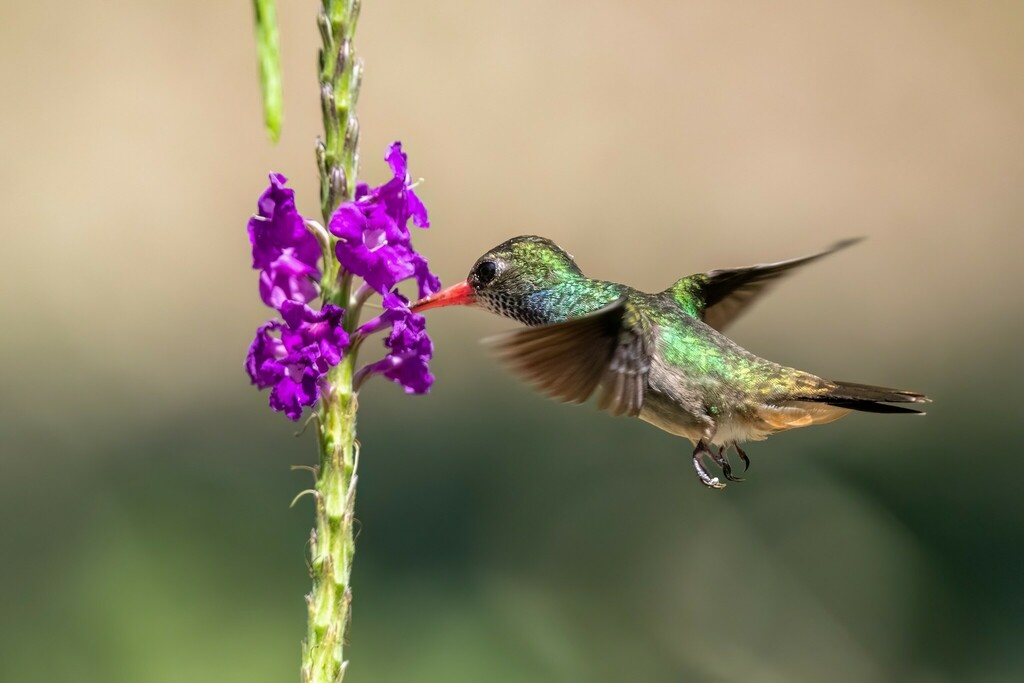
Blue-throated Sapphire
Photo © Adam Jackson
Photo © Adam Jackson — CC0 1.0 — Source: iNaturalist photo #339620395Identification
The Blue-throated Sapphire is a small hummingbird measuring 9 cm (3.5 inches) and weighing just 3.6 grams. Males are slightly larger than females and display more vibrant plumage. The most distinctive feature is the male's glittering blue-violet to violet throat, which contrasts sharply with its green crown and upperparts and cream-brown buff belly. The tail shades to a metallic golden-green, and the sides of the breast and flanks are streaked with green. Both sexes have a striking straight bill that is bright red with a black tip. Females are considerably paler overall, with a violet-blue throat mixed with gray buff and more black on the bill. Juveniles resemble females with duller colors, particularly noticeable in young females.
This species can be confused with the Rufous-tailed Hummingbird, which is larger with a longer rufous tail, green throat and breast, and a more curved bill. The Blue-headed Sapphire also resembles this species but differs by its blue crown, sides of the head, green throat, and blue tail. Where their ranges overlap in extreme eastern Panama and northwestern Colombia, the two species show no evidence of interbreeding.
Range & Habitat
The Blue-throated Sapphire is found from southern Mexico through Central America to western Panama, with a few occurrences in northern Chocó, Colombia. It occurs throughout Belize, Costa Rica, El Salvador, Guatemala, Honduras, Nicaragua, and Panama. The species is resident throughout most of its range, with seasonal movements that remain poorly documented.
This hummingbird occupies subtropical and tropical moist lowland forests and heavily degraded former forest areas. It typically inhabits lowlands and valleys, usually between 950 and 1000 meters elevation, though specimens have been recorded up to 2000 meters in places such as Braulio National Park in Costa Rica and in El Salvador.
Behaviour & Diet
Like all hummingbirds, the Blue-throated Sapphire is primarily nectarivorous, feeding on flowers of shrubs such as Stachytarpheta and Hamelia, as well as large herbs including Heliconia, Renealmia, and Thalea. It also feeds on epiphytes and occasionally supplements its diet with small arthropods.
Males are highly vocal and sing in leks with a distinctive song that varies between different leks and sometimes within a single lek. The typical song consists of 5-8 notes, beginning with a piercing "tseee" followed by single, double notes, or short trills, with males usually giving 1-3 phrases before pausing and repeating. The species produces high, buzzy "tzip" or "tzet" calls, with aggressive interactions accompanied by sharp, liquid, descending twitter sounds.
Best Time & Places to See It
The Blue-throated Sapphire is resident year-round throughout most of its range, making it a reliable species for wildlife travelers. The species is relatively common in suitable habitat across Central America, from Mexico through Panama. Look for this hummingbird in subtropical and tropical moist lowland forests and in areas of disturbed or degraded former forest, where flowering shrubs and herbs provide abundant nectar sources.
Photography Tips
Photographing this small hummingbird requires patience and careful attention to lighting. The male's glittering blue-violet throat is the defining field mark, but this iridescent coloration is highly directional and will only show brilliantly when the bird is positioned to catch the light at the correct angle. Position yourself with the sun behind you or to the side to maximize the throat's iridescence. Males singing in leks offer excellent opportunities to observe and photograph perched birds, though they may be territorial and vocal rather than hovering at flowers. Fast shutter speeds are essential to freeze wing motion, and a telephoto lens will help you maintain distance and minimize disturbance to this small bird.
Corcovado National Park
Puerto Jiménez, Costa Rica
+444 birds+48 mammals
Where the Osa Peninsula juts into the Pacific, rainforest descends almost to the tide line, and Corcovado National Park protects one of Central America's most intact…
VIEW NATIONAL PARKManuel Antonio National Park
Quepos, Costa Rica
+426 birds+22 mammals
Where tropical rainforest descends steeply to a rocky Pacific coastline, Manuel Antonio National Park distills Central American biodiversity into one of Costa Rica's most compressed and…
VIEW NATIONAL PARKArenal Volcano National Park
Peñas Blancas, Costa Rica
+551 birds+21 mammals
Straddling the border between Alajuela and Guanacaste in northwestern Costa Rica, this national park rises dramatically around one of Central America's most active volcanic systems. The…
VIEW NATIONAL PARKTortuguero National Park
Roxana, Costa Rica
+420 birds+23 mammals
Canals and lagoons thread through a labyrinth of lowland rainforest where the Caribbean coast of Costa Rica meets the wetland frontier. This is terrain shaped by…
VIEW NATIONAL PARKBraulio Carrillo National Park
Las Horquetas, Costa Rica
+547 birds+18 mammals
Where the Caribbean slope descends from the central volcanic cordillera toward the humid lowlands of Heredia, Braulio Carrillo National Park preserves one of Costa Rica's most…
VIEW NATIONAL PARKPiedras Blancas National Park
Golfito, Costa Rica
+386 birds+24 mammals
Where the Golfo Dulce meets the southwestern Pacific coast of Costa Rica, Piedras Blancas National Park protects a dramatic transition zone where lowland rainforest descends toward…
VIEW NATIONAL PARKSanta Rosa National Park
Santa Elena, Costa Rica
+359 birds+30 mammals
Where Pacific-facing slopes descend from volcanic uplands toward the Guanacaste lowlands, Santa Rosa National Park unfolds across a mosaic of tropical dry forest, gallery woodland, and…
VIEW NATIONAL PARKGuanacaste National Park
Santa Elena, Costa Rica
+461 birds+17 mammals
Where the Pacific slopes of northwestern Costa Rica rise toward the Continental Divide, dry tropical forest gives way to cloud-laden peaks and misty ridges—a landscape that…
VIEW NATIONAL PARKNatural Utría National Park
Alto Baudó (Pie de Pató), Colombia
+372 birds+11 mammals
Where the Chocó's coastal mountains plunge toward the Pacific, Utría National Park preserves one of Colombia's most biodiverse and least-visited wilderness expanses. Sprawling across 1,287 square…
VIEW NATIONAL PARKCoiba National Park
Montijo, Panama
+260 birds+10 mammals
An archipelago of volcanic and sedimentary islands rises from the Pacific waters off Panama's southwestern coast, its densest rainforest canopy unbroken for millennia. Coiba National Park…
VIEW NATIONAL PARKBaru Volcano National Park
Cerro Punta, Panama
+402 birds+6 mammals
Where the land rises sharply toward the Caribbean's western spine, Baru Volcano National Park sprawls across roughly 220 square kilometres of southwestern Panama, anchored by the…
VIEW NATIONAL PARKSoberanía National Park
Cristóbal, Panama
+495 birds+34 mammals
Rainforest and riverine woodland blanket the rolling terrain of this 714-square-kilometre national park in Colón Province, where the Caribbean watershed feeds a maze of streams and…
VIEW NATIONAL PARKDarién National Park
Tucutí, Panama
+534 birds+13 mammals
Where the spine of Central America crumbles into wetland and rainforest, Darién National Park sprawls across more than 20,000 square kilometres of some of the tropics'…
VIEW NATIONAL PARKMarino Golfo de Chiriquí National Park
Boca Chica, Panama
+82 birds+2 mammals
Where mangrove forests meet tropical Pacific waters, Marino Golfo de Chiriquí National Park spans 463 square kilometers of one of Central America's most biodiverse coastal systems.…
VIEW NATIONAL PARKLagunas de Montebello National Park
Laguna de Montebello, Mexico
+360 birds+2 mammals
Where turquoise lagoons pierce the limestone plateau of southeastern Chiapas, the Lagunas de Montebello National Park unfolds across roughly 174 square kilometers of spectral water and…
VIEW NATIONAL PARKCarara National Park
Tárcoles, Costa Rica
+397 birds+19 mammals
Where the Pacific coastal plain meets transitional forest, Carara National Park straddles one of Central America's most dynamic ecological boundaries. The park's landscape encompasses lowland deciduous…
VIEW NATIONAL PARKPalo Verde National Park
Bagaces, Costa Rica
+318 birds+24 mammals
Dry forest spreads across Palo Verde's low-lying terrain in northwestern Guanacaste, where seasonal rivers and lagoons etch through deciduous woodland that sheds its canopy each winter.…
VIEW NATIONAL PARKCahuita National Park
Talamanca, Costa Rica
+359 birds+15 mammals
Where the Caribbean shoreline dissolves into mangrove creeks and coral gardens, Cahuita's mosaic of habitats unfolds across the Limón coast. The park's signature feature—a living coral…
VIEW NATIONAL PARKRincón de la Vieja National Park
Liberia, Costa Rica
+451 birds+30 mammals
Where volcanic slopes rise abruptly from the Guanacaste lowlands, Rincón de la Vieja National Park sprawls across a landscape shaped by geothermal drama and seasonal extremes.…
VIEW NATIONAL PARKLa Amistad International Park
Crorina, Costa Rica
+532 birds+20 mammals
Where the Caribbean slopes of Costa Rica's Talamanca Mountains rise steeply inland from Limón, the boundary between two nations dissolves into an unbroken expanse of rainforest.…
VIEW NATIONAL PARKVolcán Tenorio National Park
Guatuso, Costa Rica
+480 birds+12 mammals
Where volcanic slopes rise through Costa Rica's northwestern borderlands, Volcán Tenorio National Park sprawls across terrain shaped by ancient lava flows and mineral-rich springs. The park's…
VIEW NATIONAL PARKMarino Ballena National Park
Bahía Ballena, Costa Rica
+336 birds+8 mammals
Where mangrove forests meet coral-fringed shorelines along Costa Rica's southern Pacific coast, Marino Ballena National Park encompasses a marine and terrestrial mosaic that ranks among Central…
VIEW NATIONAL PARKMarino Las Baulas National Park
Santa Cruz, Costa Rica
+246 birds+9 mammals
Where the Pacific meets a mosaic of dry forest and mangrove estuary, this coastal national park protects one of Central America's most dynamic wildlife theatres. The…
VIEW NATIONAL PARKCaño Negro National Wildlife Refuge
Caño Negro District, Costa Rica
+486 birds+16 mammals
Where the San Juan River's seasonal floodplain opens into expansive wetlands, Caño Negro Wildlife Sanctuary sprawls across one of Central America's most productive freshwater ecosystems. This…
VIEW WILDLIFE SANCTUARYGandoca-Manzanillo National Wildlife Refuge
Manzanillo, Costa Rica
+394 birds+18 mammals
Where the Caribbean coastal plain surrenders to water-logged forest and mangrove tangles, Gandoca-Manzanillo Wildlife Sanctuary shelters one of Costa Rica's most biodiverse lowland wetland ecosystems. The…
VIEW WILDLIFE SANCTUARYBarra del Colorado National Wildlife Refuge
Tortuguero, Costa Rica
+462 birds+36 mammals
Where the Caribbean's restless waters meet the Limón Province coastline, Barra del Colorado National Wildlife Sanctuary unfolds across a landscape of extraordinary ecological complexity. This equatorial…
VIEW WILDLIFE SANCTUARYCurú National Wildlife Refuge
Paquera, Costa Rica
+249 birds+8 mammals
Where the Pacific coast of Puntarenas dissolves into dry deciduous forest and mangrove fringe, Curú Wildlife Sanctuary holds one of Costa Rica's most ecologically vital yet…
VIEW WILDLIFE SANCTUARYNo community photos yet. Log in to add the first one.
No community observations of this species yet.