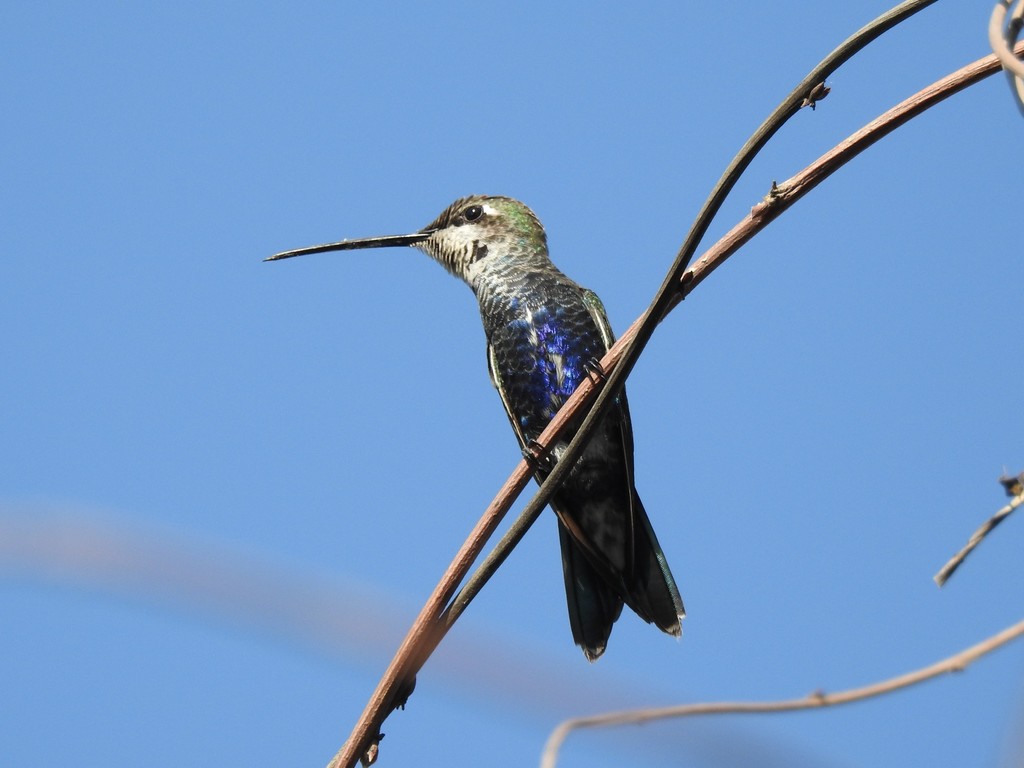
Blue-tufted Starthroat
Photo © Eduardo Luis Beltrocco
Photo © Eduardo Luis Beltrocco — CC BY 4.0 — Source: iNaturalist photo #72853695Identification
The blue-tufted starthroat is a small hummingbird, measuring 12.6 to 13 cm in length and weighing just 5 to 6.5 grams. Both sexes share a long, decurved black bill and a distinctive small white spot behind the eye, along with a forked tail, though the male's fork is more deeply indented than the female's.
Breeding males are particularly striking, with an emerald green crown, nape, and upper back, while the rest of the upperparts gleam with shining coppery green. The throat displays a glittering violet iridescence, and the underparts and elongated neck feathers are iridescent ultramarine—the "blue tufts" that give the species its name. Non-breeding males lose this splendor, becoming grayish below like females. Females have coppery green upperparts with a gray throat and underparts, a white line running down the belly, and green spots on the flanks. Their tail is bronze-green above with black tips on central feathers and shining blue-green below with white tips on the outer feathers.
Range & Habitat
The blue-tufted starthroat's core range spans eastern Bolivia, southern Brazil, Paraguay, northern Argentina, and northern Uruguay, with additional records from Colombia and Peru. A single undocumented sighting exists from Ecuador. The species inhabits open landscapes including forest edges, cerrado, and grasslands, making it a bird of transitional and semi-open environments rather than dense forest.
Behaviour & Diet
This hummingbird feeds primarily on nectar from a wide variety of flowering plants, and is one of the major pollinators of Dolichandra cynanchoides, a flowering vine. It typically forages between 2 and 8 meters above the ground. Males actively defend flower patches, and the species supplements its nectar diet by hawking for small insects in flight. The blue-tufted starthroat does not appear to have a conventional song, though it does produce a descending, pure-whistled "tseep" call.
Breeding occurs from November to March. Females construct cup nests from soft fibers covered with lichen, usually positioned 3 to 6 meters above the ground. A typical clutch consists of two eggs, which the female incubates for 15 to 16 days. Fledging occurs 20 to 25 days after hatching. The species' movement patterns remain poorly understood, though records at the edges of its range suggest possible post-breeding migration or dispersal.
Best Time & Places to See It
The breeding season from November to March offers the best opportunity to observe males in their brilliant plumage. The species is considered rare to locally common across its large range and occurs in some protected areas. The core range in eastern Bolivia, southern Brazil, Paraguay, and northern Argentina represents your best bet for encounters, particularly in open habitats such as forest edges and cerrado.
Photography Tips
Focus on photographing males during the breeding season when their iridescent throat and ultramarine underparts are most vibrant. The bird's preference for foraging 2 to 8 meters above ground makes it accessible to photographers with moderate telephoto lenses. Look for individuals defending flower patches, as males remain relatively stationary while feeding territorially. Backlighting will best reveal the glittering violet throat and iridescent blue tufts that make this species so visually distinctive.
Emas National Park
Brazil
+333 birds+23 mammals
Across the high plateaux of central Brazil, where the cerrado grasslands roll toward distant horizons under an immense sky, Emas National Park anchors one of South…
VIEW NATIONAL PARKIguaçu National Park
Brazil
+387 birds+17 mammals
Where the Paraná Plateau plunges toward the Atlantic watershed, six thousand square kilometers of subtropical rainforest cling to steep gorges and river valleys in this corner…
VIEW NATIONAL PARKIlha Grande National Park
Brazil
+233 birds
Across the subtropical plateaus and Atlantic forest remnants of southern Brazil, a vast protected landscape spanning nearly 4,600 square kilometers safeguards one of the continent's most…
VIEW NATIONAL PARKChapada dos Guimarães National Park
Brazil
+450 birds+1 mammals
Where weathered sandstone plateaus rise above the cerrado grasslands of central Brazil, Chapada dos Guimarães National Park protects 624 square kilometres of ecological transition zone that…
VIEW NATIONAL PARKChapada dos Veadeiros National Park
Brazil
+324 birds+6 mammals
Where granite plateaus rise above the cerrado savanna in central Brazil, Chapada dos Veadeiros National Park unfolds across 6,665 square kilometres of some of the world's…
VIEW NATIONAL PARKPantanal Matogrossense National Park
Brazil
+322 birds+17 mammals
Where the flooded forests of central Brazil meet vast seasonally inundated grasslands, Pantanal Matogrossense National Park sprawls across nearly 2,900 square kilometers of one of the…
VIEW NATIONAL PARKEl Palmar National Park
Distrito Sexto, Argentina
+244 birds+14 mammals
Across the Paraná River floodplain in northeastern Argentina, palms rise from wetland and grassland in a landscape shaped by water and time. El Palmar National Park…
VIEW NATIONAL PARKRío Pilcomayo National Park
Argentina
+271 birds+13 mammals
Where the Río Pilcomayo cuts through northeastern Argentina's subtropical lowlands, a sprawling mosaic of wetlands, grasslands, and seasonally flooded forests creates one of South America's most…
VIEW NATIONAL PARKIguazú National Park
Puerto Iguazú, Argentina
+346 birds+15 mammals
Where the Paraná Plateau plunges toward the Atlantic watershed, nearly 800 square kilometers of subtropical rainforest drape across Misiones Province in a landscape carved by millennia…
VIEW NATIONAL PARKEl Rey National Park
Municipio de Las Lajitas, Argentina
+317 birds+4 mammals
Where the eastern slopes of the Andes descend into northwestern Argentina's subtropical transition zone, El Rey National Park unfolds across 841 square kilometers of dramatically varied…
VIEW NATIONAL PARKCalilegua National Park
Municipio de Calilegua, Argentina
+288 birds+8 mammals
Where the eastern Andean slopes plunge into northwestern Argentina's humid subtropics, nearly 2,645 square kilometers of steep terrain and luxuriant forest compose one of South America's…
VIEW NATIONAL PARKSierra de las Quijadas National Park
Argentina
+168 birds+5 mammals
Sandstone cliffs and deeply incised canyons define this 1,137-square-kilometre expanse in San Luis Province, where the dry Chacoan landscape of central Argentina reveals an unexpected ecological…
VIEW NATIONAL PARKParque Provincial Pampa del Indio
Laguna Limpia, Argentina
+231 birds+4 mammals
Across the flat horizons of Chaco Province, where the Paraná River system spills into vast wetlands and grasslands, Parque Provincial Pampa del Indio protects one of…
VIEW NATURE RESERVEChaco National Park
Municipio de Presidencia de la Plaza, Argentina
+258 birds+7 mammals
Across the humid subtropical lowlands of northeastern Argentina, where the Paraná River basin feeds vast seasonal wetlands and gallery forests, Chaco National Park protects one of…
VIEW NATIONAL PARKNo community photos yet. Log in to add the first one.
No community observations of this species yet.