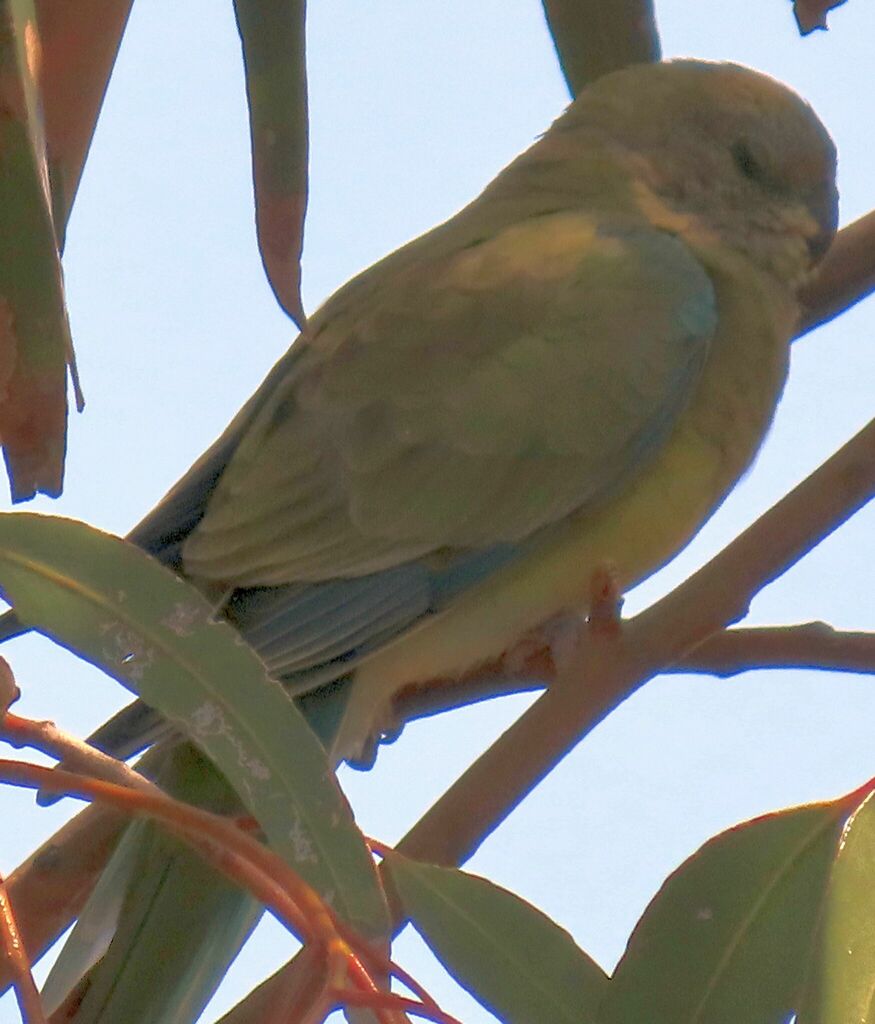
Blue-winged Parrot
Photo © ian_mcallan
Photo © ian_mcallan — CC BY 4.0 — Source: iNaturalist #260965895Identification
The blue-winged parrot is a small parrot measuring 20 to 24 cm long and weighing around 55 g. Both sexes are predominantly olive-green, but they differ noticeably in plumage. Males are more striking, displaying a distinctive two-toned blue frontal band across the face (ultramarine above, paler turquoise below), a yellowish crown, pale green throat and breast, and a yellow belly. Their wings are characterized by deep blue coverts. Females are considerably duller, with dull olive underparts, smaller blue patches on the wings, and a less distinctive frontal band. Juveniles are dull olive-green with slate-blue wings and lack the frontal band entirely. The greater amount of blue on the wings helps distinguish this species from the similar elegant parrot and orange-bellied parrot, which display more yellow-green or bright green plumage overall.
Range & Habitat
The blue-winged parrot is found across southeastern Australia, ranging from the Flinders Ranges in eastern South Australia, across Victoria, and sporadically through central and western New South Wales into Queensland as far north as Diamantina National Park. The species favours open habitats including savannah woodland, grasslands, orchards, farmlands, marshes, heath, and dunes, typically at elevations up to 1,200 metres above sea level. Notably, it is one of only three parrot species that undertake regular yearly migrations across sea or ocean, with many individuals travelling between Tasmania—where they breed in spring and summer—and the mainland, where they winter. However, some populations remain sedentary year-round, either wintering in Tasmania or breeding on the mainland during summer. The species is a spring visitor to King Island in the Bass Strait.
Behaviour & Diet
Blue-winged parrots are predominantly ground feeders, specializing in grass seeds. Their diet includes wallaby grass and silver hairgrass in southern regions, pale sundew in Tasmania, and species such as Poa caespitosa and the introduced capeweed on the mainland. In Queensland, they feed on tangled lignum. They have been observed feeding alongside European goldfinches in Victoria. Flock sizes vary considerably with season, ranging from pairs during breeding season to aggregations of up to 2,000 birds just before autumn migration. Breeding occurs from September to January, with birds attempting one to two broods each season. They nest in hollows of live and dead trees, typically eucalypts, situated up to 20 metres above ground. Clutches consist of four to six glossy white eggs, with incubation lasting approximately 20 days and nestling periods of around 35 days.
Best Time & Places to See It
Spring and summer are the prime seasons to observe blue-winged parrots in Tasmania, where breeding populations concentrate. On the Australian mainland, winter months offer the best viewing opportunities for migratory birds. Suitable habitats to search include open grasslands, farmlands, and savannah woodlands throughout southeastern Australia, particularly in Victoria and along the south coast. Observers should also consider visiting King Island during spring when the species arrives as a seasonal visitor. Early morning and late afternoon often provide the most active feeding periods, when birds are most visible on the ground.
Photography Tips
The blue-winged parrot's ground-feeding behaviour offers excellent opportunities for photography, as birds often remain at close range while foraging. The sexual dimorphism of the species makes it rewarding to capture images of both males and females for comparison; males with their vibrant blue frontal bands and deep blue wing coverts provide particularly striking subjects. Photographing flocking behaviour, especially the large aggregations before autumn migration, can yield dynamic images. Use of natural morning or afternoon light will best showcase the blue and green plumage details. Patient observation of breeding sites in eucalypt hollows during the September-January season may also reward photographers with family group images.
Greater Bendigo National Park
Whipstick, Australia
+202 birds+8 mammals
Across the red volcanic plains of inland Victoria, Greater Bendigo National Park sprawls across more than 1,000 square kilometres of eucalyptus woodland, open grassland, and scattered…
VIEW NATIONAL PARKIkara-Flinders Ranges National Park
Australia
+149 birds+10 mammals
Where ancient quartzite ridges rise across the semi-arid heart of South Australia, Ikara-Flinders Ranges National Park unfolds across nearly two thousand square kilometres of one of…
VIEW NATIONAL PARKKinglake National Park
Australia
+164 birds+11 mammals
Where the volcanic plains of central Victoria rise into forested ridges, Kinglake National Park encompasses roughly 844 square kilometres of diverse habitat that represents one of…
VIEW NATIONAL PARKLower Glenelg National Park
Australia
+161 birds+12 mammals
Where the Glenelg River carves through southeastern Victoria's limestone country, Lower Glenelg National Park unfolds across nearly 800 square kilometres of river gorge, eucalypt woodland, and…
VIEW NATIONAL PARKBudj Bim National Park
Australia
+137 birds+7 mammals
Across southwestern Victoria's volcanic plains, Budj Bim National Park preserves a landscape shaped by ancient lava flows and Indigenous land stewardship spanning millennia. The park's 184…
VIEW NATIONAL PARKLittle Desert National Park
Australia
+200 birds+11 mammals
Across northwestern Victoria's semi-arid interior, sandstone ridges and heathland plateaus rise from red earth in a landscape sculpted by fire and drought rather than water. Little…
VIEW NATIONAL PARKNaracoorte Caves National Park
Australia
+116 birds+12 mammals
Beneath the grassy limestone plains of southeastern South Australia lies one of the Southern Hemisphere's most significant underground landscapes. Naracoorte Caves National Park encompasses a mosaic…
VIEW NATIONAL PARKWilsons Promontory National Park
Australia
+210 birds+21 mammals
Where granite headlands plunge toward Bass Strait, Wilson's Promontory National Park sprawls across nearly 1,300 square kilometers of southeastern Victoria's most rugged coastal wilderness. The park's…
VIEW NATIONAL PARKKosciuszko National Park
Australia
+211 birds+52 mammals
Where the Great Dividing Range reaches its highest peaks in southeastern Australia, Kosciuszko National Park encompasses a landscape of windswept plateaus, rocky ridges, and deep river…
VIEW NATIONAL PARKMungo National Park
Australia
+135 birds+7 mammals
Across the semi-arid inland plains of New South Wales, where sparse shrubland and scattered grassland stretch beneath enormous skies, lies a landscape shaped by ancient geological…
VIEW NATIONAL PARKGrampians National Park
Australia
+214 birds+18 mammals
Where sandstone ridges rise above the Western District of Victoria, Grampians National Park unfolds across rolling terrain sculpted by ancient geology and sustained by a temperate…
VIEW NATIONAL PARKGreat Otway National Park
Australia
+255 birds+42 mammals
Temperate rainforest and wet eucalyptus woodland cloak the ridges and gullies of Victoria's Great Otway National Park, where persistent moisture and mild year-round temperatures sustain a…
VIEW NATIONAL PARKMurray-Sunset National Park
Australia
+205 birds+2 mammals
Across the semi-arid borderlands of northwestern Victoria, where the Murray River defines the state's edge, sprawls a landscape of remarkable resilience and subtle beauty. Murray-Sunset National…
VIEW NATIONAL PARKPort Campbell National Park
Port Campbell, Australia
+170 birds+7 mammals
Dramatic sea cliffs rise from churning waters along Victoria's southwestern coast, where sandstone and limestone formations tower over a hundred metres above the Southern Ocean. Port…
VIEW NATIONAL PARKCoorong National Park
Australia
+217 birds+15 mammals
Where the Murray River meets the Southern Ocean, a chain of shallow lagoons stretches across the South Australian coast, separated from the sea by a ribbon…
VIEW NATIONAL PARKCradle Mountain-Lake St Clair National Park
Australia
+72 birds+8 mammals
Where glacial valleys plunge between quartzite peaks, Tasmania's Cradle Mountain-Lake St Clair National Park unfolds as a temperate wilderness of uncommon grandeur. The park's terrain ranges…
VIEW NATIONAL PARKFreycinet National Park
Coles Bay, Australia
+115 birds+9 mammals
Granite peaks rise abruptly from the Tasmanian coast where Coles Bay opens into the Freycinet Peninsula, sculpting one of southeastern Australia's most dramatically vertical national parks.…
VIEW NATIONAL PARKNo community photos yet. Log in to add the first one.
No community observations of this species yet.