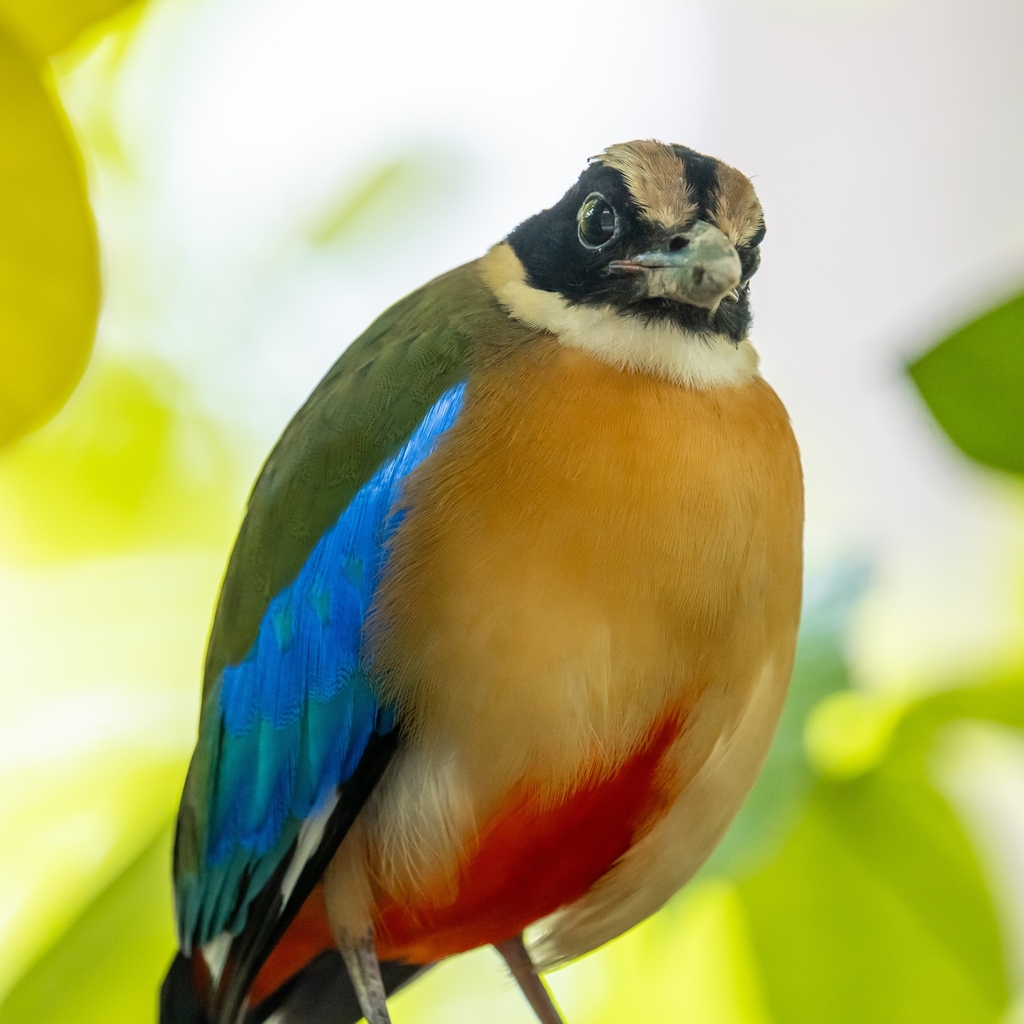
Blue-winged Pitta
Photo © Carman Chew
Photo © Carman Chew — CC BY 4.0 — Source: iNaturalist #259029170Identification
The blue-winged pitta is a striking small passerine measuring 180–205 mm in length, unmistakable in its brilliant plumage. It features a black head with a distinctive buff-coloured stripe above the eye, a white chin, and buff underparts. The back and shoulders are greenish, while the wings are bright blue—the bird's most eye-catching feature. The vent area is reddish, and the bird has a notably short tail. The bill is black, eyes are brown, and legs are pale pink. Juveniles display similar patterns but are noticeably duller. The loud, distinctive call is transcribed as taew-laew taew-laew.
The blue-winged pitta resembles the mangrove pitta, but can be reliably distinguished by its shorter bill. This is one of four closely related species forming a superspecies complex with the Indian pitta, fairy pitta, and mangrove pitta.
Range & Habitat
The blue-winged pitta is regularly found across a vast swathe of Asia, from central Myanmar eastward through Thailand and peninsular Malaysia, with its range extending into India, Indonesia, southern China, and the Philippines. It has been recorded as a vagrant to Australia, Christmas Island, Taiwan, and Hong Kong. It serves as a winter visitor to Borneo and Sumatra.
This species favours lowland subtropical and tropical forests and is remarkably adaptable, occurring in broadleaved forests, parks, gardens, and mangroves up to 800 metres elevation. Notably, it actively avoids dense rainforest, preferring more open woodland habitats where it can forage effectively on the ground.
Behaviour & Diet
The blue-winged pitta is primarily a ground feeder, hunting worms, insects, and hard-shelled snails by foraging on the leaf litter or from low branches and perches. Its secretive nature and preference for the forest floor make it somewhat elusive despite its colourful appearance.
Breeding occurs in spring, with birds in peninsular Malaysia laying eggs from early May through late July. The pitta constructs a characteristically large, untidy spherical nest from twigs, roots, grasses, leaves, and mosses, typically positioned on the ground between tree roots near water and featuring a side entrance. Clutches comprise 4–6 white or cream-coloured eggs marked with purple. Both parents incubate the eggs for 15–17 days until hatching.
Best Time & Places to See It
The breeding season from May to July offers the best opportunity to encounter this species, particularly in peninsular Malaysia where it is regular. Thailand and Myanmar are reliable locations within its core range. Winter visitors should also check Borneo and Sumatra during the cooler months. Early mornings when the bird's loud call is most active increase the chances of locating this ground-dwelling species.
Look for the blue-winged pitta in open woodland, forest margins, and gardens rather than in dense interior forest. Its preference for areas near water and between tree roots makes forest floors and damp woodland edges prime habitat to search.
Photography Tips
The blue-winged pitta's bright blue wings and contrasting black head make it visually striking, but its ground-foraging habits and preference for shaded forest understory present challenges. Early morning light, when the bird is most active and vocal, provides the best opportunities for photography. A longer lens (300–400 mm equivalent) is advisable given the bird's wariness and the often-dappled light of its woodland habitat.
Patient waiting near known feeding areas, especially near water margins and around fallen logs and leaf litter, increases success rates. The bird's loud call can help locate individuals. Avoid dense rainforest; focus instead on open woodland edges and clearings where light penetration is better and the bird is more visible.
Phou Khao Khouay National Protected Area
Thaphabath District, Thailand
+113 birds
Where the Annamite Mountains descend into central Thailand's monsoon forests, Phou Khao Khouay National Protected Area sprawls across rugged limestone terrain interlaced with river valleys and…
VIEW NATIONAL PARKHat Noppharat Thara-Mu Ko Phi Phi National Park
Ao Nang, Thailand
+253 birds+9 mammals
Where limestone karsts rise dramatically from turquoise waters, Hat Noppharat Thara-Mu Ko Phi Phi National Park unfolds across a mosaic of beach, mangrove forest, and island…
VIEW NATIONAL PARKKhao Yai National Park
Prachantakham District, Thailand
+377 birds+46 mammals
Evergreen dipterocarp forest blankets the rolling terrain of this national park in eastern Thailand, where limestone hills rise abruptly from the forest floor and seasonal streams…
VIEW NATIONAL PARKMu Ko Similan National Park
Lam Kaen, Thailand
+82 birds+1 mammals
Granite islands rise from the Andaman Sea in a scattered archipelago where limestone cliffs meet turquoise shallows, their steep faces weathered into caves and overhangs that…
VIEW NATIONAL PARKKhao Laem Ya-Mu Ko Samet National Park
Mueang Rayong District, Thailand
+159 birds+3 mammals
Where limestone hills meet the Gulf of Thailand, Khao Laem Ya–Mu Ko Samet National Park stitches together a mosaic of terrestrial and marine worlds that few…
VIEW NATIONAL PARKKhao Laem National Park
Sangkhla Buri District, Thailand
+197 birds
Where the Vajiralongkorn Reservoir sprawls across the forested valleys of Kanchanaburi's northern borderlands, Khao Laem National Park protects a landscape where limestone ridges rise dramatically from…
VIEW NATIONAL PARKBako National Park
Kuching, Malaysia
+210 birds+17 mammals
Weathered sandstone cliffs rise dramatically from the South China Sea, their ochre faces sculpted by millennia of wind and tide into a landscape of extraordinary geological…
VIEW NATIONAL PARKTaman Negara National Park
Kampong Samas, Malaysia
+393 birds+48 mammals
Where ancient rainforest meets limestone peaks, one of Southeast Asia's oldest protected wilderness preserves sprawls across 4,343 square kilometers of primordial landscape. Dipterocarp giants tower overhead,…
VIEW NATIONAL PARKPenang National Park
Balik Pulau, Malaysia
+107 birds+2 mammals
Granite peaks rise abruptly from the Andaman Sea where tropical rainforest clings to steep slopes in one of Malaysia's oldest protected landscapes. Mangrove forests fringe the…
VIEW NATIONAL PARKGunung Mulu National Park
Long Seridan, Malaysia
+280 birds+39 mammals
Where granite monoliths pierce the rainforest canopy of Sarawak, an ancient limestone karst landscape reveals one of Southeast Asia's most biodiverse strongholds. Soaring peaks cloaked in…
VIEW NATIONAL PARKWay Kambas National Park
Lampung Timur, Indonesia
+237 birds+20 mammals
Across the low swamplands of eastern Lampung, where freshwater wetlands merge into tidal mangrove forests along the Sunda Strait, sprawls one of Sumatra's most vital sanctuaries.…
VIEW NATIONAL PARKNo community photos yet. Log in to add the first one.
No community observations of this species yet.