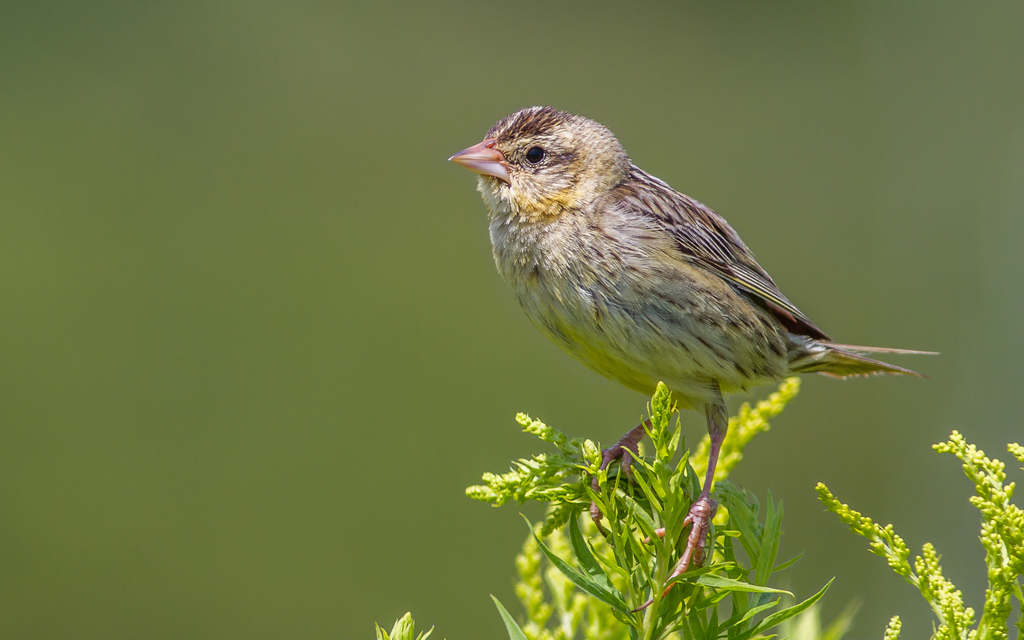
Bobolink
Photo © Fyn Kynd
Photo © Fyn Kynd — CC BY-SA 4.0 — Source: iNaturalist photo #2576095Identification
The bobolink is a small blackbird, measuring 6.3–7.1 inches long and weighing about 1 ounce, with a distinctive short, finch-like bill. Males in breeding plumage are unmistakable: mostly black with a creamy nape and contrasting white scapulars, lower back, and rump—a striking pattern that makes them easy to spot in open fields. Females are quite different, appearing mostly light brown with black streaks on the back and flanks and dark stripes on the head; their wings and tails are noticeably darker than their bodies.
The bobolink's name derives from its remarkable song, described by ornithologist Arthur Bent as "a bubbling delirium of ecstatic music" that flows like sparkling champagne—a comparison that captures the bird's unique and difficult-to-imitate vocal performance. Males sing two distinct song types, often combining them into compound songs delivered both from perches and in flight.
Range & Habitat
Bobolinks breed across the northern United States and southern Canada during summer, with their range extending from the Midwestern states to the Canadian Maritimes. They are famous for their extraordinary long-distance migration: one tracked individual traveled 12,000 miles over a year, sometimes covering up to 1,100 miles in a single day before resting for days or weeks. They winter in southern South America, primarily in Paraguay, Argentina, and Bolivia.
Historically, bobolinks nested in tallgrass and mixed-grass prairies of the Great Plains; today, modern breeding habitats include open grassy fields, particularly hay fields, across the northern half of North America. During migration, they often travel in flocks, feeding on cultivated grains and rice—a habit that has earned them old names like "rice bird" and "reedbird." Remarkably, bobolinks are the only land birds known to annually migrate through the Galápagos Islands, more than 1,200 miles from their primary migration route.
Behaviour & Diet
Bobolinks forage on or near the ground, primarily eating seeds and insects. They have earned the nickname "armyworm bird" for their significant predation on large numbers of armyworms, including the true armyworm and fall armyworm, making them valuable natural pest controllers. In Florida, they feed more often on fall armyworms, which are more abundant there than true armyworms.
During breeding season in high-quality habitats, males are often polygynous, attending to multiple nests. Females construct cup-shaped ground nests alone and lay three to seven eggs; both parents feed the young. The species' long-distance migrations sometimes have unexpected consequences—bobolinks have been found carrying seeds from invasive plants entangled in their feathers, potentially dispersing them across continents.
Best Time & Places to See It
To observe bobolinks, visit open grassy fields and hay fields in the northern United States and Canada during the breeding season (late spring through summer). The birds are most vocal and visible when males are singing from perches or in flight. During migration periods, they can be encountered in various habitats where they pause to feed on grain and seed crops. The Galápagos Islands offer a unique opportunity to see this species far from its primary range, though sightings there are rare.
Bobolinks have been recorded as vagrants in Europe, though such sightings remain uncommon, with most records concentrated in the British Isles.
Photography Tips
Capture the bobolink's striking male plumage in strong morning or afternoon light to showcase the contrast between black and white markings and the distinctive creamy nape. Males are most active and visible while singing, either perched or in flight—anticipate flight photography by positioning yourself near singing birds. The females' more subdued brown coloring blends into grassland backgrounds, so shoot in conditions that provide definition against the habitat.
During migration, when bobolinks gather in flocks at feeding sites, you may capture behavioral shots of multiple individuals. Note that breeding birds are most vocal and active during spring and early summer, making this the optimal season for both sound recording and visual documentation of their remarkable displays.
Acadia National Park
Alaska Maritime National Wildlife Refuge
Algonquin Provincial Park
Alligator River National Wildlife Refuge
Amacayacu National Park
Badlands National Park
Banff National Park
Bear River Migratory Bird Refuge
Bic National Park
Nothing matches these filters.
No community photos yet. Log in to add the first one.
No community observations of this species yet.