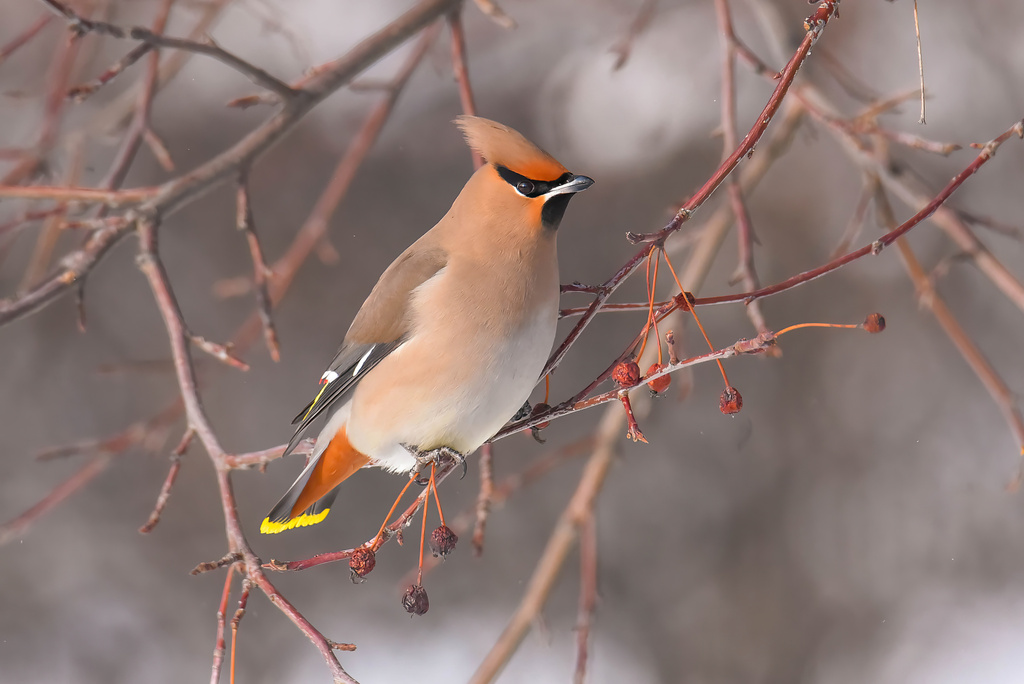
Bohemian Waxwing
Photo © Настя Бухвалова
Photo © Настя Бухвалова — CC BY 4.0 — Source: iNaturalist photo #618069027Identification
The Bohemian waxwing is a starling-sized passerine measuring 19–23 cm in length with a wingspan of 32–35.5 cm. It is unmistakable in appearance: a short-tailed, stocky bird with soft plumage and a conspicuous pointed crest. The plumage is mainly buff-grey, with a distinctive black face mask through the eye and black throat. White streaks behind the bill and below the eye add subtle elegance to the face pattern. The lower belly displays rich chestnut colouration, while cinnamon areas frame the mask.
The wings are the bird's most striking feature. The flight feathers are black, with primaries showing yellow stripes and white "fishhooks" on the closed wing. The secondaries end in distinctive long red appendages that resemble drops of sealing wax—the origin of the bird's common name. The tail ends in a bright yellow band with a broad black border. Females are similar to males, though young birds are less well-marked and lack or have few of the characteristic red waxy wingtips. The Bohemian waxwing is easily distinguished from the cedar and Japanese waxwings by its larger size and plumage differences.
Range & Habitat
The Bohemian waxwing breeds across the northern forests of the Palearctic and North America. In Europe, the nominate subspecies ranges from northern Norway eastward to the Ural Mountains, while another subspecies inhabits northern Asia from the Urals across Siberia. A third subspecies breeds in northwestern North America. The preferred breeding habitat consists of coniferous forests, usually located near water.
Many birds abandon their breeding range during winter and migrate farther south. In certain years, large numbers of Bohemian waxwings irrupt far beyond their normal winter range, reaching unusual locations as they search for fruit. During these winter movements, they become notably tame, readily entering towns and gardens in their quest for food.
Behaviour & Diet
Bohemian waxwings are highly social birds, often seen in large flocks, particularly outside the breeding season. Their flight resembles that of common starlings—fast, direct, and performed with long wings and short tail. They breed in pairs, building lined cup-shaped nests in trees or bushes, often close to the trunk. A clutch of 3–7 eggs is incubated by the female alone for 13–14 days. The altricial chicks are fed by both parents, initially mostly with insects but thereafter mainly with fruit. Young birds fledge 14–16 days after hatching.
Fruit forms the staple of the adult diet, with rowan berries being a particular favourite. Remarkably, waxwings possess the ability to metabolise alcohol produced in fermenting fruit, though they can still become intoxicated—occasionally fatally. Hazards to survival include predation by birds of prey, parasitic infestation, and collisions with vehicles or windows.
Best Time & Places to See It
Winter is the prime season for observing Bohemian waxwings, when they are most likely to venture into accessible areas such as towns and gardens. During irruption years, when food shortages in their normal range drive large numbers southward, sightings may occur far beyond their usual haunts. The birds' tameness during winter makes them relatively approachable in these human-modified landscapes.
The coniferous forests of northern Europe, Asia, and North America provide the best opportunities to see breeding birds during summer, though they are less accessible to most travellers. Winter sightings in fruit-bearing areas—particularly where rowan, hawthorn, and other berry-producing shrubs and trees grow—offer the most reliable viewing opportunities for most observers.
Photography Tips
Photograph Bohemian waxwings in winter when they are most tame and present in accessible locations. Their distinctive plumage, particularly the red-tipped secondaries and yellow tail band, photograph well in natural light. The crest is often raised, adding to the bird's striking silhouette.
Large flocks present excellent opportunities for behavioural photography—capture them feeding on berry-laden branches or in flight, when their starling-like flocking behaviour is apparent. Winter light may be low, so fast film or high ISO settings may be necessary. Close approach is often possible in winter, allowing detailed shots of the intricate wing patterns and facial markings that make this species so distinctive.
Tombstone Territorial Park
Acadia National Park
Alaska Maritime National Wildlife Refuge
Algonquin Provincial Park
Arctic National Wildlife Refuge
Åsnens National Park
Avesnois Regional Nature Park
Baikal National Park
Banff National Park
Nothing matches these filters.
No community photos yet. Log in to add the first one.
No community observations of this species yet.