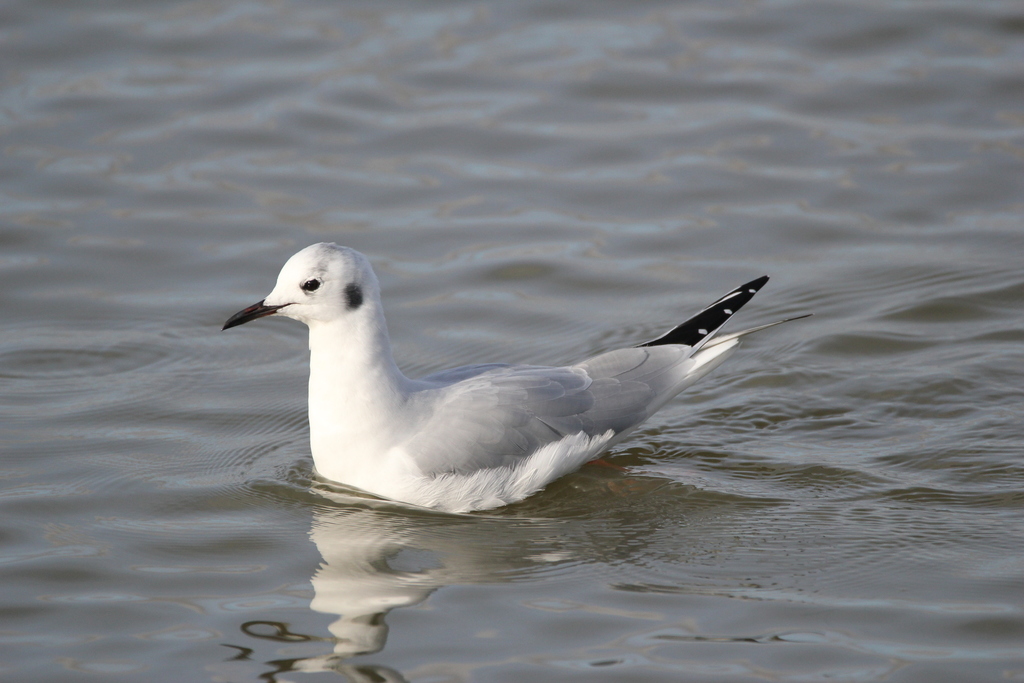
Bonaparte’s Gull
Photo © Quinten Wiegersma
Photo © Quinten Wiegersma — CC BY 4.0 — Source: iNaturalist photo #30950262Identification
Bonaparte's gull is one of the smallest gull species, measuring just 28 to 38 cm (11 to 15 in) in length with a wingspan of 76–84 cm (30–33 in). Adults display mainly white plumage with grey upperparts, and the grey extends unusually far up the rear of the neck. The wingtips are distinctive: black and white striped above, with the outer four primary feathers white-tipped in black, while other primaries are grey with black tips. The underwing is notably pale. During breeding season, Bonaparte's gull acquires a striking slaty-black hood, which is lost in non-breeding plumage. The bill is short and thin, black in colour, while legs are pinkish-red in winter and orangish-red in summer. Males and females are similar in appearance, though males tend to be slightly heavier.
First-year birds resemble adults but retain a brown bar across the forewing, blackish secondary tips, and a black tail tip. Fewer than 5 percent acquire a duller hood in their first summer. The most similar species is the black-headed gull, but Bonaparte's gull is noticeably smaller with a slenderer, darker bill, paler rear neck, pinker legs, and a conspicuously whiter underwing lacking the dark primary undersides of black-headed gulls.
Range & Habitat
Bonaparte's gull breeds across the boreal forests of southern Alaska and interior western Canada, extending as far east as central Quebec and south to within 320 km of the Canada–United States border. The species favours open areas rather than dense conifer stands, preferring the treed edges of bogs, fens, marshes, ponds, and islands, typically nesting within 60 m of open water.
In winter, the species moves to coastal waters of North America and the Great Lakes. Though primarily a North American bird, Bonaparte's gull is a rare but annual visitor to western Europe and the Azores, with increasing frequency in Great Britain—records there have risen from an average of six per year at the start of the 21st century to around 12 per year by 2018–2022. Vagrants have also been recorded in Iceland, Hawaii, Japan, Brazil, and Senegal.
Behaviour & Diet
Bonaparte's gull is migratory, with most individuals moving southeast or southwest to coastal waters and the Great Lakes for winter. The species is notably graceful in flight, moving with a tern-like elegance more characteristic of terns than most other gulls. This slender, buoyant style of flight is one of the species' most distinctive features and aids in identification from a distance.
Best Time & Places to See It
The best opportunities to observe Bonaparte's gull are along the coasts of North America and around the Great Lakes during winter months, when the species congregates in these areas. In breeding season, the birds can be found across the boreal regions of Alaska and interior Canada, particularly around water bodies bordered by open woodland. Birdwatchers in western Europe and Great Britain may encounter vagrants, particularly during autumn, often in association with flocks of black-headed gulls.
Photography Tips
Photograph breeding birds when the striking black hood is visible, as this plumage is highly photogenic and diagnostic. The pale underwing and distinctive wingtip pattern are best captured in flight; shoot with the sun behind you to illuminate these features. The species' tern-like flight style offers excellent opportunities for dynamic action shots. Lighting is crucial to reveal the subtle grey tones of the upperparts and the contrast with white underparts. In winter plumage, focus on capturing the distinctive pale rear neck and leg colour. When photographing first-year birds, pay attention to the brown forewing bar and tail pattern, which are key identifying features.
Tombstone Territorial Park
Acadia National Park
Alaska Maritime National Wildlife Refuge
Algonquin Provincial Park
Alligator River National Wildlife Refuge
Arctic National Wildlife Refuge
Banff National Park
Bear River Migratory Bird Refuge
Becharof National Wildlife Refuge
Nothing matches these filters.
No community photos yet. Log in to add the first one.
No community observations of this species yet.