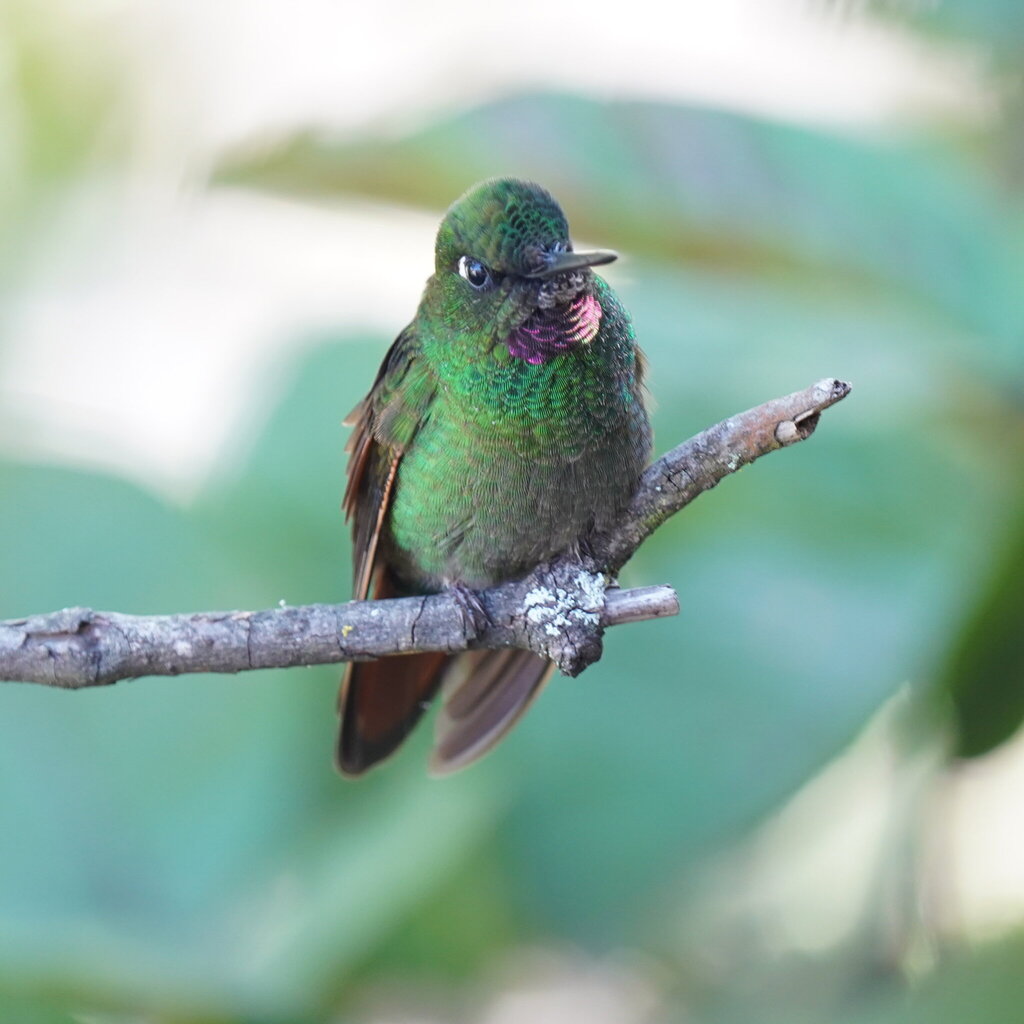
Brazilian Ruby
Photo © Daniel S. Katz
Photo © Daniel S. Katz — CC BY 4.0 — Source: iNaturalist #356120006Identification
The Brazilian ruby is a small hummingbird measuring 10.8 to 11.3 cm in length, with males weighing 7 to 9.2 grams and females slightly lighter at 5.9 to 7.1 grams. Both sexes share a distinctive white spot behind the eye and a medium-length black bill. Males are particularly striking, displaying an iridescent emerald green forehead and crown contrasting with a golden bronze back and rump, a blackish chin, and a brilliant ruby-red gorget that gives the species its common name. The breast is iridescent emerald green and the belly dark gray with green speckles. The tail features golden bronze central feathers with rufous outer feathers edged in bronze. Females are more subdued in coloration, with a grass-green crown and back, cinnamon rump, and entirely cinnamon underparts. Juveniles resemble females but with slightly longer head feathers. Melanistic dark morph individuals occur with notable frequency in this species.
Range & Habitat
The Brazilian ruby is endemic to eastern and southeastern Brazil, ranging from Bahia south to Rio Grande do Sul. This hummingbird favors the interior of forests, scrublands, parks, and banana plantations, and has proven remarkably adaptable to human-modified landscapes. It is most abundant below 500 meters elevation but can be found as high as 1,500 meters. The species is common throughout its range and readily accepts man-made habitats including tree-filled gardens and plantations, making it accessible to travelers in populated areas.
Behaviour & Diet
The Brazilian ruby is mostly sedentary, though it makes some local seasonal elevational movements. Like many hummingbirds, it feeds primarily on nectar from a wide variety of flowering plants and trees, both native and introduced species. Males often establish and defend feeding territories, with females occasionally doing the same. The species supplements its diet by hawking small insects directly from a perch. The breeding season extends from November through March, during which females construct delicate cup nests from soft plant material decorated with lichen on the outside, typically placing them 3 to 10 meters above the ground on horizontal branches. Clutches contain two eggs, incubated for 15 to 16 days, with fledging occurring approximately 25 days after hatching.
Best Time & Places to See It
The Brazilian ruby is common throughout its range and readily visits gardens, parks, and plantations in eastern and southeastern Brazil. The species is frequently seen at feeders, making it relatively easy for travelers to observe. For those hoping to witness breeding behavior and activity, visit between November and March. The species' adaptability to human-modified habitats means excellent viewing opportunities exist around Bahia, Rio de Janeiro, and other populated regions in southeastern Brazil, even in non-protected areas. Several protected areas throughout the range also harbor healthy populations.
Photography Tips
The Brazilian ruby's brilliant iridescence—particularly the ruby gorget of males and emerald breast—demands careful attention to lighting angles for optimal color saturation in photographs. The white eye-spot provides a useful identification feature and focusing point. The species' frequent visits to feeders offer excellent opportunities for controlled photography in gardens and parks. Males' smaller size and territorial behavior mean patient positioning near flowering plants or feeders during the breeding season (November to March) can yield rewarding images of displaying birds. The contrast between the iridescent plumage of males and the more subtle cinnamon tones of females offers compositional possibilities for comparative documentation.
Tijuca National Park
Brazil
+317 birds+13 mammals
Where the Atlantic forest rises steeply from Rio de Janeiro's urban edge, Tijuca National Park encompasses a landscape of dramatic granite peaks, cascading waterfalls, and closed-canopy…
VIEW NATIONAL PARKSerra do Cipó National Park
Brazil
+379 birds+5 mammals
Where granite escarpments rise above the Atlantic Forest transition zone in southeastern Brazil, Serra do Cipó National Park unfolds across a landscape of dramatic ridges, cascading…
VIEW NATIONAL PARKItatiaia National Park
Brazil
+519 birds+12 mammals
Where granite peaks pierce the Atlantic rainforest canopy in southeastern Brazil, Itatiaia National Park rises as one of the country's oldest and most ecologically vital protected…
VIEW NATIONAL PARKSaint-Hilaire/Lange National Park
Brazil
+225 birds
Subtropical Atlantic forests rise and fall across the plateaus of inland Paraná, where Saint-Hilaire/Lange National Park protects nearly 578 square kilometres of Brazil's most biodiverse woodland…
VIEW NATIONAL PARKSerra do Itajaí National Park
Brazil
+227 birds+2 mammals
Where the Atlantic rainforest rises steeply from the coastal plains of Santa Catarina, Serra do Itajaí National Park spreads across 1,136 square kilometres of montane wilderness…
VIEW NATIONAL PARKSerra da Bocaina National Park
Brazil
+441 birds+5 mammals
Where the escarpment of the Serra da Bocaina rises sharply from the Atlantic coastal plain, tropical rainforest cloaks steep mountainsides that climb toward peaks exceeding 2,000…
VIEW NATIONAL PARKSerra dos Órgãos National Park
Brazil
+446 birds+13 mammals
Granite peaks thrust skyward through the Atlantic Forest canopy in the mountains immediately north of Rio de Janeiro, their bare rock faces rising above a landscape…
VIEW NATIONAL PARKSerra do Gandarela National Park
Brazil
+333 birds+3 mammals
Where granite massifs rise through Atlantic Forest in southeastern Brazil's highlands, Serra do Gandarela National Park protects nearly 1,000 square kilometres of montane terrain that few…
VIEW NATIONAL PARKNo community photos yet. Log in to add the first one.
No community observations of this species yet.