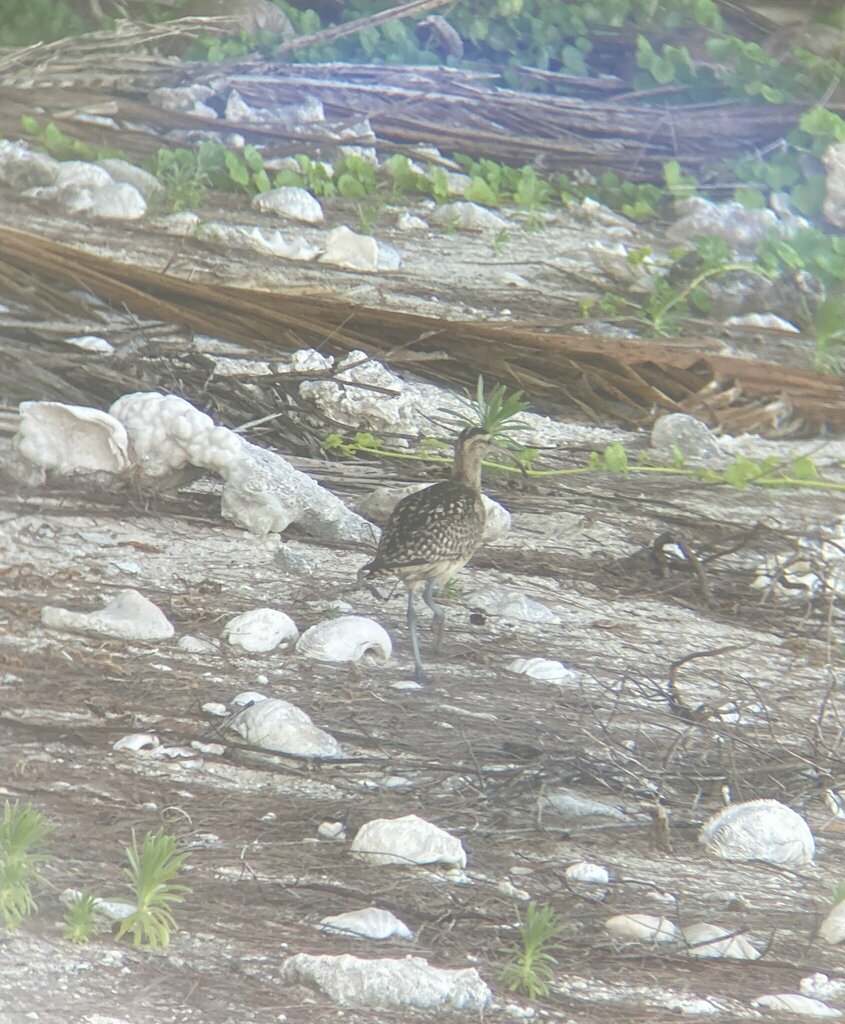
Bristle-thighed Curlew
Photo © Samuel Brown
Photo © Samuel Brown — CC BY 4.0 — Source: iNaturalist #255562435The bristle-thighed curlew (Numenius tahitiensis) is a medium-sized shorebird that breeds in Alaska and winters on tropical Pacific islands. It is known in Mangareva as kivi or kivikivi and in Rakahanga as kihi; it is said to be the origin of the name for the New Zealand flightless bird kiwi although some linguists like Robert Blust has proposed an alternate origin from Proto-Oceanic *kiwiwi, the Pacific golden plover, instead. == Taxonomy == The bristle-thighed curlew was formally described in 1789 by the German naturalist Johann Friedrich Gmelin in his revised and expanded edition of Carl Linnaeus's Systema Naturae. He placed it in the genus Scolopax and coined the binomial name Scolopax tahitiensis. Gmelin based his description on the "Otaheite curlew" that had been described in 1785 by the English ornithologist John Latham in his A General Synopsis of Birds. "Otaheite" is a former name of Tahiti. The specimen used by Latham was supplied by the naturalist Joseph Banks. Banks had accompanied James Cook on his first voyage to the south Pacific but had also received specimens from Cook's subsequent voyages. The bristle-thighed curlew is now one of nine species placed in the genus Numenius that was erected in 1760 by…
Kenai Fjords National Park
Kenai Peninsula Borough, United States
+164 birds+19 mammals
Granite peaks and tidewater glaciers dominate Alaska's Kenai Peninsula, where nearly 7,900 square kilometers of pristine coastal wilderness descend from the Harding Icefield toward the Gulf…
VIEW NATIONAL PARKHawaiʻi Volcanoes National Park
Hawaiʻi County, United States
+84 birds+2 mammals
Where volcanic slopes descend toward the Pacific across more than five thousand square kilometers, Hawaiʻi Volcanoes National Park presents one of Earth's most dynamic laboratories of…
VIEW NATIONAL PARKSt. Paul Island
Saint Paul, United States
+255 birds+8 mammals
Windswept tundra rolls across this remote Pribilof island, where volcanic basalt cliffs plunge into the Bering Sea and fog rolls in thick enough to erase the…
VIEW PROTECTED LANDSCAPEKodiak National Wildlife Refuge
United States
+221 birds+22 mammals
Where temperate rainforest meets subarctic coast, Kodiak National Wildlife Refuge sprawls across Alaska's largest island, a sanctuary defined by steep valleys carved by tidewater glaciers and…
VIEW WILDLIFE SANCTUARYAlaska Maritime National Wildlife Refuge
Alaska, United States
+391 birds+58 mammals
Where the North Pacific collides with Alaska's rugged coastline, a sprawling archipelago of islands, rocky outcrops, and coastal headlands forms one of North America's most remote…
VIEW WILDLIFE SANCTUARYYukon Delta National Wildlife Refuge
Bethel, United States
+156 birds+12 mammals
Across the Yukon Delta sprawls one of North America's most expansive coastal wetland sanctuaries, where the boreal subarctic climate strips down existence to essentials. This vast…
VIEW WILDLIFE SANCTUARYKīlauea Point National Wildlife Refuge
Kilauea, United States
+79 birds+1 mammals
At the northernmost tip of Kauai, where the Pacific trades collide with volcanic rock, Kīlauea Point National Wildlife Sanctuary crowns a dramatic headland overlooking one of…
VIEW WILDLIFE SANCTUARYMidway Atoll National Wildlife Refuge
United States
+91 birds+1 mammals
Straddling the international date line roughly midway between North America and Asia, this atoll sanctuary rises from the North Pacific as a cluster of coral and…
VIEW WILDLIFE SANCTUARYNo community photos yet. Log in to add the first one.
No community observations of this species yet.