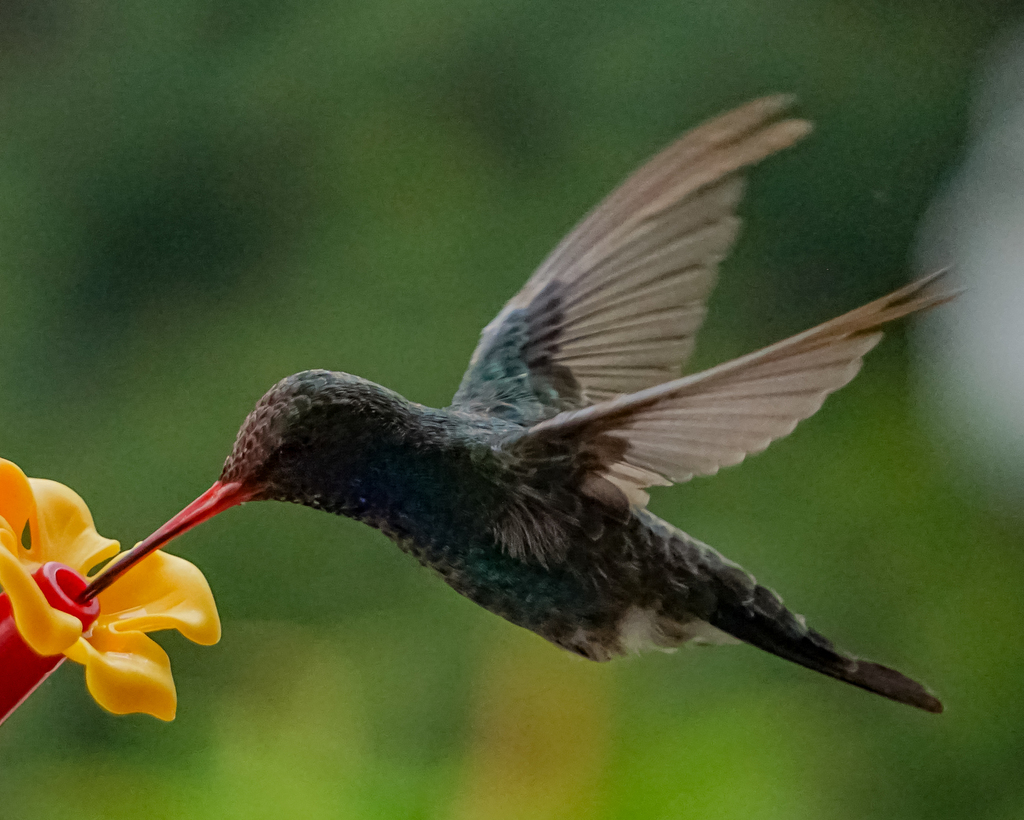
Broad-billed Hummingbird
Photo © Franco Asis González Ibarra
Photo © Franco Asis González Ibarra — CC BY 4.0 — Source: iNaturalist #52260683Identification
The broad-billed hummingbird is a small hummingbird, measuring 8–10 cm (3.1–3.9 in) long and weighing only 3–4 grams. Its most distinctive feature is its long, bright reddish bill with a black tip, visible in both sexes. The bird's metallic green upperparts contrast with duller colouring on the crown and forehead, making it recognizable even at a distance.
Sexual dimorphism is pronounced in this species. Males are dark green with a striking blue throat or gorget, white undertail-coverts, and a blackish-blue tail. Females are paler underneath with a white eyestripe behind the eye and white-tipped tail feathers. Juveniles resemble females more closely than males, though young males gradually develop the characteristic red bill and iridescent throat feathers within 6–8 months.
Range & Habitat
The broad-billed hummingbird resides in Mexico and the southwestern United States, with three recognized subspecies distributed across different regions. In the United States, it is found along streamsides and in oak woodlands, particularly in southeast Arizona, southwest New Mexico, and rarely in southwest Texas. The bird favours areas with Arizona sycamore, Fremont cottonwoods, and mesquite.
Throughout Mexico, the species occurs at nearly every elevation, from sea level to 3,048 meters high. Along the Pacific coast, it is a common resident of arid thorn forests, tropical deciduous forests, and riparian gallery forests. In Sonora, Mexico, it is the most common hummingbird species. During breeding season, it frequents desert canyons and low mountain oak woodlands throughout the Southwest and into central Mexico.
Behaviour & Diet
The broad-billed hummingbird is highly diurnal, being more active during daylight hours. Both males and females produce a distinctive chatter that resembles a rapid "chi-dit," similar to the note of a Ruby-crowned Kinglet. This vocalization can be made while perching or in flight. Males also produce a whining "zing" display call, though little is known about their full song repertoire.
Northern breeding populations in the United States, Sonora, and Nuevo León are migratory, departing in early November and returning in early March, with birds believed to winter deeper in Mexico. Most populations residing in central and southern Mexico are permanent residents. The species has also hybridized with Rivoli's hummingbird and the Violet-crowned hummingbird.
Best Time & Places to See It
The broad-billed hummingbird is best observed during the breeding season from March through early November in the southwestern United States. In Arizona and New Mexico, streamside canyons with dense vegetation and oak woodlands are prime locations. For year-round viewing, central and southern Mexico offer the best opportunities, particularly in riparian gallery forests and arid thorn forests along the Pacific coast and in regions like Sonora.
Within the United States, southeast Arizona and southwest New Mexico are the most reliable locations during breeding season. Migration periods in early spring and late autumn can also be productive for observation. Those seeking views outside the breeding season should focus on Mexico, where most populations are permanent residents.
Photography Tips
The broad-billed hummingbird's brilliant red bill and metallic green plumage offer excellent photographic opportunities. The male's blue gorget is particularly striking when illuminated by bright sunlight, so position yourself with the sun behind or to the side of the bird for optimal colour saturation. Early morning light is ideal for capturing the iridescence of the male's gorget.
Focus on streamside habitats and flowering plants within oak woodlands and canyon areas, as the bird frequently visits these locations. Fast shutter speeds are essential due to the rapid wing beats of hummingbirds. The bird's relatively small size requires patient stalking, but its diurnal activity pattern and preference for open habitats make it more accessible than many other hummingbird species.
Saguaro National Park
Rincon Valley, United States
+354 birds+40 mammals
Where the Sonoran Desert meets sky-island mountains, two geographically separated districts of Saguaro National Park sprawl across nearly two thousand square kilometers of Arizona's most iconic…
VIEW NATIONAL PARKZion National Park
Washington County, United States
+244 birds+30 mammals
Towering sandstone cliffs in shades of crimson, rust, and cream rise abruptly from the Virgin River's winding canyon floor, their sculpted faces bearing witness to millions…
VIEW NATIONAL PARKEl Vizcaíno
Laguna San Ignacio, Mexico
+317 birds+29 mammals
Where the Baja California peninsula thins into a tapestry of salt lagoons and coastal desert, one of Mexico's most biodiverse reserves sprawls across half a million…
VIEW BIOSPHERE RESERVEParque Nacional Cerro de la Estrella
Mexico
+126 birds+4 mammals
Where volcanic peaks rise sharply above Mexico City's sprawling metropolis, Parque Nacional Cerro de la Estrella offers a rare glimpse of high-altitude terrain within one of…
VIEW NATIONAL PARKParque Nacional Grutas de Cacahuamilpa
Pilcaya, Mexico
+97 birds+12 mammals
Where limestone ridges rise abruptly from the tropical deciduous forests of central Guerrero, the Grutas de Cacahuamilpa National Park shelters one of Mexico's most extensive cave…
VIEW NATIONAL PARKTutuaca
Tosanachi, Mexico
+147 birds+13 mammals
Where copper canyons plunge deeper than the Grand Canyon itself, Mexico's remote Sierra Madre Occidental unfolds in dramatic vertical relief. Tutuaca anchors this wilderness realm, a…
VIEW PROTECTED LANDSCAPEBosque del Apache National Wildlife Refuge
Socorro County, United States
+345 birds+17 mammals
Where the Rio Grande emerges from its desert canyon in central New Mexico, a narrow ribbon of riparian woodland defies the arid landscape that surrounds it.…
VIEW WILDLIFE SANCTUARYMalheur National Wildlife Refuge
Harney County, United States
+309 birds+24 mammals
Across the high desert plateau of southeastern Oregon, where sagebrush scrubland stretches toward distant ridgelines under an enormous sky, lies a sanctuary shaped by water in…
VIEW WILDLIFE SANCTUARYNo community photos yet. Log in to add the first one.
No community observations of this species yet.