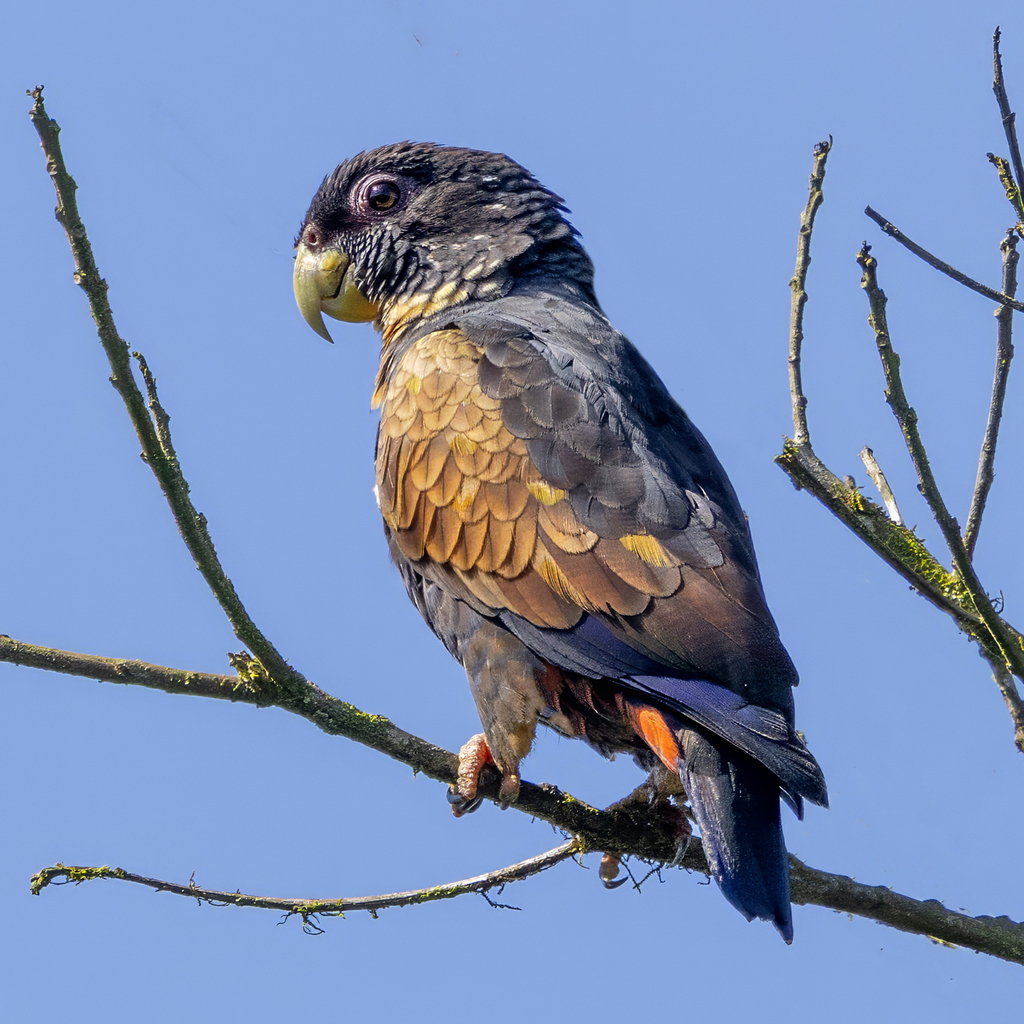
Bronze-winged Parrot
Photo © Dan Vickers
Photo © Dan Vickers — CC BY 4.0 — Source: iNaturalist photo #558090872Identification
The bronze-winged parrot is a medium-sized stocky parrot measuring 28 cm (11 inches) in length. Its plumage is predominantly dark, with a distinctive whitish chin patch and pink-speckled upper chest. The head is dark blue-green, while the mantle, back, and underparts display dark bronze-green coloration with blue-tipped feathers and occasional scattered red feathers. The rump, tail, and wings are dark blue with noticeably lighter blue underwings, and short red undertail feathers provide a flash of colour in flight. Adults have a pale yellow beak and a pink bare eye-ring, while juveniles can be distinguished by whitish eye-rings and brownish underparts.
Range & Habitat
This parrot inhabits the mountainous regions of north-western South America, ranging across far western Venezuela, western and central Colombia, western Ecuador, and far north-western Peru. Altitude preferences vary considerably across its range: Venezuelan birds favour 900–1400 metres, Colombian populations typically occur between 1400–2400 metres (occasionally reaching 2800 metres), Ecuadorian birds stay mainly below 1400 metres, and Peruvian populations remain below 800 metres. The species prefers the canopy of humid and semi-deciduous forests and woodlands, though it also utilizes adjacent habitats with tall trees. It exhibits nomadic tendencies in parts of its range, with movements likely driven by food availability, though these movements remain poorly understood.
Behaviour & Diet
Bronze-winged parrots are typically observed in pairs or small groups of up to ten individuals. They nest in tree cavities, where females incubate clutches of three to four white eggs for approximately 26 days. Young birds fledge around 70 days after hatching. While specific dietary details are limited in available sources, like other pionus parrots they likely feed on fruits, seeds, and vegetation found in their forest habitat.
Best Time & Places to See It
The species' nomadic nature and preference for the forest canopy make it an elusive subject for birdwatchers. Visiting appropriate elevations within the bird's range—particularly the montane forests of Colombia and Ecuador—offers the best opportunities, though sightings cannot be guaranteed. Local guides familiar with the species' movements and food sources will significantly increase your chances of observation.
Photography Tips
Photographing bronze-winged parrots presents challenges due to their canopy-dwelling habits and preference for the tallest trees. A telephoto lens of at least 400–600 mm is essential for capturing detail from a distance. Early morning hours often provide the best light and most active bird behaviour. The distinctive pale beak, pink eye-ring, and bronze-green underparts provide useful identification features to look for when composing shots. Patience is rewarded: capturing images of this understudied species contributes valuable documentation for the birdwatching community.
Guided Birding Tour
Cerros de Amotape National Park
District of San Jacinto, Ecuador
+246 birds+1 mammals
Arid mountains rise abruptly from Peru's northwestern frontier, their slopes clothed in xerophytic scrubland and seasonal deciduous forest that transforms these Andean foothills into one of…
VIEW NATIONAL PARKCajas National Park
Cuenca, Ecuador
+190 birds+7 mammals
High in the Andes above Cuenca, where elevation ranges from 3,100 to 4,200 metres, the páramo landscape dominates—a windswept realm of cushion plants, alpine grasses, and…
VIEW NATIONAL PARKNatural Serranía de los Churumbelos National Park
Santa Rosa, Colombia
+70 birds+2 mammals
Where the western cordillera of Colombia rises toward the Pacific watershed, the Serranía de los Churumbelos unfolds across more than 3,200 square kilometers of some of…
VIEW NATIONAL PARKNatural Serranía de los Yariguíes National Park
El Carmen de Chucurí, Colombia
+320 birds+3 mammals
Where the northern cordilleras of Colombia rise toward cloud forest, the Serranía de los Yariguíes unfolds across nearly 1,820 square kilometers of some of the most…
VIEW NATIONAL PARKNatural Farallones de Cali National Park
Buenaventura, Colombia
+733 birds+27 mammals
Where the Pacific coastal plain meets the western slopes of the Andes, Farallones de Cali National Park sprawls across nearly 3,500 square kilometers of dramatic topography…
VIEW NATIONAL PARKNatural el Cocuy National Park
Güicán, Colombia
+313 birds+3 mammals
Where the Andes rise to their highest peaks in Colombia's eastern cordillera, El Cocuy National Park sprawls across more than 6,600 square kilometers of some of…
VIEW NATIONAL PARKPuracé National Natural Park
Puracé, Colombia
+327 birds+2 mammals
Where the Andes thrust upward across southwestern Colombia, Puracé National Natural Park spans nearly 2,631 square kilometers of some of South America's most dramatic montane terrain.…
VIEW NATIONAL PARKGuácharos Cave National Natural Park
Acevedo, Colombia
+359 birds
High in the Andean foothills of southern Huila, where mist-laden slopes rise above 1,600 metres, lies a landscape carved by underground rivers and crowned by karst…
VIEW NATIONAL PARKNatural Sumapaz National Park
Cubarral, Colombia
+368 birds+1 mammals
Where the Andes descend toward the Amazon basin, the high páramo grasslands of Sumapaz National Park sprawl across more than five thousand square kilometers of Meta…
VIEW NATIONAL PARKEl Tamá National Park
Toledo, Colombia
+435 birds
Where the Andes descend toward the Caribbean coastal lowlands of northern Colombia, El Tamá National Park sprawls across nearly 3,800 square kilometres of montane forest, cloud…
VIEW NATIONAL PARKNatural Sierra de la Macarena National Park
Vista Hermosa, Colombia
+566 birds+15 mammals
Across nearly 20,000 square kilometres of Colombia's Meta Department, the terrain rises from lowland savanna into Andean foothills through a mosaic of gallery forests, palm-fringed wetlands,…
VIEW NATIONAL PARKNo community photos yet. Log in to add the first one.
No community observations of this species yet.